
How to Calculate Crypto Tax under the 10% Amendment
The value of Bitcoin, Ethereum, and many other coins has gone to the moon though, so what gives in buy crypto tax? One thing that may offer some relief to traders is that if you purchased an asset, say Bitcoin, way back in 2014, and you don’t sell it before 2025 ends, waiting, rather, until 2028, you won’t have to pay tax on the entire capital gains you made on it since you bought it. The figure that will be used instead is its market value as of December 31, 2025.
Imagine Lars, an Austrian citizen and resident of Ghent. He bought 1 BTC in 2014 for €500. By the end of 2025, Bitcoin’s price reaches €105,000. He decides not to sell until 2028, when Bitcoin is trading at €120,000. Under the new rules, Lars won’t be taxed on the jump from €500 to €120,000. Instead, his taxable gain will only be based on the increase from €105,000 to €120,000.
€120,000 − €105,000 = €15,000 taxable gain. So instead of being taxed on nearly the entire €119,500 increase, Lars is only taxed on €15,000 – a massive difference.
What if the Asset’s Value Dipped before December 31, 2025?
There’s also a safeguard for investors whose assets dipped below their original purchase price before the 2025 valuation date. If the value of a crypto asset on December 31, 2025, is lower than what you originally paid for it, you can — with proper justification — choose to use your original purchase cost as the basis instead. This prevents investors from being taxed on so-called “paper gains” that don’t really exist. As a disclaimer though, this rule only applies to capital gains realized between January 1, 2026, and December 31, 2030.
Sophie from Lyon, who became a Belgian resident in 2024, bought 1 ETH in 2021 for €3,500. On December 31, 2025, ETH is trading at €2,900. In 2028, she sells her ETH for €3,200. Normally, her December 31, 2025, reference value (€2,900) would be used to calculate gains. But since her original purchase price (€3,500) is higher than both the 2025 reference and her sale price, she can elect to use that instead.
- Sale price: €3,200
- Original purchase: €3,500
- Result: €300 loss
Because her original acquisition value exceeds the sale price, Sophie owes nothing.
Acquired Crypto Assets beyond 2025
If you buy other crypto starting next year, and they go down in value and you sell them at a loss, that means you won’t have to report those either, since those are losses. In fact, that’s a common strategy some Belgian residents use. When an investor sells crypto at a loss, that loss can be used to reduce the taxes owed on other profitable sales. Some investors purposely sell assets that are currently below their purchase price to “lock in” the loss. Later, they might buy back the same crypto if they still believe in its long-term value.
While navigating the new 10% capital gains tax, prudent investors may want to explore diversified opportunities beyond crypto. 8lends allows investors to participate in crowdlending, offering structured, lower-volatility returns compared with volatile crypto markets. By allocating part of your portfolio to 8lends, you can potentially offset risk, maintain liquidity, and generate steady income – a smart complement to long-term crypto holdings under the new Belgian tax regime.
What About Traditional Assets?
Suppose you not only invest in crypto but also, say, shares, ETFs, bonds, and etc., they too are taxed ten percent. It, meanwhile, makes no difference whether they’re in foreign banks. In fact, if that’s a Belgian bank, it’ll just suck out the duties automatically. The same applies to foreign currency exchanges, unless you’re just transferring between your own accounts.
Once again though, 10,000 euros of your overall assets will be excluded from the new 10% tax.
Residency: Where You Declare Your Cryptocurrencies
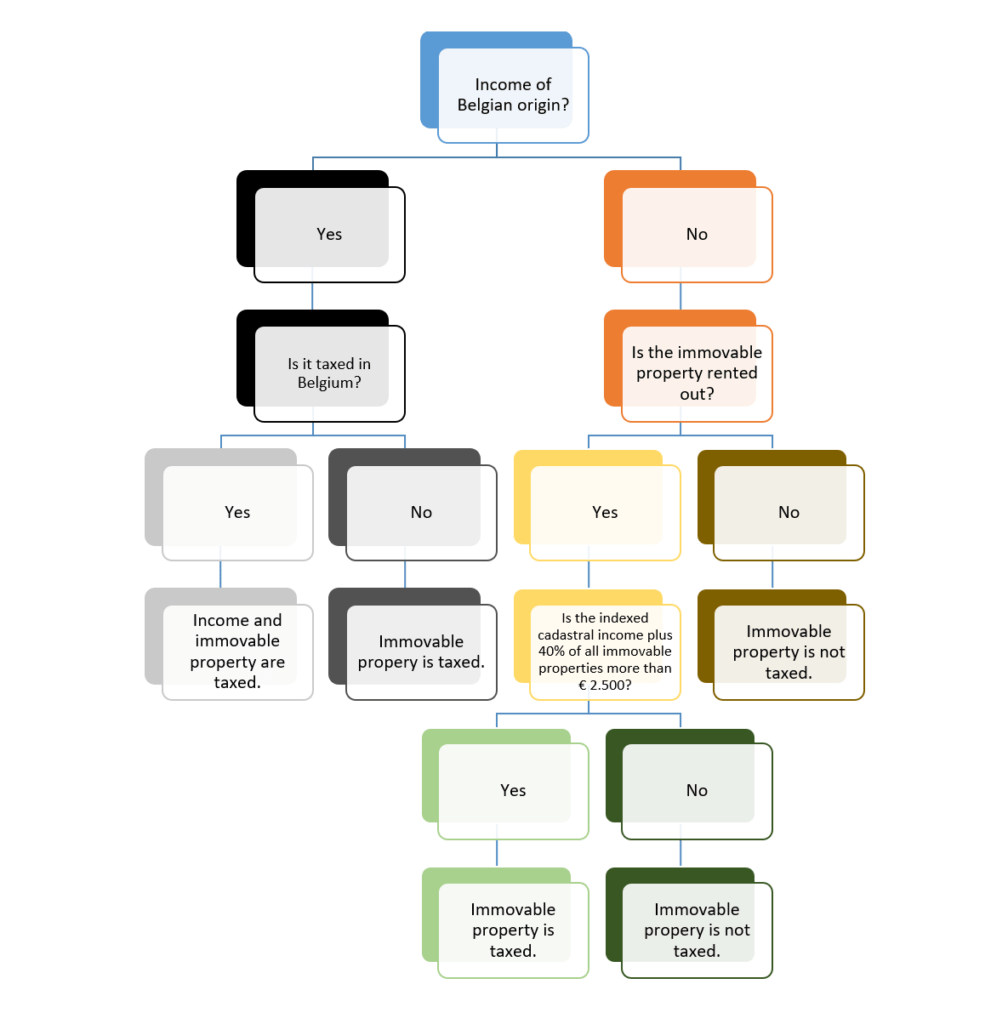
The SPF cryptocurrency tax government doesn’t determine residency based simply on owning property or spending a few weeks in the country. Instead, it looks at where your life is truly based. If Belgium is considered your primary home, economically and personally, you’re treated as a Belgian tax resident and taxed on your worldwide income. Non-residents are only taxed on Belgian-source income.
There isn’t one single test. Instead, the tax authorities examine a number of different things, and your official registration in Belgium creates a presumption of residency unless you can prove otherwise.
Here are the things the SPF will look at:
- Your primary home, where you normally live, sleep, and return to
- If you're registered in the Belgian National Register or local commune, you're presumed resident by default.
- Family resides in Belgium: spouse/partner or children.
- Running a business or freelancing from Belgium
- Your workplace
- Holding long-term rental housing
- Belgian bank accounts or regular expenditures here
Belgium does not use a strict 183-day physical presence rule like many other countries. Spending more than 183 days in Belgium is a strong signal, but you can be a resident even with fewer days if your home and life are centered here.
Late-Year Moves
Here, your Belgian taxes as soon as your move to Belgium is deemed locked in.
The Exit: Cryptocurrency Profit Tax
Suppose you were planning on leaving Belgium, to obtain cryptocurrency tax government relief or due to personal reasons, there’s probably a dual taxation arrangement between the governments; however, at the precise time of your exit, you get whacked with an exit tax for asset appreciations. The day your switch to the new country is done, a fictitious sale is recorded to base your gains on.
Regarding this payment, Belgium has deferral agreements with all other EU member states, EEA countries, and many others. In the event that there is no such agreement with the nation you move to though, you can apply for a deferral. A deferral of the tax payment can still be obtained through application, but you will need a yearly confirmation of that situation, provided you give sufficient guarantees. Otherwise, it’s automatic.
How to Avoid It
Simply wait two years before profitably selling your assets.
Scenarios
Carlo, an investor in Liège, decides to move to Lisbon in mid-2026 for a change of lifestyle and lower living costs. Portugal is in the EU, so Belgium automatically grants him an exit-tax deferral on his crypto holdings. Carlo doesn’t need to provide guarantees or file annual confirmations, the deferral happens by default. He keeps holding his crypto and waits more than two years after leaving Belgium before selling. As a result, he avoids the Belgian exit tax and falls under Portugal’s tax regime instead.
Mark, a careful saver from Brussels, chooses Singapore as his new home. Like Vince, he must provide guarantees and yearly confirmation to obtain the deferral. Eight months after relocating, he sees a market surge and sells part of his holdings. Because he sold within the two-year window, the deferral ends, and Belgium charges exit tax on the gain — even though he now lives abroad.
Final Thoughts
Belgium’s upcoming 10% capital gains tax, combined with rules on historic acquisition values, exit taxes, and residency considerations, signals a new era for crypto investors. While careful planning and holding strategies can minimize your taxable gains, it’s also wise to diversify and explore complementary investments.
Investors who earn monthly interest on a crowdlending platform face a different reporting path than traders. The country-by-country breakdown is in how P2P and crowdlending income is taxed in Europe.
Read next on 8lends
- Airdrops, NFTs, and DeFi: Cryptocurrency Profit Tax in Belgium
- Belgium’s 33% Crypto Profit Tax Explained: Who Pays and Who Doesn’t
Furthermore, prudent investors may want to explore diversified opportunities beyond simple profitable trades. Platforms like 8lends allow you to participate in crowdlending, offering structured, lower-volatility returns compared with volatile crypto markets. By allocating part of your portfolio to 8lends, you can potentially offset risk, maintain liquidity, and generate steady, collateral-backed income – a smart complement to long-term crypto holdings under the new Belgian tax regime.