Preparing Information to Declare Your Cryptocurrencies
Before you declare your cryptocurrencies in the “Déclaration à l’impôt des personnes physiques”, or your 273 Form, you have to first get everything organized to avoid losing out on opportunities for write-offs and failing to report your true figures, ending up paying for it later. Belgium’s tax system relies heavily on proof and traceability, so accurate documentation is key. The SPF doesn’t ask you to submit every file upfront, but you must be able to produce records if requested.
Think of this stage as building a clean paper trail showing what you earned, where it came from, and how you valued it.
For each tax year, gather and store:
- Complete transaction history from all exchanges
- Wallet transaction logs
- Fiat deposits and withdrawals
- Trades
- Mining reward logs and payout addresses
- NFT buys, sells, mints, and royalties
- Borrowing
- Screenshots or PDFs of balances at year-end
At a minimum, you should be able to show the date each transaction took place, the type, its value equivalent in euros, and the relevant repositories.
If you’re looking to make your crypto work harder while staying on top of Belgian tax obligations, 8lends offers a secure way to lend or invest your digital assets. Their platform allows you to earn interest or participate in crowdlending opportunities, giving your crypto portfolio an additional income stream. Integrating these activities into your tax records is straightforward, especially when you keep detailed transaction histories.
Using 8lends can help you generate legitimate income while maintaining transparency with the SPF.
How to Declare Your Cryptocurrencies
There wasn’t some extra special tax form dedicated just to declare your cryptocurrencies. Sure, the government was slow to fully grasp it, and thus they were hands-off for a while, which is becoming an ever more distant remnant of the past with every passing year. Instead, you file them along with other pre-existing taxes under the same philosophy. The trick is going to be understanding which box on the 273 and which sections apply to you.
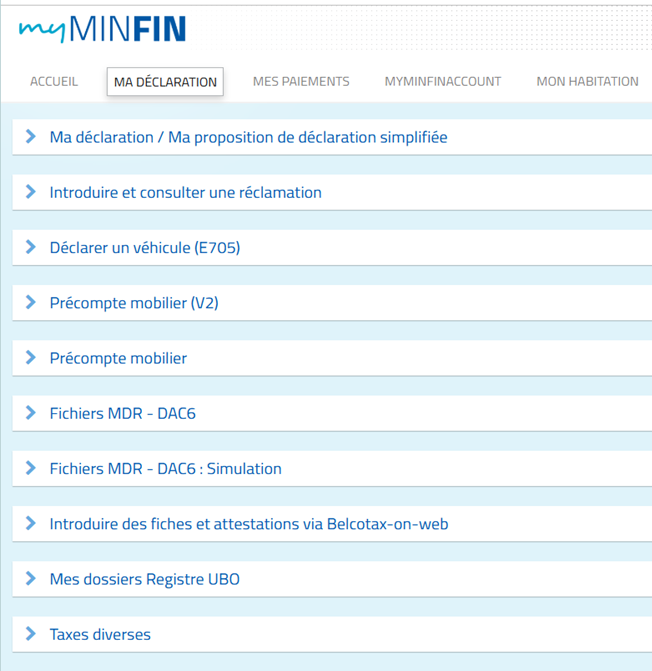
Step 1: Log in to MyMinfin using your eID, Itsme, or another approved method.
Step 2: Open your annual tax return by clicking on the relevant year.
Step 3: Identify your investor category.
Before filling anything in, determine how the SPF will likely classify your crypto:
- Business or professional trading: profits listed under Section I, taxed using progressive rates up to approximately 50%.
- Speculative trader: asset gains listed in Section II (Revenues from Movable Property) if you engage in repeated or speculative machinations, taxed at a flat rate of 33%.
- Long-term private investor (capital gains usually tax-free): Section III (Other Movable Income) for isolated transactions not considered habitual or professional. But for 2026, they’re considering a 10% solidarity tax even for these people.
Furthermore, there’s a communal tax of up to 10%, from your municipality. Most private investors only need to declare if they sold or earned “prudently”. If your activity is such, you may not enter taxable income, but still prepare documentation in case the SPF requests it.
Step 4: Enter Your Figures
Enter the euro values of each type of endeavor you received the crypto from, classified under miscellaneous or professional income depending on whether you belong to the category professional trader, speculator, or long-term investor. The guidelines are very clear, and the government even provides a questionnaire to help you determine that. Ultimately though, it’s at the SPF’s discretion.
Calculating Gains
For disposal events such as sales or swaps, calculate the gain or loss per transaction and enter the net taxable gain. Make sure your calculation method is consistent. The way you calculate your gains will be up to you, though. This is in contrast with other European countries which command following either the Last-In-First-Out or the First-In-Last-Out method.
In the former case, in the event that you bought certain digital assets at different times and then sold them, you would calculate the gains based on the value of the coins in the last instance that you bought them first. In the latter, you count the first batch of the coin and the corresponding value they held in that transaction to come up with the capital gains.
Step 5: Upload Supporting Notes (Optional but Smart)
It is wise to attach a summary of your crypto activity, total gains or losses, income earned in crypto, and explanation of your investor classification. Annual reports or tool-generated summaries can also help.
Step 6: Submit and Save Confirmation
File the return electronically, save the submission receipt, and store all crypto documentation for at least seven years.
Step 7: Keep Your Full Files
Keep your documentation on hand in case you get audited.
Calculate Crypto Tax: Ordinary vs Business Income
A curious and important note is how to calculate crypto tax. In most countries, you check the particular coefficient percentage by which you’re supposed to multiply your entire income, and that’s what you owe – simple. In Belgium though, it’s slightly fancier. They calculate the first bracket you made at the lowest percentage, and as you reach each subsequent threshold of income, that portion is then taxed at a higher rate, as follows:
- Up to €15,990: 25%
- €15,991 – €27,360: 40%
- €27,361 – €49,020: 45%
- Above €49,020: 50%
Examples of How to Calculate Crypto Tax
The cryptocurrency tax government reviews Michael’s return, a 32-year-old crypto trader and staking enthusiast living in Antwerp, Belgium, runs a small crypto operation from his home, trading altcoins, earning staking rewards, and occasionally flipping NFTs. In 2025, his total taxable income from all sources, including crypto gains, staking rewards, and a small salary from freelance blockchain consulting, comes to €46,750.
Different portions of Lukas’s income are taxed at different rates:
- The first €15,990 is taxed at 25% → €15,990 × 0.25 = €3,997.50
- The next portion, €27,360 – €15,990 = €11,370, is taxed at 40% → €11,370 × 0.40 = €4,548
- The remaining income, €46,750 – €27,360 = €19,390, is taxed at 45% → €19,390 × 0.45 = €8,725.50
€3,997.50 + €4,548 + €8,725.50 = €17,271 federal income tax. So his effective tax rate is €17,271 ÷ €46,750 ≈ 36.9%.
Capital Gains
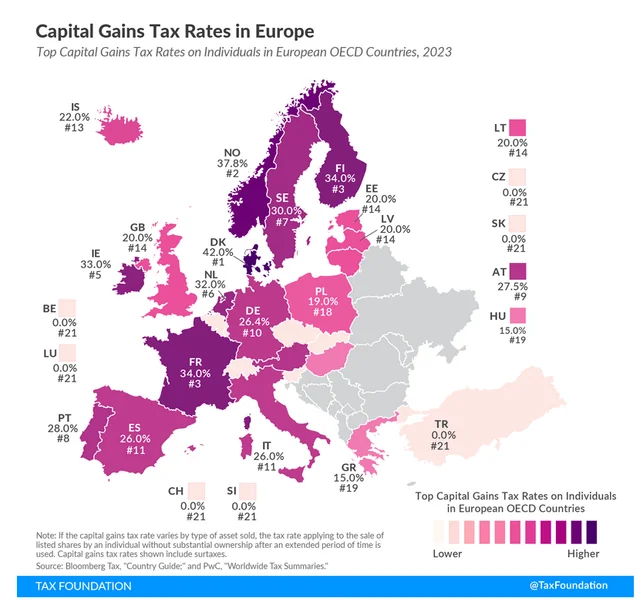
Emma lives in Ghent and spends her year actively trading altcoins. She buys and sells quite a bit, chasing short-term gains. By the end of 2025, her net crypto profits total €12,500. Because her activity is considered speculative, the SPF treats these gains as miscellaneous income. This means she owes 33 percent in federal tax, which comes out to roughly €4,125, not counting any municipal surcharge. Even though Emma doesn’t operate a formal crypto business, the authorities consider her short-term trading taxable.
Marc, on the other hand, lives in Liège and is a casual long-term investor. Five years ago, he bought €8,000 worth of Bitcoin. The next, he sells it all off. As a long-term private investor, his gains are fiscally exempt. He does keep records of his purchases and historical prices in case the SPF requests proof of his holding period and are satisfied upon their presentation.
Conclusion
Navigating crypto taxes in Belgium may seem complex, but with careful preparation, accurate record-keeping, and understanding your investor classification, you can stay fully compliant while minimizing stress and penalties. Whether you are a long-term investor, a speculative trader, or run a small crypto operation, following the step-by-step approach outlined here puts you in the optimal position.
Platforms like 8lends allow you to safely lend or invest your digital assets, creating additional income streams while keeping your records organized for tax purposes.
Lending interest and capital gains follow separate rules, which is where most reporting mistakes start. The comparison across EU jurisdictions is set out in how P2P and crowdlending income is taxed in Europe.