
The 30% Capital Gains Tax on Crypto
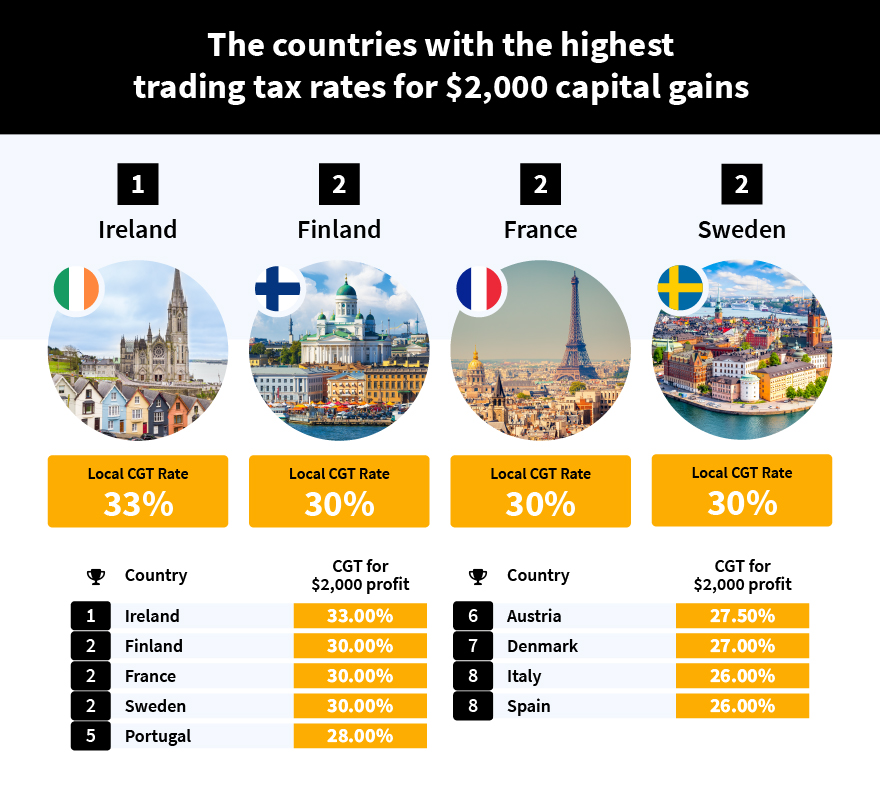
The system tax on crypto couldn’t be much simpler. There is a 30% tax that applies whenever you dispose of crypto as an asset and make money off of the entire deal. Whether you’ve earned 5,000 SEK or 5 million SEK in profits, the same rate applies. There are no progressive brackets, long-term holding discounts, or separate rates for different crypto assets. However, beneath this simplicity lies some nuance, especially when calculating what portion of your crypto activity is actually taxable and how losses can be offset.
Daniel, who lives in Gothenburg, bought Bitcoin for 100,000 SEK earlier this year. A few months later, he sold his Bitcoin for 130,000 SEK, making a profit of 30,000 SEK. At the 30% rate, Daniel owes 9,000 SEK in taxes on his gain. Unlike some other countries, Sweden does not differentiate between short-term and long-term holdings. This flat rate applies regardless of how long he held his Bitcoin.
Sweden also taxes conventional assets on which passive income is made in this same way. When someone receives rent money, dividends, or their bond matures, they pay 30% as well.
HODLing
Now suppose that Daniel goes out and buys 100,000 SEK in Bitcoin and decides to put off selling for now, seeing how high the Bitcoin’s value will soar over the next decade. He doesn’t owe any taxes – not yet. If and when he decides to sell them, that’s when he’ll have to pay the government.
Swaps
Now imagine that Anna has 167,000 SEK in Bitcoin, and she decides that she wants to hold some Monero too for her privacy. Over that time, Bitcoin’s value had outgrown Monero relative to each of their market rates before. That means she made a gain, and thus has to pay 30% on whatever that gain is.
In the event that Anna gets paid 50,00 in Bitcoin on Binance and she previously hadn’t held any crypto there before. So she transfers that virtual cash to her same cold wallet. She doesn’t owe any tax on that, since she’s just transferring to herself.
A lot of businesses nowadays accept crypto as payment. If you do so, that requires it to be converted to fiat currency, and at that point, it’s taxed at 30%.
Gifts
However, what if Anna didn’t do any crypto-related work? Suppose that her father is hugely successful investing in crypto, and he decides to send her some college tuition money in crypto. Neither of them has to pay any tax because Sweden doesn’t tax gifts and donations. Sweden also regards airdrops as just gifts. The same applies to forks when tokens are reissued. None of these are taxed unless they then spend that money or exchange it and come out making a profit from holding it.
DeFi Interest
If you loan money in crypto and are making money off of the interest, the Swedish government recognizes that as capital gains, and thus those are taxed at the 30% rate as well.
Reducing Tax Debt
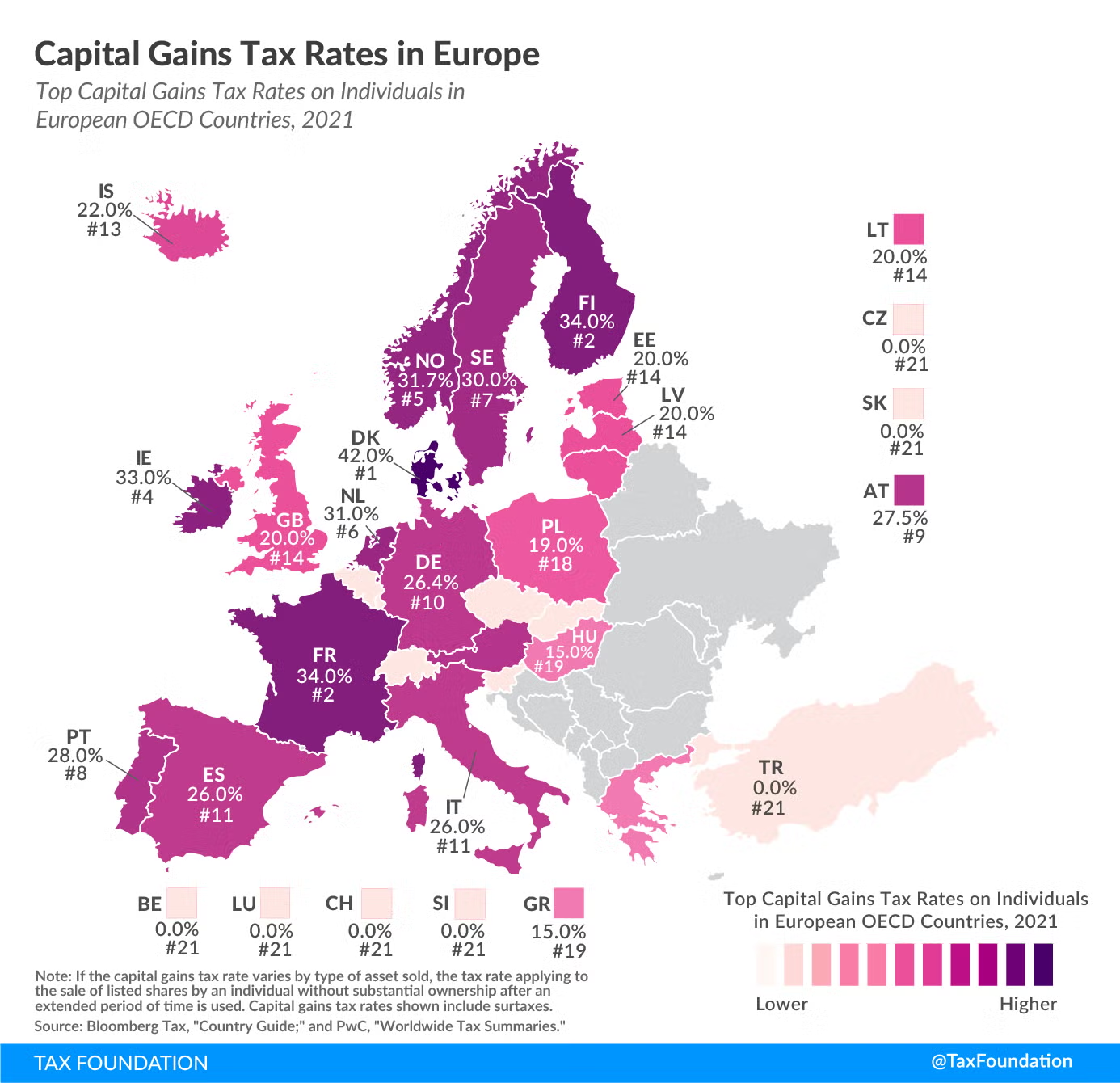
Of course, it’s not as if everyone is winning every trade. Oftentimes, crypto coins crash or the entire market becomes a bear market. If you experience some wins, but mostly losses, the good news is you can use losses to offset your gains. The bad news is this is limited to 70% of your losses. Losses can, however, carry forward into the next year. So you can take advantage of this strategically to position yourself to pay less in taxes.
For Swedish crypto holders looking to maximize their holdings, 8lends offers a way to make your assets work harder. Through collateral-backed crowdlending and other digital asset investments, you can earn passive income while keeping your transactions fully transparent for tax reporting. This makes it easier to track gains, losses, and interest earned – crucial when filling out the K4 form for Skatteverket. 8lends helps you grow your crypto portfolio strategically while maintaining compliance, so you can focus on smart trading instead of bookkeeping.
Help Declaring Crypto from Business Activity
There is an exception in Skatteverket crypto tax based on who you are. The tax agency may view you as a full-blown professional or business trader, whether you are working solo or you own a whole company. This is based on how regular, frequent, profit-motivated, and high-tech your operations and activities are. In that case, crypto-related income and expenses are reported under business income (inkomst av näringsverksamhet), which is subject to progressive tax rates and social contributions.
Cost Basis for the K4 Form Crypto
A very important factor in paying the 30% capital gains crypto tax is answering the question “Where’s the starting point of that gain?” Some nations use the first-in-first-out method, like Germany, and others, like Italy, use the last-in-first-out method. Suppose you bought Bitcoin on January 4th, March 21st, June 5th, October 17th, November 12th, and November 27th.
In the FIFO, if you bought a particular cryptocurrency in several different transactions over the year, its value would’ve fluctuated, and thus the basis for the purchase price would vary. So here, what you take as the cost basis for the first coin you sell would be January 4th. Under the LIFO method, it would be November 27th’s price.
Average Cost
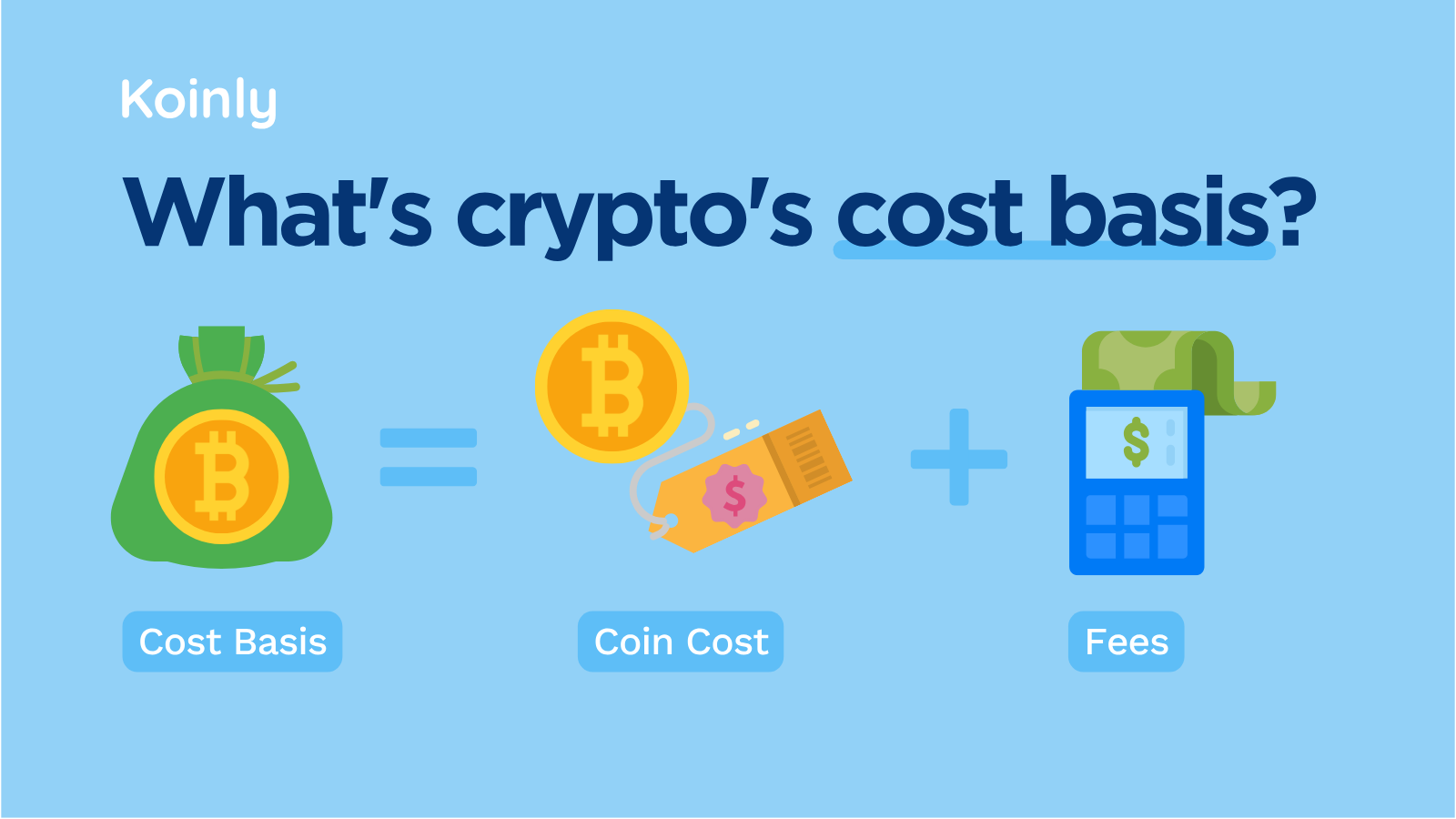
In Sweden, the primary method used is average cost basis. The way that’s calculated is by first totaling overall money spent buying crypto coins over that year divided by the total asset units bought. That gives you the average cost. If you sold at a higher rate than the average, those constitute taxable gains.
Reporting Gains on the K4 Form Crypto
Having calculated crypto profits and losses, you declare them using Skatteverket’s K4 form for crypto. It’s designed for reporting the sale of securities and other capital assets, including cryptocurrency.
Even though the tax rate is fixed at 30%, accurately filling the K4 form is crucial. Every sale, trade, or crypto disposal during the year must be accounted for.
The K4 form is part of your annual income tax declaration (Inkomstdeklaration 1). You can access it through Skatteverket’s e-service using BankID. If you file online, you’ll find the K4 under the section titled “Försäljning av värdepapper, valutor m.m.” (Sales of securities, currencies, etc.).
Filling in the K4
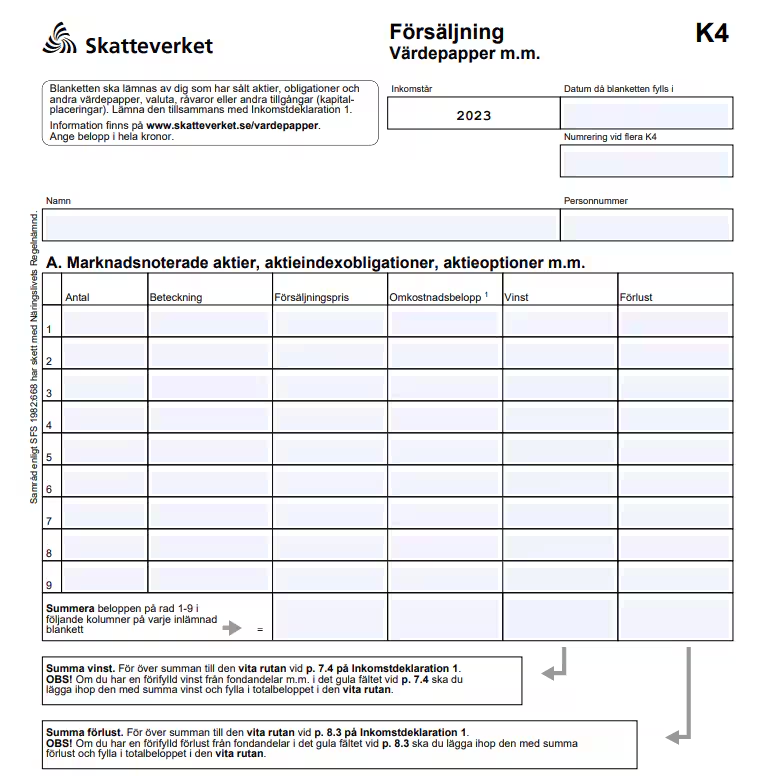
If you’ve made multiple trades throughout the year, entering them manually is time-consuming. You can instead:
- Upload a CSV file exported from your exchange or tracking software.
- Use crypto tax software that generates a K4-compatible report, which you can attach or copy directly into the online form.
Be sure that each SEK value reflects the exchange rate at the time of transaction, as Skatteverket requires conversions for every trade into SEK.
Conclusion
Sweden’s 30% crypto tax may seem straightforward at first glance, but the nuances – from gifts, swaps, and airdrops to mining, staking, and DeFi interest – make it impossible to overestimate the importance of accurate record-keeping and reporting. Understanding cost basis methods, using tax-loss harvesting, and separating personal and business crypto activity can make a real difference in how much you owe. Filing correctly on the K4 form ensures you stay compliant while minimizing unnecessary payments.
Investors who earn monthly interest on a crowdlending platform face a different reporting path than traders. The country-by-country breakdown is in how P2P and crowdlending income is taxed in Europe.
- What Counts for Crypto Tax in Sweden?
- Crypto P2P Lending vs. Traditional P2P Lending: A 2026 Comparison
To make your crypto truly productive, 8lends provides an easy way to earn passive income on your holdings while keeping everything transparent and organized for tax purposes. Whether you’re actively trading, staking, or lending, 8lends helps you grow your portfolio safely and efficiently.