
RWA: Two Different Approaches to Real-World Assets, and Only One Is Delivering
September 11, 20264 min read
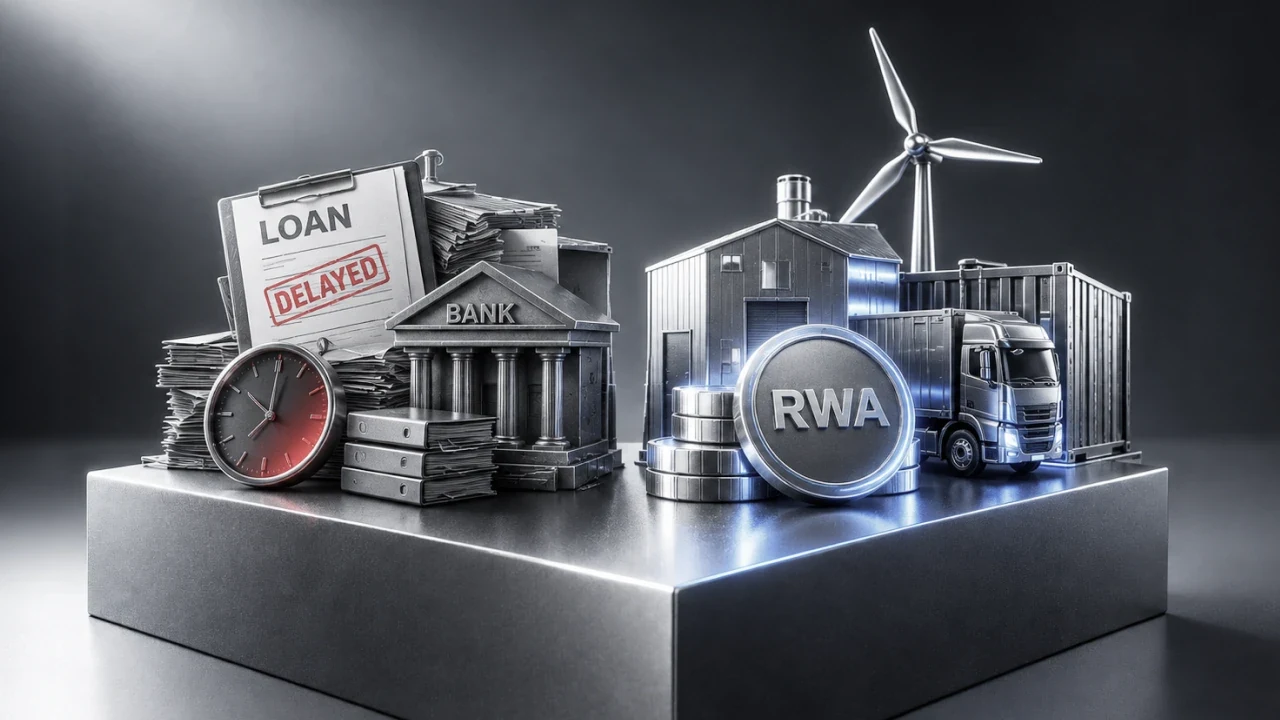
RWA (Real-World Assets) refers to tangible assets brought onto the blockchain, such as real estate, equipment, inventory, debt obligations, and Treasury bonds. However, people often use this term to mean two different things, and you shouldn't confuse them.
The first meaning is tokenization: wrapping an asset in a digital token.
The second meaning often refers to lending against a real-world asset: no tradable token is issued; the asset itself serves as collateral.
When it comes to 8lends, RWA on our platform means real-world collateral — the second meaning.
Meaning 1: RWA tokenization
RWA tokenization is the process of converting a real-world asset into a digital token that can be tracked, transferred, or used on the blockchain.
Several independent reports from 2026 reveal one consistent pattern: the majority of tokens issued this way remain unused. According to some data, over half of tokenized assets valued above $100,000 show no on-chain activity at all over the course of a week. Other figures indicate that less than 10% of the total volume of issued RWA tokens is actually utilized in decentralized finance (DeFi) protocols.
The issue is demand: while the industry has solved the problem of issuing a token backed by an asset, it has failed to address the challenge of what happens next. A buyer, a secondary market, and specific use cases for the token still need to be established — steps that, in most instances, do not happen.
The token may serve simply to verify ownership, and its functionality ends there.
Meaning 2: Real-World Collateral
In this case, an asset is not converted into a token. The loan is secured by a real asset, and investor returns are generated from the cash flow of the business that owns that asset. This is how 8lends works.
Investor capital goes directly to a specific business. The company uses the funds to purchase raw materials, manufacture and ship goods, while the loan is repaid from the business's revenue.
RWA takes the form of a real company asset, such as equipment, inventory, or real estate, which is valued and monitored by an independent Collateral Agent, Maclear AG. The project's credit rating (on an AAA–D scale) reflects the likelihood that the specific business will repay the loan. No RWA token is issued against the loan or the collateral.
The platform's utility token, 8LNDS, operates independently: it can only be earned through "Proof of Loan" and does not represent a specific loan or collateral asset.
Why this isn't crypto-backed DeFi lending
Many people confuse this approach with classic DeFi lending, where cryptocurrency such as ETH or BTC serves as collateral and the interest rate fluctuates based on liquidity demand.
8lends offers a distinct secondary product called Fastlending, where borrowers provide their own crypto as collateral, with variable rates and automatic liquidation.
The platform's core product is P2B lending, and it works differently: it involves real-world collateral, a fixed interest rate for the entire loan term, and a pre-assigned credit rating for the business.
These are two different types of lending and shouldn't be confused.
How it works in practice
An investor deposits funds into a chosen business listed on 8lends (minimum 100 USD). The funds remain within the platform's smart contract until the investor claims them; once withdrawn, they are transferred to the investor's personal non-custodial wallet. Throughout the loan term, the borrowing company services the debt using its revenue, and the investor receives monthly interest payments. If an investor wishes to exit the position before maturity, they can sell it to another investor through the Secondary Market (the "Classifieds" section in the user dashboard). In this case, the seller pays a 10% fee.
Spotlight — 8lends Real-world collateral, not a tradable token On 8lends, investors fund real SME loans using USD, receiving monthly interest at fixed rates. Every transaction — investment, interest payout, principal return — is recorded on the Base blockchain and publicly verifiable. Each borrower passes 40+ due diligence criteria assessed by Maclear AG and is rated AAA–D before listing. Loans are backed by real-world collateral and selected projects include BuyBack protection — returning 100% of principal if a borrower delays beyond 60 days. 19–25% APR Fixed APR in USD $152.7M+ Total funded $53.2M+ Total repaid 50.8K+ Investors View open projects →
FAQIs it worth investing in RWA tokenization when much of the market remains stagnant?It depends on how you define RWA. If the goal is to purchase a tokenized asset without a built-in mechanism for demand or utility, the risk is that the token may sit idle and lack liquidity. However, if a real-world asset serves as collateral for a loan backed by business cash flow (like 8lends), the outcome depends not on the token's tradability, but on the specific business's ability to repay the loan — a factor assessed upfront through credit ratings and due diligence.How does P2B lending backed by real-world assets differ from crypto-backed DeFi lending?In DeFi lending, cryptocurrency serves as collateral, interest rates are floating, and automatic liquidation occurs if the collateral's value drops. In P2B lending, such as 8lends, a real business asset serves as collateral, the interest rate is fixed for the entire term, and risk is assessed beforehand through the borrower's credit rating rather than the on-chain price of the collateral.How do you generate income by investing in a real business asset if it isn't traded on an exchange?Income is generated not through asset appreciation or resale, but through interest payments made by the business borrower using its operating revenue. 8lends offers a fixed annual rate of 19–25% with monthly payouts, tied to a specific loan rather than the market price of any token.What should you do if you need to withdraw your invested funds before the loan matures?If the position was purchased directly, rather than on the secondary market, it can be sold to another investor through the Secondary Market (the "Classifieds" section in your personal account) before the loan term ends. In this case, the seller pays a 10% fee, while the buyer pays nothing.What is the minimum investment in an RWA-backed loan on 8lends?100 USD. An investor deposits funds into a chosen business listed on 8lends; the funds stay in the platform's smart contract until the investor claims them and are then transferred to the investor's personal non-custodial wallet. Interest is paid monthly at a rate fixed for the entire loan term.
Explore open 8lends projects — SME loans secured by real-world collateral, legally registered through an independent Swiss collateral agent.Start investing →The content of this article is provided for informational and educational purposes only. It does not constitute investment, financial, tax, or legal advice. P2P lending and crowdlending investments carry a risk of partial or total capital loss. Collateral and BuyBack arrangements do not guarantee the return of funds; recovery outcomes vary. Past performance is not indicative of future results. Readers should conduct independent research and consult qualified advisors before making any financial decisions. Availability of products and services may be restricted in certain jurisdictions.
Read next
Do You Have Any Questions?
All questionsThe platform has been audited by CertiK and Cyberscope, and all transactions are publicly visible on the Base blockchain. Two companies with clear responsibilities stand behind the platform: CLEARCHAIN CORP operates the platform and is registered as a Money Services Business with FINTRAC (Canada), and Maclear AG conducts due diligence and monitors collateral. So the platform is well regulated, transparent and accountable
If the project has BuyBack, the partner buys the loan and returns 100% of the principal once it is overdue for 60 days or more. Without BuyBack, Maclear AG initiates the sale of the collateral, and the proceeds are distributed proportionally among investors. Since launch there have been no defaults
The platform is operated by CLEARCHAIN CORP, registered in Canada as a Money Services Business (MSB) and subject to mandatory AML/CFT compliance requirements under FINTRAC. Settlements are made in USD. The platform is not a CASP, so DAC8 requirements do not apply
Small and medium-sized businesses in developing regions do not have easy access to bank financing and are willing to pay higher rates than businesses in the EU or US
You can sell your position to another investor through the Secondary Market before the end of the loan term. With Fastlending there is no fixed term: the principal and accrued income can be withdrawn at any time
The minimum investment is 100 USD
Risk of non-payment by the business, risk of changes in the value of the collateral, risk of limited liquidity if there is no buyer on the Secondary Market, and technical risk associated with the smart contract
Investments from 100 to 500 USD are available without KYC. For amounts over 500 USD, full verification is required: an identity document and proof of address