
Where a Fixed 19-25% APR Yield on 8lends Really Comes From
August 27, 20269 min read
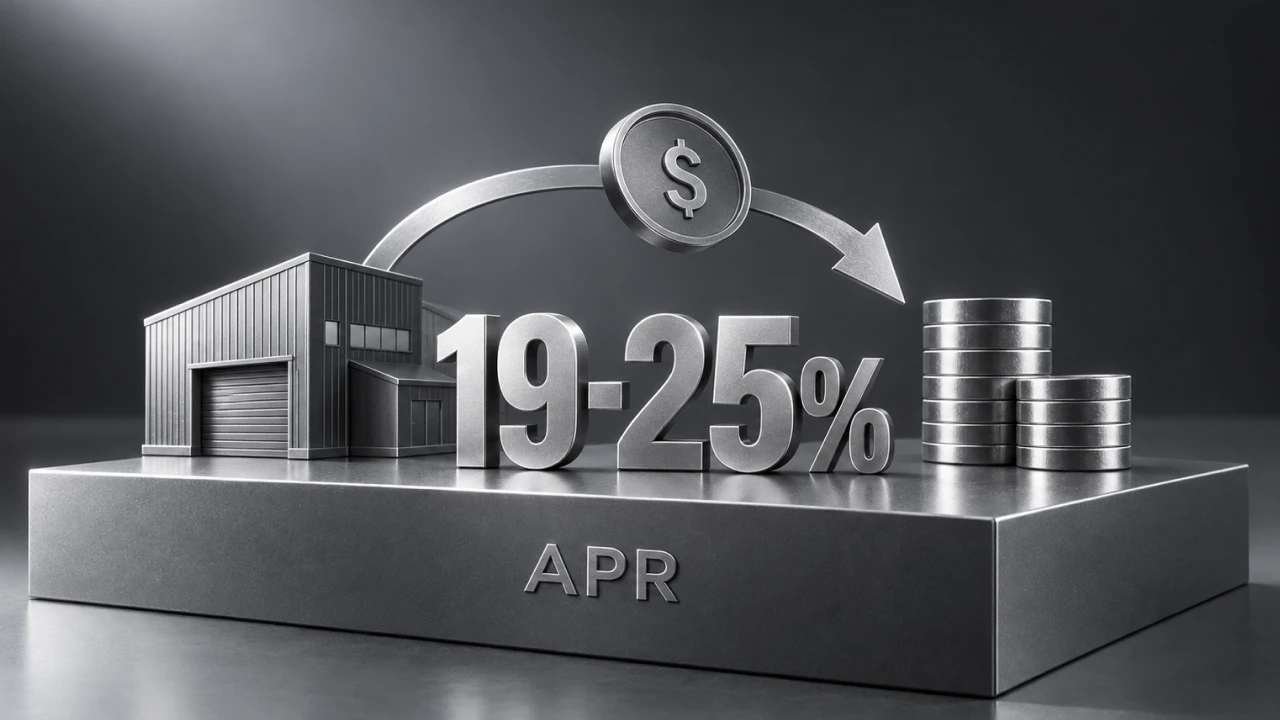
A fixed 19-25% APR USD yield on 8lends is paid by small and medium businesses borrowing against real-world collateral, not generated by reward-unit emissions or digital-asset speculation. Borrowers pay a loan rate; 8lends deducts a 3% origination fee from the pool raised; investors receive the remainder as monthly interest, with zero platform fees beyond blockchain gas.
Where Does a Fixed 19-25% APR USD Yield Actually Come From?
A fixed APR USD yield on a loan comes from the borrower. If the business wants expansion, coverage of operational equipment, or capacity for growth, it can apply for financing in a crowdlending platform. If the platform rules out that the risk profile and other criteria related to the borrower are within the limits, the company may receive a loan from the private investors who are willing to fund them. The borrower agrees to pay the fixed interest to the investor to compensate them for funding and provide returns since the claim does not give the lender ownership of the company. 8lends claims typically have an APR between 19% and 25%.
The loan on 8lends is backed by the collateral, the real-world asset that a business can provide to secure the loan. The collateral may come in multiple forms, including real estate, vehicles, and operational assets. Therefore, when the company receives the loan, the company has already followed this pipeline:
Investor capital — SME loan — borrower interest — investor monthly payment
8lends charges the borrower a 3% fee when the company completes the formation of the requested pool. Then, the loan becomes active, and the investors can start receiving monthly interest one month after the loan is active. The investors do not have to pay any fees for investing in the project on 8lends, nor on the receipt of the interest. The only expense for the investors is the on-chain gas fee paid in ETH to sustain Base infrastructure.
What backs the interest rate a borrower pays on 8lends?
The interest rate a borrower pays on 8lends is backed by the contractual obligation on the loan. Since the loan is formed with the collateral pledged against it and the specific term until maturity, the borrower agrees to pay a fixed monthly interest to the investor in exchange for their capital. The collateral pledged against the loan is reviewed by an independent Collateral Agent Maclear AG, a member of PolyReg SRO.
Why Would a Business Agree to Pay 19-25% Interest?
Although the borrowing rate of 20% on a business loan may seem high, it is not equivalent to a traditional low-risk corporate loan. The market of P2P claims and private debt functions differently.
The enterprise may need capital to finance the renovation of the facility, the purchase of the new equipment, or business expansion. Occasionally, they may need money within a shorter timeframe. Since traditional bank underwriting for corporate entities may take months, companies can consider the alternative of borrowing from private investors via a P2P lending platform. If the company needs money in the most proximate future, some may genuinely consider P2P lending to cut the costs for waiting.
8lends typically lists projects with a loan term between 4 and 16 months until maturity. Therefore, the purpose of the loan shifts from a longitudinal business expense to a finite business commitment with a relatively higher annualized rate for the borrower.
Why would a business pay 20% interest instead of a bank loan?
A business may decide to pay 20% annual interest instead of a bank loan because of a possibility to acquire funds faster. Sometimes, rapidly expanding businesses cannot wait months until the loan is approved by the bank, as every month without new production capacities may stall the expansion. That is why, when the timeframe for which the need to acquire financing is shorter, a business may genuinely accept this trade-off.
How Is This Different From Protocol-Based Lending Rates and Staking Rewards?
The easiest way to understand the 8lends yield is to look at the different mechanisms that allow it to generate the cash flow. An overview of these mechanisms is presented in the table below.
| Yield source | Who pays | What backs it | What breaks it |
|---|---|---|---|
| Business loan interest (RWA crowdlending) | SME borrower | Business cash flow, due diligence, asset pledged as collateral | The borrower enters default |
| Protocol-based lending borrow rate | On-chain borrowers | Usually over-collateralized digital-asset positions | Collateral crashes and liquidation fails to recover |
| Staking rewards | Blockchain or network issuance and protocol economics | Network participation and protocol issuance economics | Issuance fails, validator economics change or the decline in the network's native asset price happens |
| Savings-account interest | Bank from its lending and funding margin | Bank balance sheet plus applicable statutory deposit protection | The deposit rate is reduced as monetary conditions change |
Does 8lends pay yield on 8LNDS?
No, 8lends does not pay yield on 8LNDS. Monthly interest payments are made to an investor’s non-custodial wallet in USD and come from the borrower. 8LNDS-based reward programs are a separate way to increase the investor’s incentive but are not added to a contractual loan rate.
A 1,000 USD Loan: What the Cash Flow Looks Like
To understand how a 1,000 USD loan may function in practice, a hypothetical example of a claim with a 12-month term may be used.
Supposedly, the investor has purchased a claim for 1,000 USD with the lower end of the stated range, or 19% APR. Then, the investor would get a monthly interest of 15,83 USD per month calculated with the following formula:
1,000 * 19% / 12 = 15.83 USD per month
If the investor purchases the same 12-month claim but with an APR of 22%, then monthly interest would be:
1,000 * 22% / 12 = 18.33 USD per month
In case the investor’s claim sits at 25% APR, the expected monthly interest would be around 20,83 USD per month.
The contractual schedule and the loan funding structure determine the interest payment structure. 8lends standard structure of interest payments, which are monthly payments to the non-custodial wallet owned by the investor.
Why Is the Rate Fixed but the Return Not Guaranteed?
A fixed rate means that the interest is fixed based on the terms of the loan agreement. The final result depends on the borrower’s performance.
When the loan is successfully funded, the APR attributed to the loan agreement remains fixed until maturity. Typically, projects on 8lends have an APR between 19% and 25%, whereas the terms vary between 4 and 16 months. Yet the contract does not guarantee that the borrower will never experience financial issues and will be able to repay the debt.
8lends standard default term is 60 days. If the borrower fails to resume interest payments or repay the principal after 60 days, the enforcement of the collateral through Maclear AG may begin. The realization of the collateral may take between 1 month and a year as stated in the current 8lends documentation. Upon liquidation, the funds are distributed among the investors on a pro rata basis. If the collateral did not realize an expected value, or its price did not cover the outstanding principal, the investors may lose some funds.
The projects on 8lends that have a BuyB badge go into a different category. When the BuyBack is activated, the partner is obligated to repurchase the loan under specific terms. BuyBack can be activated after 60 days of the borrower’s delinquency. BuyBack is the mechanism providing an additional layer of protection of the invested principal and does not serve as a guarantee of repayment.
8lends, based on the data available in August 2026, have reported 0 historical defaults. The overall amount of funds raised by the projects on the website amounts to $15.27 million. Yet these figures are representative of the current state of the platform and do not guarantee future performance and cannot serve as investment advice.
How Do 8lends and Maclear AG Earn From Every Loan?
8lends and Maclear AG share a separate economy from the investors’ returns. The operator of 8lends, Alpha Systems LLC, takes a 3% fee from the borrower once the financing goal has been successfully reached. Investors only have to pay for the blockchain gas to the Base network, not to 8lends directly.
One exception is the sale of the claim on the Secondary Market. The investor who wants to exit earlier has to pay a seller commission of 10% upon a successful sale. The buyer does not have to pay anything.
Maclear AG performs a different function, being an independent Collateral Agent and dealing with all the operations connected to the assessment of the collateral, its potential enforcement, registration, and many other operations. Maclear AG is a member of PolyReg SRO, a self-regulatory organisation recognised by FINMA, and acts as Collateral Agent.
Alpha Systems LLC operates as a VASP under the supervision of a regulatory body, FSA of Saint Vincent and the Grenadines. Alpha Systems is the entity responsible for the operations of 8lends and the maintenance of smart contract infrastructure.
Is a 19-25% APR Yield Too Good to Be True?
A fixed 19-25% APR is a contractual rate, not a guaranteed outcome: the actual return depends on timely repayment by the borrowing business, and capital remains at risk if a loan defaults and collateral proceeds fall short.
There is no universal answer to the question of whether an APR rate between 19% and 25% is “too good” or “too bad." Since private lending is typically riskier than traditional lending, the rates may be higher. Likewise, the liquidity for the investor may be lower.
The investor will not automatically get 19% or 25% in interest if the borrower fails to meet the contractual obligations. Likewise, if the borrower enters default, even the recovery of the collateral may not guarantee complete returns to the investor. That is why an APR rate between 19% and 25% corresponds to a significantly higher risk profile of such loans.
Although mechanisms like real-world collateral and proper due diligence can reduce the risk related to the borrower’s default. But it does not eliminate them completely, as the final performance on the loan depends on the success of the collateral liquidation and the performance of the borrower before it.
Spotlight — 8lends Interest paid by real businesses, not emissions On 8lends, investors fund real SME loans using USD, receiving monthly interest at fixed rates. Every transaction — investment, interest payout, principal return — is recorded on the Base blockchain and publicly verifiable. Each borrower passes 40+ due diligence criteria assessed by Maclear AG and is rated AAA–D before listing. Loans are backed by real-world collateral and selected projects include BuyBack protection — returning 100% of principal if a borrower delays beyond 60 days. 19–25% APR Fixed APR in USD $152.7M+ Total funded $53.2M+ Total repaid 50.8K+ Investors View open projects →
FAQWhere does the 19-25% APR yield come from?The 19%—25% APR yield comes from the borrower agreeing to the loan from the private investor under the terms fixed in the contract. Upon successful formation of the loan agreement, 8lends takes a 3% fee, and the rest is attributed towards the principal.Why would a business pay 20% interest?The business can agree to pay 20% annual interest because the alternative of waiting for the approval of the loan by the traditional bank for months or the refusal of the loan’s approval may result in the stalling of expansion or issues with the operations.Is a 19-25% APR yield too good to be true?No, it is not automatically better since the risk profile of a P2P loan is entirely different. The investor carries a borrower credit risk, and the loan generally has lower liquidity than a traditional bank loan. Likewise, such a loan may be very attractive for the investors who seek higher returns and are willing to accept higher risk.Does 8lends pay yield on 8LNDS?No, 8lends does not pay yield on 8LNDS. 8LNDS is a separate bonus of Proof of Loan. It is not included in the loan agreement and is not part of the APR of the project.Is the 19-25% APR rate fixed, or can it change?A 19%—25% APR rate is fixed on the term of the loan. It indicates the expected interest that the borrower should monthly allocate to the investor. However, the returns depend on the solvency of the borrower and the payment of interest as well as the return of the principal on the claim, which are not guaranteed.
Explore open 8lends projects — SME loans secured by real-world collateral, legally registered through an independent Swiss collateral agent.Start investing →The content of this article is provided for informational and educational purposes only. It does not constitute investment, financial, tax, or legal advice. P2P lending and crowdlending investments carry a risk of partial or total capital loss. Collateral and BuyBack arrangements do not guarantee the return of funds; recovery outcomes vary. Past performance is not indicative of future results. Readers should conduct independent research and consult qualified advisors before making any financial decisions. Availability of products and services may be restricted in certain jurisdictions.
Read next


Do You Have Any Questions?
All questionsThe platform has been audited by CertiK and Cyberscope, and all transactions are publicly visible on the Base blockchain. Two companies with clear responsibilities stand behind the platform: CLEARCHAIN CORP operates the platform and is registered as a Money Services Business with FINTRAC (Canada), and Maclear AG conducts due diligence and monitors collateral. So the platform is well regulated, transparent and accountable
If the project has BuyBack, the partner buys the loan and returns 100% of the principal once it is overdue for 60 days or more. Without BuyBack, Maclear AG initiates the sale of the collateral, and the proceeds are distributed proportionally among investors. Since launch there have been no defaults
The platform is operated by CLEARCHAIN CORP, registered in Canada as a Money Services Business (MSB) and subject to mandatory AML/CFT compliance requirements under FINTRAC. Settlements are made in USD. The platform is not a CASP, so DAC8 requirements do not apply
Small and medium-sized businesses in developing regions do not have easy access to bank financing and are willing to pay higher rates than businesses in the EU or US
You can sell your position to another investor through the Secondary Market before the end of the loan term. With Fastlending there is no fixed term: the principal and accrued income can be withdrawn at any time
The minimum investment is 100 USD
Risk of non-payment by the business, risk of changes in the value of the collateral, risk of limited liquidity if there is no buyer on the Secondary Market, and technical risk associated with the smart contract
Investments from 100 to 500 USD are available without KYC. For amounts over 500 USD, full verification is required: an identity document and proof of address