
September 3, 202610 min read
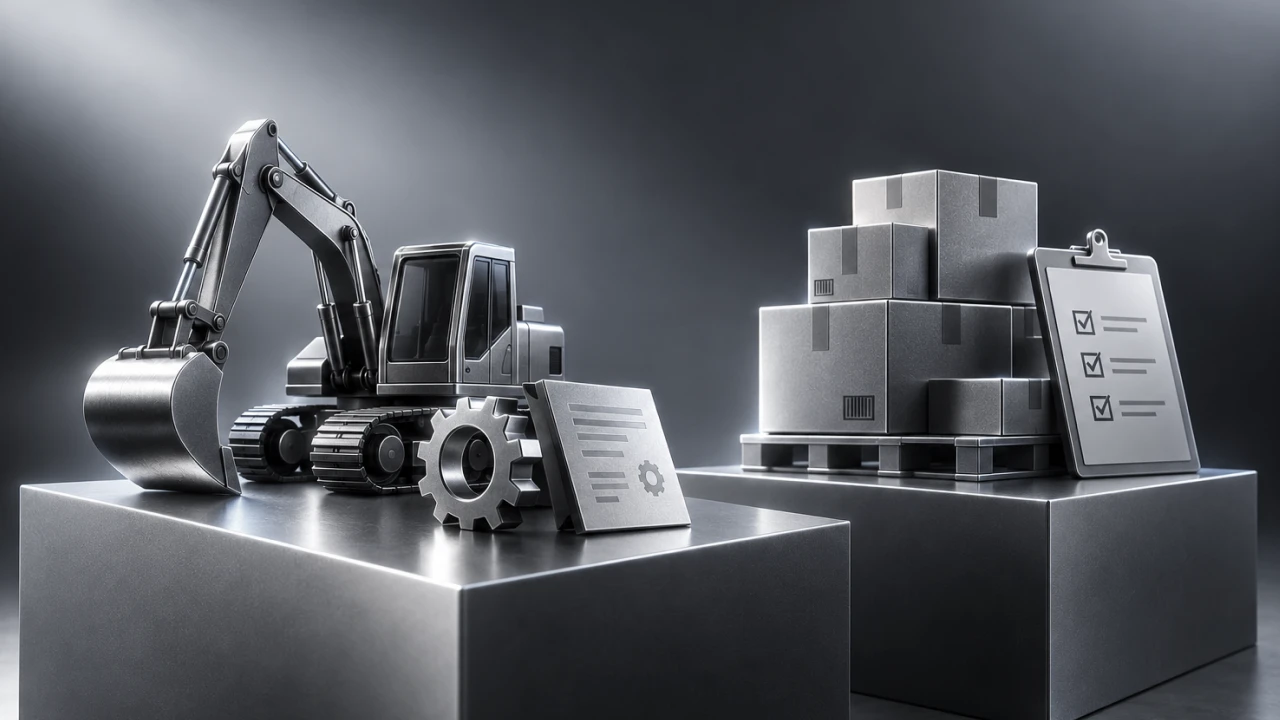
Equipment and inventory financing are both secured loans, but the assets behave differently. Equipment sits on your floor for years and has a resale market; inventory moves, ages, and can lose value fast. That difference changes how much you can borrow, what a lender asks to see, and what happens if payments stop.
Equipment Financing vs. Inventory Financing: What's the Real Difference?
The simplest distinction is what the borrowed money is intended to support. An equipment loan is generally associated with a durable asset: a production machine, commercial vehicle, specialist tool, or another item the business expects to use over multiple operating cycles.
An inventory loan is tied to goods that the business expects to sell, process, or consume. Examples include raw materials, wholesale stock, seasonal merchandise, components, or finished products awaiting sale. That creates a basic difference in collateral behavior.
Equipment usually remains physically identifiable throughout the loan. A machine has a manufacturer, model, serial number, age, condition, and resale market. Inventory is dynamic. The company may sell one batch and replace it with another, while the composition and market value of the stock can change continuously. This is why asset-based lending cannot treat the two categories as equivalent.
| Criterion | Equipment | Inventory |
|---|---|---|
| Asset identification | A specific unit (serial number, model, year of manufacture) is easy to identify and register as collateral | A lot of goods or raw materials are identified as a category and volume in stock on the valuation date, not individually. |
| Valuation | An independent assessment of the market value of a specific unit at the time of application | Valuation at cost or market price on the valuation date; often revalued due to turnover |
| Typical LTV range | Typically higher than inventory — the asset retains its value longer (for the exact methodology and ranges, see “How Collateral is Evaluated and LTV is Calculated”) | As a rule, it is lower than that of equipment — the risk of obsolescence and price fluctuations is higher (see the same article about the methodology). |
| Control during the loan term | Periodic checking of the availability and condition of a specific unit | Requires more frequent monitoring of warehouse balances — goods are rotated, the batch composition changes |
| Secondary Market upon liquidation | There is usually a resale market for specialized machinery/equipment from the same industry | May be narrow or absent — especially for perishable or highly specialized goods |
| What happens when the borrower defaults | It goes through the same foreclosure process as any 8lends collateral — see "Real Default Rates and What Happens Next." | The same, but the speed and outcome of collection depend more on whether the goods have had time to turn over or become obsolete during the procedure. |
The table is a qualitative comparison rather than an LTV schedule. The actual collateral structure and valuation methodology depend on the individual project.
Why Lenders Treat Equipment and Inventory Differently
The difference comes down to predictability.
A machine can depreciate, but its identity normally does not change. If a business pledges a CNC machine manufactured in a specific year, the Collateral Agent can identify that same machine later. Inventory behaves differently. A retailer that holds 5,000 units of stock today may hold a completely different product mix three months later. A manufacturer may transform raw materials into finished goods. Food products can expire. Fashion inventory can lose value rapidly after a season.
That makes inventory as collateral more difficult to monitor. A used forklift, commercial vehicle, or standard production machine may have an established secondary market. Highly specialized equipment can still be difficult to sell, but valuation starts with a defined physical item. Inventory value depends more heavily on commercial context. Ten thousand units of a product may be valuable before a seasonal peak and worth substantially less afterwards.
How Much of My Equipment's Value Can I Actually Borrow Against?
There is no universal percentage that applies to every piece of equipment.
The amount that can reasonably support a loan depends on the independently assessed market value, age, condition, ownership status, resale demand, and how specialized the asset is. A lender will also distinguish between an appraisal value and a realistic enforcement value. A machine that is theoretically worth €100,000 in normal commercial conditions may realize less if it has to be sold quickly.
For that reason, the loan amount is usually set below the appraised collateral value rather than assuming that every euro of valuation can support one euro of borrowing. The same principle applies to inventory, usually with greater sensitivity to price changes and obsolescence.
Financing a Machine: What a Typical Equipment Loan Looks Like
A business equipment loan is useful when the financing need can be linked directly to a durable operating asset. A manufacturer may need a new cutting machine. A logistics company may need another commercial vehicle. A food processor may need refrigeration equipment. A construction business may need to replace machinery that has become unreliable.
In each case, the financing requirement is specific and measurable. The lender can ask what kind of machinery is being purchased, how much does it cost, and who owns it. That makes equipment financing is relatively straightforward to document compared with constantly changing inventory.
What Documents Do I Need to Finance New Equipment?
The asset-specific documents normally need to establish both the identity of the equipment and its value.
For new equipment, relevant documentation includes an invoice, purchase order, or commercial quotation; manufacturer, model, and serial number where available; production year and technical specification; information on current condition if the asset is already in use; and an independent assessment of market value.
If the business already owns the equipment and wants to use it as collateral, proof of ownership replaces the purchase quotation as the key starting document. The purpose is not to produce paperwork for its own sake. The lender and Collateral Agent need to establish that the asset actually exists, belongs to the borrower, and can be identified if recovery becomes necessary.
A Common Case — Replacing an Aging Machine
Consider a manufacturing company whose main machine is approaching the end of its economic life. The machine still operates, but downtime is increasing and a breakdown during a large contract could disrupt production.
The company identifies a replacement costing €80,000. Waiting until enough retained earnings accumulate may take too long. A longer bank process may also conflict with the delivery timetable. An equipment-backed loan allows the financing case to be structured around the new machine and the company's ability to service the debt from operating cash flow.
The economic decision is then simple to frame: does replacing the machine now create enough value through higher output, lower maintenance, or avoided downtime to justify the financing cost? The collateral is part of the risk structure, but the loan still needs to make sense as a business decision.
Financing a Stock Purchase: What a Typical Inventory Loan Looks Like
Inventory financing is more closely connected to working capital. The borrower is not necessarily buying an asset expected to remain for years. It may be purchasing goods that should convert back into cash within months. Typical situations include a retailer preparing for a seasonal peak, a wholesaler purchasing a large batch at favorable supplier terms, a manufacturer buying raw materials for confirmed orders, or a distributor increasing stock before an expected increase in demand.
An inventory loan can therefore match short operating cycles better than long-term capital expenditure financing.
The key issue is turnover because, if inventory is expected to sell quickly, financing may bridge the period between paying the supplier and collecting revenue from customers. But that same turnover makes collateral control more complex.
What Documents Do I Need to Finance a Stock Purchase?
The asset-specific documents should show what inventory exists, who owns it, and how quickly similar goods historically turn into sales. Relevant records include a warehouse inventory list dated around the application, product names, quantities, unit values, supplier invoices or purchase documentation proving ownership, etc. Inventory that normally sells within 30 days has a very different risk profile from stock that remains unsold for nine months. For perishable or trend-driven goods, the timing of the financing can matter as much as the nominal collateral value.
A Common Case — Buying Inventory Before a Seasonal Peak
Imagine a retailer that generates a large share of annual sales during a three-month seasonal period. The company expects demand to rise sharply but must pay suppliers before the sales occur. It wants to purchase €120,000 of stock now rather than replenish slowly throughout the season. The financing logic is based on a working-capital gap: cash leaves the company before customer revenue arrives. An inventory-backed structure can match that cycle, provided the borrower can demonstrate historical sales, supplier documentation, ownership of the stock, and a realistic path from inventory to cash.
The risk is different from equipment financing. If the season underperforms, the inventory may remain unsold. Its value can also fall rapidly after the peak period. That is why the collateral assessment needs to consider more than the original purchase price.
What Happens If You Fall Behind on Payments
Both equipment-backed and inventory-backed loans remain debt obligations. Collateral does not replace repayment. If a borrower misses scheduled payments, the loan first becomes delinquent. On 8lends, a loan is considered in default after 60 days of missed payments. At that point, the collateral can enter the applicable recovery process.
With equipment, enforcement may involve identifying, taking control of, and selling the pledged asset. With inventory, the process can be more sensitive to timing because the stock may have changed, been sold, deteriorated, or lost market value since the original assessment. This is one reason accurate collateral records matter throughout the financing period.
A business owner should also understand that falling into default can have consequences beyond losing the pledged asset. Legal costs, operational disruption, and damage to future access to financing can all matter.
RiskBoth equipment and inventory financing on 8lends are backed by real collateral, but collateral reduces the severity of a loss — it does not remove the risk of one. A loan is considered in default after 60 days of missed payments, after which the collateral goes through a recovery process handled by a third party, not by the platform itself. Capital is at risk, including in fully collateralized deals; see how default rates and recovery actually work for the full picture.
Which One Fits Your Situation?
The right structure usually follows the purpose of the financing. Choose equipment financing when the financing need is tied to a specific durable operating asset. Typical examples include replacing machinery, purchasing a commercial vehicle, adding production capacity, or financing specialized equipment that will remain in the business for years.
Choose inventory financing when the need is connected to stock turnover and working capital. Examples include buying goods before a seasonal peak, financing raw materials for confirmed production, taking advantage of supplier discounts, or increasing stock ahead of expected demand. The distinction becomes especially important for seasonal purchases.
If the money will be converted into stock and then into sales within a short operating cycle, inventory financing is usually the more natural structure. If the money buys a machine that will generate value over many operating cycles, an equipment loan is generally more aligned with the asset. A business should also consider documentation to prove transparency and compliance.
A clearly identifiable machine with an independent valuation is easier to track than constantly changing warehouse stock. Conversely, a company with strong inventory turnover but few durable assets may have a better financing case built around stock.
Spotlight — 8lends Equipment and inventory as real collateral On 8lends, investors fund real SME loans using USD, receiving monthly interest at fixed rates. Every transaction — investment, interest payout, principal return — is recorded on the Base blockchain and publicly verifiable. Each borrower passes 40+ due diligence criteria assessed by Maclear AG and is rated AAA–D before listing. Loans are backed by real-world collateral and selected projects include BuyBack protection — returning 100% of principal if a borrower delays beyond 60 days. 19–25% APR Fixed APR in USD $152.7M+ Total funded $53.2M+ Total repaid 50.8K+ Investors View open projects →
FAQWhat's the difference between equipment financing and inventory financing?Equipment financing funds machinery, vehicles, or other long-lived business assets, with the equipment typically serving as collateral. Inventory financing is designed around stock held for resale. The key difference is collateral behavior: equipment usually retains value over a longer period, while inventory turns over, changes in value, and may require more frequent monitoring.Can I use inventory as collateral for a business loan?Yes. Inventory can serve as collateral if ownership, quantity, condition, and value can be documented. However, lenders may treat it differently from equipment because inventory can sell quickly, become obsolete, or fluctuate in value. The amount available to borrow therefore depends on the lender's valuation methodology and resulting LTV.How much of my equipment's value can I actually borrow against?There is no universal percentage. The amount depends on the equipment's appraised value, age, condition, resale market, and the lender's required loan-to-value ratio. Importantly, lenders may consider expected liquidation value rather than simply using the original purchase price. See the guide on how collateral is valued and LTV is calculated for the full methodology.What happens if I fall behind on payments?Late payments do not immediately mean the collateral is sold. On 8lends, a loan is considered in default after 60 days of missed payments. From that point, collateral recovery can proceed through the third party responsible for enforcement. Recovery takes time and may not cover the entire outstanding balance.Which is better for a seasonal stock purchase — equipment or inventory financing?It depends on what the business needs to finance. If the goal is buying additional stock before a seasonal sales peak, inventory financing generally matches the use of funds more closely. If the business needs a new machine or vehicle to increase production capacity, equipment financing is the more natural structure.
Explore open 8lends projects — SME loans secured by real-world collateral, legally registered through an independent Swiss collateral agent.Start investing →The content of this article is provided for informational and educational purposes only. It does not constitute investment, financial, tax, or legal advice. P2P lending and crowdlending investments carry a risk of partial or total capital loss. Collateral and BuyBack arrangements do not guarantee the return of funds; recovery outcomes vary. Past performance is not indicative of future results. Readers should conduct independent research and consult qualified advisors before making any financial decisions. Availability of products and services may be restricted in certain jurisdictions.
Read next
Do You Have Any Questions?
All questionsThe platform has been audited by CertiK and Cyberscope, and all transactions are publicly visible on the Base blockchain. Two companies with clear responsibilities stand behind the platform: CLEARCHAIN CORP operates the platform and is registered as a Money Services Business with FINTRAC (Canada), and Maclear AG conducts due diligence and monitors collateral. So the platform is well regulated, transparent and accountable
If the project has BuyBack, the partner buys the loan and returns 100% of the principal once it is overdue for 60 days or more. Without BuyBack, Maclear AG initiates the sale of the collateral, and the proceeds are distributed proportionally among investors. Since launch there have been no defaults
The platform is operated by CLEARCHAIN CORP, registered in Canada as a Money Services Business (MSB) and subject to mandatory AML/CFT compliance requirements under FINTRAC. Settlements are made in USD. The platform is not a CASP, so DAC8 requirements do not apply
Small and medium-sized businesses in developing regions do not have easy access to bank financing and are willing to pay higher rates than businesses in the EU or US
You can sell your position to another investor through the Secondary Market before the end of the loan term. With Fastlending there is no fixed term: the principal and accrued income can be withdrawn at any time
The minimum investment is 100 USD
Risk of non-payment by the business, risk of changes in the value of the collateral, risk of limited liquidity if there is no buyer on the Secondary Market, and technical risk associated with the smart contract
Investments from 100 to 500 USD are available without KYC. For amounts over 500 USD, full verification is required: an identity document and proof of address