How SKAT classifies crypto income
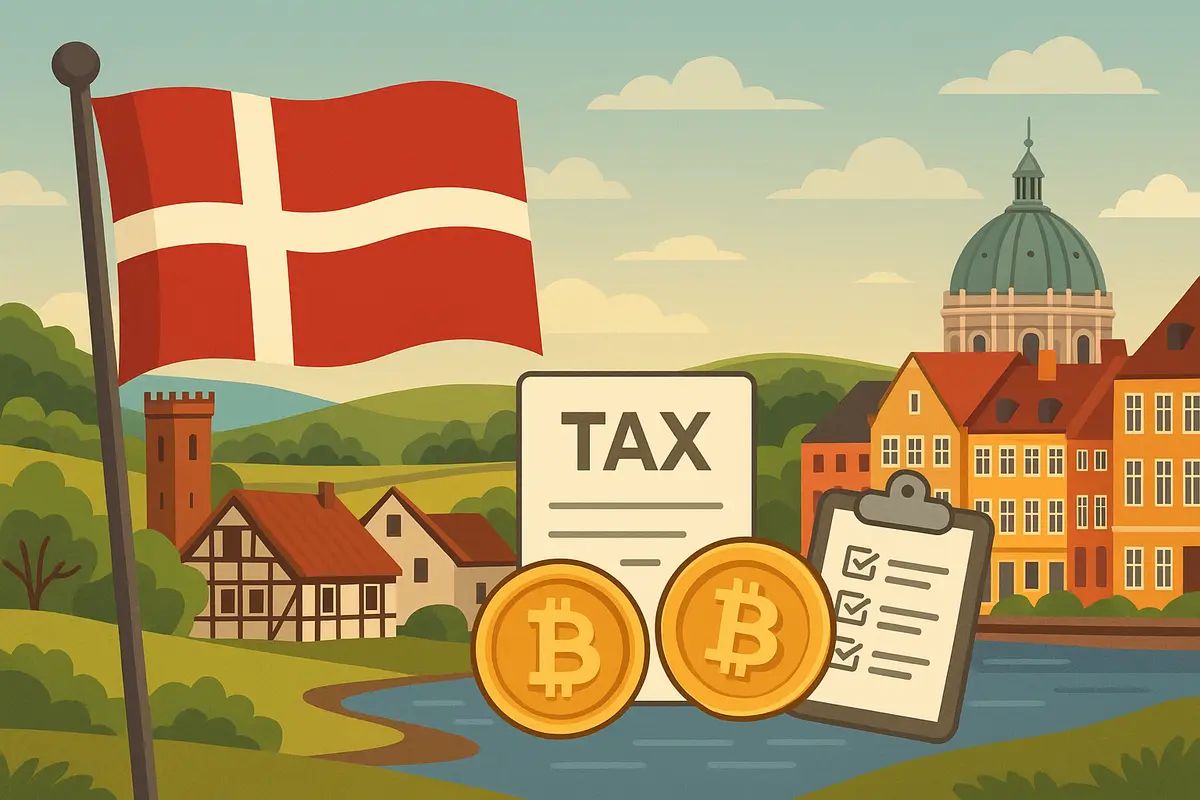
Denmark's tax authority (SKAT) splits crypto income into two regimes. Mining, staking, lending interest, and ordinary trading gains are taxed as personal income through the progressive brackets, with an effective ceiling of 52.06%. Stablecoins and certain financial-instrument gains fall under a separate 42% flat capital gains tax, with no personal allowance applied.
The labor market contribution (AM-bidrag, 8%) does not apply to crypto income for private individuals — only to wage and self-employment earnings. Crypto profits are still subject to bottom-bracket and municipal tax.
The distinction matters at the moment of receipt or disposal: SKAT looks at what the asset is and how it was obtained, not the user's intent. The framework below covers the four most common income types — mining, staking, DeFi lending, and crowdlending — and how each maps to the Danish rate system for 2025 (the 2026 thresholds are indexed and broadly similar; check skat.dk for the current year).
How SKAT taxes crypto mining
SKAT treats crypto mining as an active economic activity, equivalent to a job or business. When new coins are credited to a wallet, their fair market value in Danish kroner at the moment of receipt is recorded as personal income and taxed through the progressive brackets.
This applies equally to solo mining, pool mining, and cloud mining. The contractual form does not change the outcome — the moment the miner gains control of the coins, the value in DKK is taxable.
What happens if mined coins are sold later?
A second taxable event is triggered on disposal. If a miner holds coins after receipt and later sells, swaps, or spends them at a higher DKK value, the difference is added to personal income for the tax year in which the disposal occurs. A decrease in value, by contrast, does not automatically offset other income — mining losses are treated more narrowly than capital losses on financial instruments.
Staking rewards under Danish tax rules
Staking rewards are taxed as personal income at the moment the user gains control of the tokens — not when they are sold. This applies to on-chain staking from a private wallet, delegated staking through a validator, and custodial staking on an exchange.
The taxable value is the DKK market value at the time of receipt. It does not matter whether rewards are immediately sold, left locked in the protocol, or auto-restaked: the income event happens the moment the staker can move the tokens.
Are restaked rewards taxed twice?
Each batch of new rewards is taxed when first credited. Auto-restaking is not a second taxable event by itself — it is treated as a re-deployment of an already-taxed amount. A later sale of the restaked principal, however, triggers a disposal event, and any DKK appreciation since first receipt is added to income.
What if the validator slashes my stake?
A slashing loss reduces the holding's cost basis but does not generate a deductible expense against general income in most private cases. Document the exact slashed amount, the protocol's slashing notice, and the DKK value at the time — without this, SKAT will default to the higher pre-slash basis.
DeFi lending and crowdlending: tax treatment
Interest earned from DeFi lending and crowdlending is taxed as ordinary personal income in Denmark, not as capital gains. Most digital assets are classified as speculative property — so almost every form of yield gets pulled into the progressive bracket system rather than receiving the preferential financial-instrument treatment available for stocks or stablecoins.
Common lending structures and how they are typically taxed:
- Peer-to-peer crypto lending — personal income
- Liquidity provision to lending protocols — personal income
- Automated money-market interest — personal income
- Crowdlending interest (USDC, etc.) — personal income
- Futures and margin trading gains — flat 42% capital gains
- Stablecoin disposals at a gain — flat 42% capital gains
Crowdlending follows the same pattern as DeFi lending but with more structure: funds are pooled and lent to identified borrowers — usually SMEs — under predefined terms. The income is fixed-rate interest, generally paid monthly, which produces clearly timed and clearly categorised taxable events — easier to document than open-ended DeFi yield.
Predictable income, on-chain audit trail for SKAT reporting
One challenge for Danish crypto investors is that DeFi yield is generated across multiple protocols, in volatile assets, with no central record. Each interaction is a potential personal-income event, requiring a DKK conversion at the exact moment of receipt — and SKAT places the documentation burden on the taxpayer.
Structured crowdlending on 8lends offers a cleaner income profile. Investors fund vetted SME loans in USDC and receive monthly interest at fixed rates. Every investment, interest payment, and principal return is executed through a smart contract on the Base blockchain and is publicly verifiable — the type, amount, and timing of each income event are defined in advance.
Each borrower passes 40+ due-diligence criteria assessed by Maclear AG and is rated AAA–D before listing. Loans are backed by real-world collateral. The on-chain transaction log integrates directly with crypto tax software, satisfying SKAT's requirement for counterparty, amount, and timestamp documentation.
The progressive income brackets that apply
Rather than carving crypto into a separate investment category, SKAT aggregates mining, staking, lending, and trading income with the taxpayer's salary and assesses the total against the standard personal-income brackets for the year.
The 52.06% ceiling is enforced by a statutory rule that caps the combined central, municipal, and top-bracket tax. The labor market contribution (AM-bidrag) of 8% applies to wages and self-employment income — not to crypto profits for private investors.
How does municipal tax change the result?
The municipal rate ranges from roughly 22% in some Copenhagen suburbs to over 27% in parts of Jutland. The same DKK 100,000 of crypto income produces a different bill in Aalborg (25.4%) than in Vesthimmerland (27.0%). For taxpayers near the top-bracket threshold (DKK 588,900), a small change of residence can shift the effective rate by 1–2 percentage points.
Who counts as a Danish tax resident?
Tax residency determines whether SKAT can tax worldwide crypto income or only Denmark-source earnings. Under Danish law, an individual is considered a tax resident if any of the following applies:
- Owning or renting a permanent home available year-round
- Staying in Denmark for six or more continuous months
- Centre of vital interests (family, main job, primary economic ties) located in Denmark
- Returning to Denmark with intent to settle after time abroad
- Stays of less than six months without a permanent home
- Tourists, short-term workers, and visiting researchers
- Non-residents earning income only on Danish platforms
- Cross-border commuters with main residence abroad
Residents are taxed on worldwide crypto income — including rewards from foreign validators and interest from non-Danish lending platforms. Non-residents are taxed only on Denmark-source income, typically interpreted as activity tied to a Danish permanent establishment or earned on Danish platforms.
Crypto activities that are tax-exempt
Not every crypto event creates a tax liability. The following actions are not disposals under Danish rules and do not generate immediate income — but they still affect cost basis and must be documented.
Are NFTs and collectibles taxed differently?
If a digital asset is acquired clearly for non-speculative purposes — collecting art, personal use, or a utility unrelated to profit — SKAT may exclude it from the income regime. In practice the threshold is high: any asset with observable price volatility or a realistic resale market is presumed speculative. Documentation of purpose, holding period, and use is required for a non-speculation claim to hold up on audit.
How long must records be kept?
The standard retention window for tax documentation in Denmark is five years from the end of the relevant income year. For crypto, SKAT recommends keeping wallet addresses, transaction hashes, exchange statements, and DKK-equivalent values for every event — including non-taxable transfers — because cost-basis disputes can reach back across the entire holding period.
Two worked examples: Lars and Mette
The following cases show how the personal-income regime and the 42% flat rate produce different outcomes for similar-looking activities.
Two worked examples: Lars and Mette
The following cases show how the personal-income regime and the 42% flat rate produce different outcomes for similar-looking activities.
Lars earns a DKK 350,000 salary and an additional DKK 20,000 from selling and staking digital coins during 2025. His total personal income is DKK 370,000 — below the top-bracket threshold of DKK 588,900, so only bottom-bracket and Herlev municipal tax apply.
− Personal allowance: −DKK 51,600
Taxable base: DKK 318,400
Bottom-bracket (12.01%): DKK 38,233
Herlev municipal (23.70%): DKK 75,461
Total tax: ~DKK 113,694 · effective rate on crypto portion ≈ 35.7%
Mette has no salary in 2025 but sells DKK 100,000 worth of stablecoins for a DKK 1,000 gain. Because stablecoins are classified as financial instruments, the flat 42% capital gains rate applies — the personal allowance does not.
Flat capital gains rate: 42%
Tax due: DKK 420 — taxed separately from any other income
Jens has a DKK 480,000 salary and earns DKK 14,000 in USDC interest from crowdlending on 8lends across the year. The interest is treated as personal income and added to his salary — pushing none of it into the top bracket. His Copenhagen municipal rate is 23.50%.
− Personal allowance: −DKK 51,600
Taxable base: DKK 442,400
Bottom-bracket + municipal (~35.71%): ~DKK 157,981
Tax attributable to crypto portion ≈ DKK 5,000 (~35.7%)
Sofie earns DKK 700,000 in salary plus DKK 50,000 in mining and staking rewards. Her total of DKK 750,000 exceeds the top-bracket threshold (DKK 588,900), so the additional 15% top-bracket tax stacks with bottom-bracket and municipal rates on the excess.
Top-bracket addition (15%): DKK 24,165
Combined effective rate on excess: capped at 52.06%
Effective tax on crypto portion: ~52% (top of band)
Note: municipal rates and bracket thresholds are indexed annually. The figures above use 2025 values; the 2026 amounts have moved by single percentage points but the structure is unchanged. Confirm the current values on skat.dk before filing.
Crowdlending as a cleaner income structure
For Danish investors managing the documentation burden of multiple DeFi positions, fixed-rate crowdlending offers a more predictable income profile. The income type is unambiguous (interest, taxed as personal income), the timing is defined in advance (monthly payouts), and on blockchain-native platforms the full transaction log is auditable without manual extraction from wallet history.
On 8lends, every investment, monthly interest payment, and principal return is executed through a smart contract on Base and recorded immutably on-chain. This creates a complete, timestamped income record that integrates with crypto tax software and satisfies SKAT's requirement for counterparty, amount, and date documentation.
For investors looking at how other EU jurisdictions handle crypto, our Portugal crypto tax regime guide covers the simpler one-year holding rule, our Sweden 30% crypto tax explained guide compares the Nordic flat-rate approach, and our Irish Revenue framework guide explains the CGT-plus-income-tax split. For platform-level due diligence, see our analyses of P2P lending risks and platform risk in P2P lending.
Key takeaways for Danish crypto investors
Mining, staking, and lending income in Denmark falls under the progressive personal-income system with an effective ceiling of 52.06%. Stablecoins and financial instruments are taxed separately at a flat 42% capital gains rate. The personal allowance (DKK 51,600 in 2025), the family-gift exemption (DKK 74,100), and the absence of AM-bidrag on private crypto income are the three structural reliefs available — and each requires documentation to claim.
- Mining, staking, lending interest → progressive personal income (up to 52.06%)
- Stablecoins and financial-instrument gains → flat 42% capital gains
- Personal allowance for 2025: DKK 51,600 (resets annually)
- Family-gift exemption: DKK 74,100 per recipient per year
- AM-bidrag (8%) does not apply to private crypto income
- Records: minimum five years; SKAT can audit cost basis across the full holding period
The boundaries are strict but legible: once each activity is mapped to the correct regime, the calculation itself is straightforward. The two recurring sources of error — assuming all crypto is taxed the same way, and underestimating documentation requirements — both compound over time. As DAC8 information sharing (effective 2026) closes the data gap between exchanges and SKAT, the cost of weak record-keeping is rising.
Interest paid by a lending platform is treated differently from trading profits in most European countries, and Denmark is no exception. For the cross-border picture, see how P2P and crowdlending income is taxed in Europe.
Read next on 8lends
Explore 8lends' collateral-backed crowdlending projects — fixed-rate USDC returns with a full on-chain audit trail for straightforward Danish tax reporting.
Start investing →This article is for informational and educational purposes only. It does not constitute investment, tax, or legal advice. Danish tax rules change annually; bracket thresholds, personal allowances, and municipal rates referenced here use 2025 figures and may differ for the current year. Confirm current values on skat.dk or with a qualified Danish tax advisor before filing. P2P lending and crowdlending involve risk of partial or total capital loss; past performance is not indicative of future results. 8lends is a Web3 crowdlending platform operated within the Maclear AG group; Maclear AG is a member of PolyReg SRO and operates under Swiss financial regulations including AML, KYC, and GDPR.