Who must file crypto in Denmark — and by when
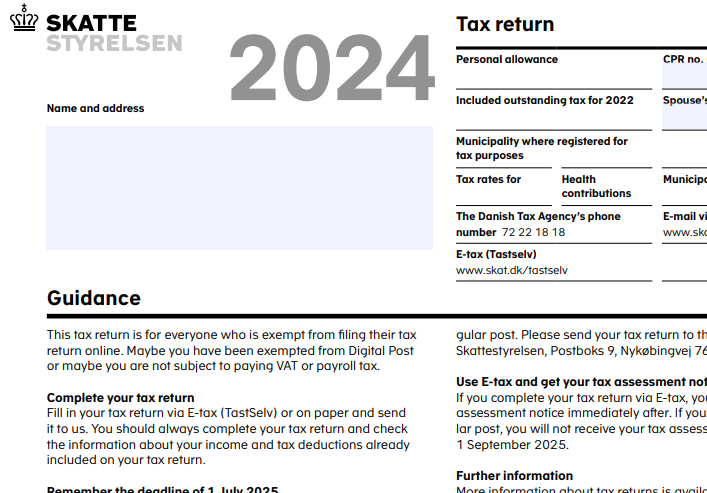
If you are a Danish tax resident — broadly, present in Denmark for more than six months in the year — you must report your crypto activity on your annual tax return, even if you also file in another country under a double-tax treaty. Non-residents are not exempt: any income from Danish platforms or Danish sources must still be reported. The filing channel is the TastSelv self-service portal, accessed with MitID.
Most taxpayers receive a pre-filled assessment notice (årsopgørelse) in TastSelv in spring. Crypto is rarely pre-filled, so the obligation to add it falls on you. SKAT places the burden of proof on the taxpayer, which is why the records step below matters more than any single number on the form.
What is the deadline to report crypto in Denmark?
Most individuals file by 1 May. The deadline extends to 1 July if you have foreign income, deductions or allowances outside Denmark, or are self-employed. Missing the deadline can trigger interest and penalties, so confirm which date applies to you well in advance (source: SKAT, skat.dk).
Do non-residents have to report crypto to SKAT?
Yes, for Danish-source income. Residents of other Nordic countries — Iceland, Norway, Finland, Sweden — with Danish earnings must report them to SKAT, whether the income is employment, self-employment, pensions, dividends, or digital assets. Foreign income is declared on the supplement SKAT designates for non-Danish income. Treaty rules, the OECD Crypto-Asset Reporting Framework (CARF), and the EU DAC8 directive increasingly share data across borders.
Step 1 — Assemble your records
Documentation is the backbone of an accurate return. For every purchase, sale, swap, or other disposal, record the core data points below. Without them, SKAT can deny deductions and assess you on the least favourable figures.
Record transfers between wallets you control too. Even when no fiat changes hands, these movements help SKAT trace the flow of assets and support your cost basis. For mined or staked coins, note the receipt date and the DKK market value at that moment; lending interest is recorded when it is credited.
Which crypto transactions are easy to forget?
The events most often missed are small but still taxable. Build them into your tracking from the start.
Step 2 — Classify each event correctly
SKAT treats most crypto as speculative or income-type activity rather than as a capital-gains asset. Gains from trading, selling, staking, lending, or mining are generally taxed as personal income, aggregated with salary, pensions, and business profit, and assessed across the progressive system up to roughly 52%. Notably, crypto gains are generally outside the labour-market contribution (AM-bidrag) that applies to wages — confirm your case with SKAT.
Are stablecoins reported differently?
They can be. Instruments SKAT classifies as financial contracts under the Capital Gains Tax Act (kursgevinstloven) — which may include certain stablecoin, futures, or margin arrangements — are taxed as capital income at roughly 42% with symmetric loss treatment, separate from the progressive brackets. The 42% rate is not "insignificant," and classification is fact-specific, so do not assume a token qualifies without confirming it.
Which cost-basis method does Denmark use?
FIFO (first-in, first-out) is the expected method, applied consistently across a holding. Because the earliest-purchased coins usually carry the lowest cost basis, FIFO can produce a larger taxable gain than other methods. Airdropped coins often carry a zero acquisition cost, which raises the gain when they are later disposed of.
Step 3 — Enter gains and losses in TastSelv
Crypto is reported inside the annual statement in TastSelv, not on a separate standalone form. Log in with MitID, open the year's return, and enter gains and losses in the fields SKAT designates for cryptoasset income and deductions. Foreign income is added on the relevant non-Danish income supplement.
After you submit, review the assessment notice TastSelv generates. If figures look wrong, you can correct the return within the amendment window. Keep your supporting records for years afterward — SKAT can review prior years, and a cost basis from 2021 may need to be evidenced when you dispose of the holding in 2026.
The mechanics of how gains are taxed and how the limited loss deduction works are covered in depth in our companion guide to how Denmark taxes crypto gains and loss deductions.
Common reporting mistakes to avoid
Most errors that lead to denied deductions or surprise assessments are avoidable with disciplined records and a correct reading of the rules.
- Assuming non-residents need not file — Danish-source and certain foreign income must still be reported.
- Omitting acquisition costs and fees, including amounts spent on gas and commissions.
- Applying the wrong cost-basis method — FIFO is expected and can increase the taxable gain.
- Weak documentation — if you cannot evidence a cost or loss, SKAT treats it as if it did not happen.
- Taxing ordinary token gains at the 42% capital-income rate when they belong in the personal-income brackets, unless they are genuine financial contracts.
- Misreading the loss rule as "only 26% of the loss counts" — the full loss is deductible, but at a tax value of about 26%.
- Relying on out-of-date form or box numbers instead of the current TastSelv fields.
Reduce future reporting pain with stablecoin lending
The hardest part of a crypto return is volume and volatility: hundreds of disposals, each needing a DKK valuation at the exact moment of the event. One way to lighten next year's filing is to favour income structures that generate fewer, cleaner, more predictable records — which is where stablecoin-denominated lending fits.
Why does stablecoin lending create cleaner records?
Interest paid in a stablecoin arrives as a defined amount at a defined time with a near-constant DKK value, so each receipt is simple to record and report. That contrasts with active trading and DeFi yield, where each swap and pool interaction can be a separate taxable event in a volatile asset. The income is still taxable — but the paper trail is far easier to file. For the wider EU picture, see our guides to Sweden's 30% crypto tax and Portugal's crypto tax regime, and our overview of P2P lending risks every investor should weigh.
About 8lends
8lends is a crypto crowdlending platform built by the team behind Swiss-based Maclear AG, giving investors access to real small and medium-sized business loans funded in USDC on the Base blockchain. Borrowers pass 40+ due diligence criteria assessed by Maclear AG and are rated on an AAA–D scale, with loans backed by real-world collateral and selected projects covered by BuyBack protection. Maclear AG operates as a financial intermediary in the non-banking sector and is a member of PolyReg SRO, under Swiss financial regulations including AML, KYC, and GDPR.