
What 40+ Due Diligence Criteria Cannot Tell an Investor

13 października 20268 min czytania
The due diligence process on 8lends screens borrowers against more than 40 criteria before listing. According to the platform, fewer than 10% of applications pass. That gives investors a useful starting point: a business has been examined before asking for their capital. It does not settle how that business will perform or what may change during the loan.
The due diligence process on 8lends screens borrowers against more than 40 criteria before listing. According to the platform, fewer than 10% of applications pass. That gives investors a useful starting point: a business has been examined before asking for their capital. It does not settle how that business will perform or what may change during the loan.
What does 8lends' due diligence actually check, and when does it happen?
Maclear AG reviews each borrower before its loan appears on the marketplace. More than 40 criteria inform the assessment and its credit rating on an AAA–D scale, where D means the application is rejected. Listing means the application met the platform’s admission requirements on the evidence reviewed.
The review checks the company’s legal identity, ownership, and control. Its operating history, credit record, and management experience are examined alongside earnings, cash flow, existing debt, and capacity to service the proposed loan.
Collateral is checked for ownership, value, ease of sale, and legal enforceability. The assessment also considers jurisdiction, market conditions, the business model, and repayment assumptions.
Strong sales may leave little cash after existing obligations, while valuable assets can be difficult to sell. Examining both the business and its collateral gives investors more context than headline figures alone.
Why is due diligence a snapshot, not ongoing supervision?
The initial assessment draws on information available before listing. A later change in the business does not automatically become part of that original judgement. 8lends does not publish a regular timetable for updating the displayed credit rating.
Maclear AG also monitors collateral during the loan term. That responsibility has a different scope from continually reassessing the borrower's finances, management, and overall creditworthiness.
A customer may stop paying. The company may take on another debt or lose a contract it expected to renew. Any of those developments could weaken repayment capacity after an application has passed review.
An unchanged rating on the project page should therefore not be read as confirmation that nothing has changed inside the business.
The platform says revised admission requirements apply to new applications, without reassessing active projects against them. Whether other circumstances trigger a fresh review, how ratings are updated, and what checks apply to repeat applications are questions for 8lends support.
Can due diligence predict whether a borrower's business will succeed?
The review examines financial health, collateral, credit history, and whether the business plan's assumptions are plausible. It can uncover weaknesses and test how repayment might hold up under pressure. It cannot know what management will decide next or whether customers will buy as much as expected.
A company can enter the loan with a credible plan and then expand too quickly. A new competitor may squeeze its margins. These are ordinary business risks, and they can develop after the documents have been checked.
Even a carefully tested plan depends on assumptions. Examining how a business might handle weaker sales is useful; the actual decline may be longer, sharper, or accompanied by another problem.
Does a high credit rating mean a loan is risk-free?
No. AAA indicates low assessed risk within the platform's scale at the time of review. The borrower still has to meet its obligations throughout a loan term of 4–16 months.
A strong rating helps an investor interpret the application. It does not promise that the conditions supporting that rating will last until the final repayment.
A due diligence check and a credit rating describe a borrower's condition at the moment of listing; they are a professional assessment, not a forecast, and they do not remove the possibility of default or loss of principal.
What sits outside borrower-level checks: industry and macro risk?
Screening can consider the borrower's country, industry, and exposure to adverse conditions. It nevertheless assesses one business. Several businesses that pass individually may remain vulnerable to the same economic event.
Imagine a portfolio containing different borrowers whose customers all depend on construction. Their finances may look acceptable at approval. A prolonged fall in construction activity could weaken demand for all of them, leaving the investor with more shared exposure than the number of loan positions suggests.
Rising financing costs can put pressure on several borrowers at once. A country-wide disruption may affect collections or make collateral harder to sell. An individual company's approval cannot remove those wider pressures.
Can due diligence see an industry downturn before it happens?
It can identify vulnerabilities and examine warning signs. It cannot reliably establish when a downturn will arrive, how long it will last, or which businesses will cope with it.
For the investor, the next question is how much capital depends on that shared exposure. Spreading holdings across borrowers, industries, countries, and repayment dates can reduce reliance on one outcome. A broad shock can still cause losses across a diversified portfolio.
What happens when a well-vetted borrower still defaults?
8lends describes default as triggered after 60 days of missed payments. What follows depends on the project: collateral realisation for standard projects, or a third-party BuyBack on selected projects. These are recovery arrangements, separate from the checks that admitted the borrower.
The collateral's earlier valuation is a reference point. The amount recovered depends on what can actually be sold and the proceeds available for distribution. A thorough assessment cannot turn that valuation into a certain future sale price.
BuyBack is provided by a third party under the relevant project terms. It is neither an undertaking by 8lends or Maclear AG nor insurance.
The platform's historical record needs the same care. As of May 2026, its borrower-selection FAQ reported zero defaults since launch on 3 March 2025. That covered roughly fourteen months, while stated loan terms run from 4 to 16 months.
Shorter loans could have matured within that period. A full sixteen-month loan issued at launch would not yet have reached scheduled maturity. The headline alone does not show how many loans had completed repayment or how concentrated those loans were.
A period without recorded defaults is useful historical information. It is too little, on its own, to establish that the assessment method has eliminated credit risk.
What should an investor do that due diligence cannot do for them?
Measure the portfolio's exposure to individual borrowers and shared economic pressures. Read the credit rating alongside the business, repayment, and collateral information.
Start with the largest borrower share. Then check for repeated exposure to one country or industry and for several loans due around the same time. These are allocation questions that a borrower review cannot answer on the investor's behalf.
Due diligence informs a crowdlending decision. How much capital to place behind that decision remains the investor's responsibility.
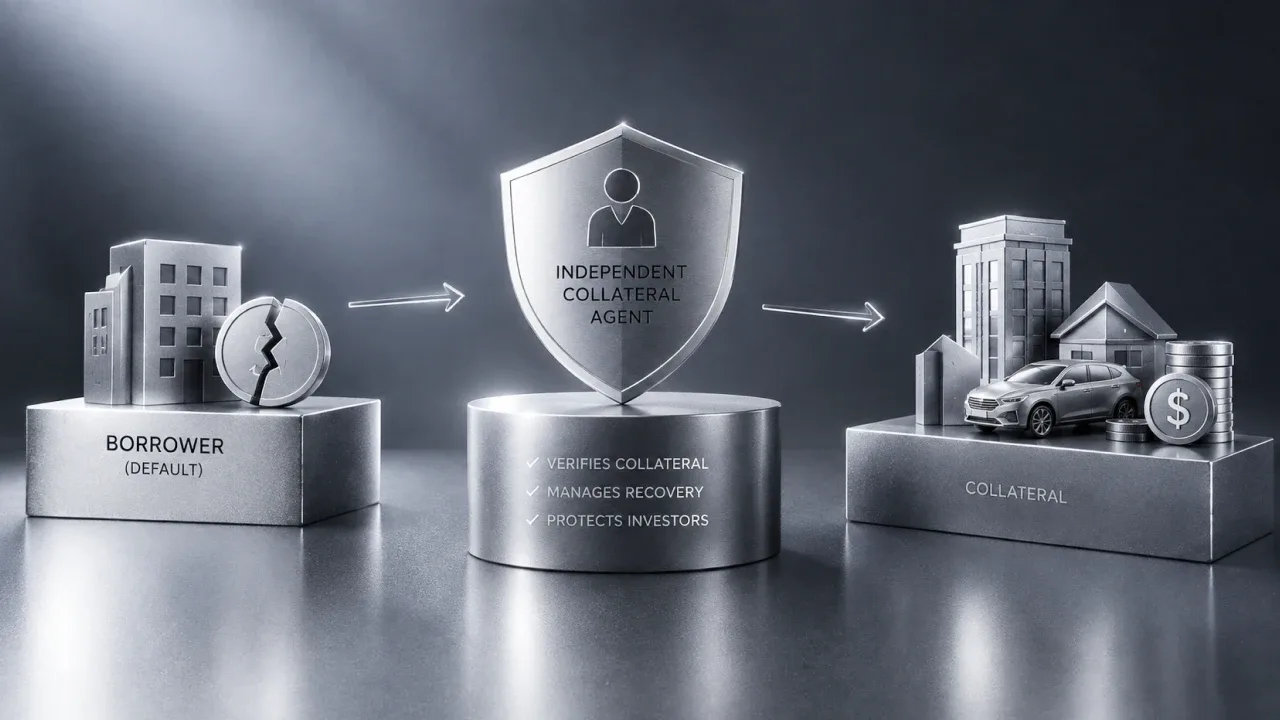
8lends is operated by CLEARCHAIN CORP, a Canadian company registered with FINTRAC as a Money Services Business (registration No. C100001102). Maclear AG (Switzerland), a member of PolyReg SRO, acts as the independent Collateral Agent — it does not operate the platform, is not its parent company, and does not hold investor funds.
Investing involves risk, including possible loss of principal. Returns are not guaranteed.
Najczęściej zadawane pytania
No. Approval means the borrower met the platform's admission requirements using the evidence reviewed before listing. The business still has to earn or collect enough money to meet its obligations. Even a highly rated borrower can encounter weaker demand, poor management decisions, or unexpected financial pressure during the loan.
8lends does not publish a regular timetable for updating displayed ratings after listing. Maclear AG's collateral monitoring is a separate responsibility and should not be mistaken for automatic rating updates. Ask 8lends support what triggers reassessment and how any changes are communicated to investors.
It cannot reliably forecast the timing or severity of a downturn. The review can include industry conditions and test adverse scenarios but several approved businesses may still experience the same drop in demand. Investors have to look at that common exposure across their holdings, rather than looking at each approval in isolation.
Recovery arrangements offer a possible route to recovering capital after the platform's 60-day missed-payment threshold. Standard projects rely on collateral realisation; selected projects have third-party BuyBack under their terms. These mechanisms are separate from due diligence and should not be treated as unconditional assurance of full recovery. BuyBack is not insurance.
When reviewing the repayment and collateral information of each project, an investor gets the chance to diversify capital over borrowers, industries, countries and maturity dates. Think of the rating as a bucket of risk that has been evaluated — not a commitment or number released for the probability of default. Diversification reduces reliance on certain outcomes, but it cannot eliminate investment risk.
No. As of May 2026, 8lends reported zero defaults since its 3 March 2025 launch: roughly fourteen months of history against loan terms of 4–16 months. That statement does not establish current performance, reveal the number of completed repayments, or predict how borrowers will respond to future economic stress.
Przeczytaj dalej


Masz pytania?
Wszystkie pytaniaPlatformę zaudytowały CertiK i Cyberscope, a wszystkie transakcje są publicznie widoczne w blockchainie Base. Za platformą stoją dwie firmy o jasno rozdzielonych obowiązkach: CLEARCHAIN CORP prowadzi platformę i jest zarejestrowana jako Money Services Business w FINTRAC (Kanada), a Maclear AG wykonuje due diligence i nadzoruje zabezpieczenie. Platforma jest więc dobrze uregulowana, przejrzysta i rozliczalna
Jeśli projekt ma BuyBack, partner odkupuje pożyczkę i zwraca 100% kapitału po 60 dniach opóźnienia lub więcej. Bez BuyBack Maclear AG rozpoczyna sprzedaż zabezpieczenia, a wpływy są dzielone proporcjonalnie między inwestorów. Od startu nie było ani jednej niewypłacalności
Platformę prowadzi CLEARCHAIN CORP, zarejestrowana w Kanadzie jako Money Services Business (MSB) i podlegająca obowiązkowym wymogom AML/CFT w ramach FINTRAC. Rozliczenia odbywają się w USD. Platforma nie jest CASP, więc wymogi DAC8 jej nie dotyczą
Małe i średnie firmy w regionach rozwijających się nie mają łatwego dostępu do finansowania bankowego i są gotowe płacić wyższe stawki niż firmy w UE czy USA
Możesz sprzedać swoją pozycję innemu inwestorowi na Secondary Market przed końcem okresu pożyczki. W Fastlending nie ma stałego terminu: kapitał i naliczony dochód można wypłacić w dowolnym momencie
Minimalna inwestycja to 100 USD
Ryzyko braku spłaty przez firmę, ryzyko zmiany wartości zabezpieczenia, ryzyko ograniczonej płynności, gdy na Secondary Market nie ma kupującego, oraz ryzyko techniczne związane ze smart kontraktem
Inwestycje od 100 do 500 USD są dostępne bez KYC. Powyżej 500 USD wymagana jest pełna weryfikacja: dokument tożsamości i potwierdzenie adresu