
What we really mean by RWA-backed loans at 8lends

May 27, 20256 min read
Our team feels the need to clarify what we mean when we say that all listed loans on the 8lends platform are backed by real-world collateral.Simply put, that’s exactly why this article appeared here, for those investors who are interested in Web3 opportunities.
Firstly, what is RWA?
RWA stands for Real-World Assets.
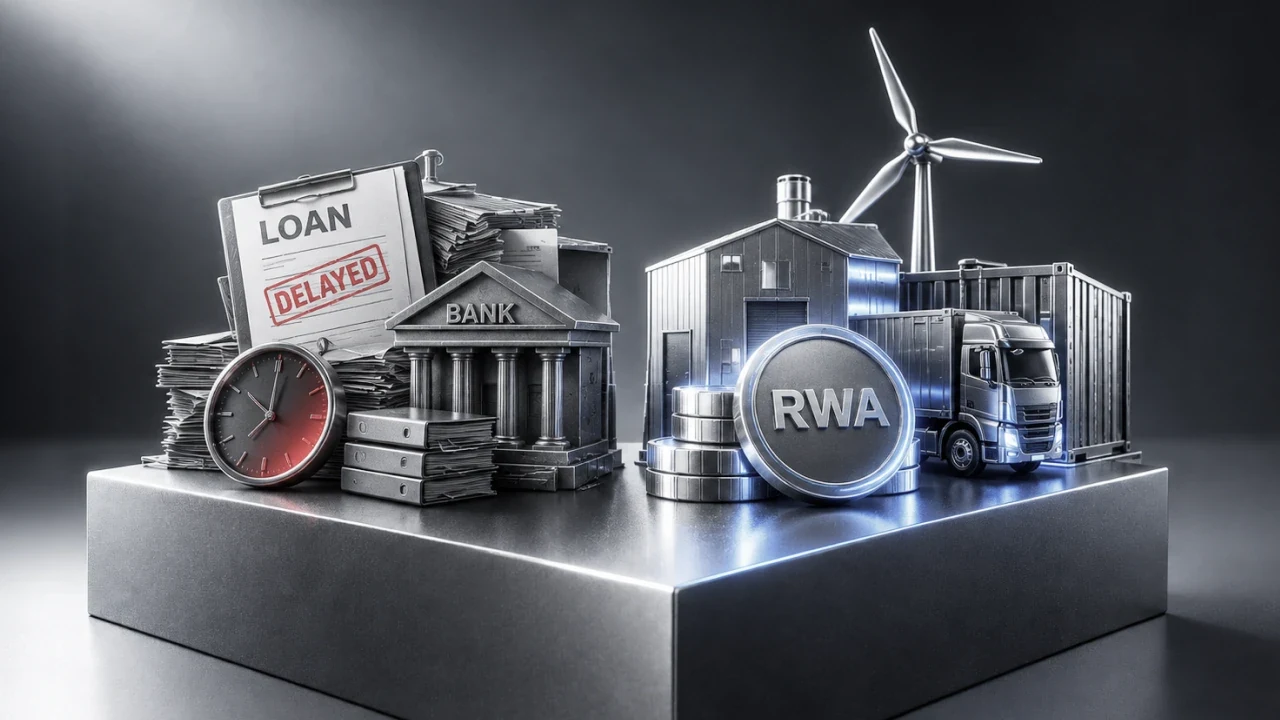
At 8lends, when we say loans are RWA-backed, we’re not talking about digital issuance, blockchain-related securities, or purely digital assets. We’re referring to real businesses operating offline that secure their loans with tangible, verifiable assets — such as property, equipment, machinery, inventory, and the company’s own capital.
To be even more precise: it’s all about real, legally enforceable security mechanisms. Settlement still happens in digital dollars (USD) on the Base network, so the two sides of the model fit together: the money moves on-chain, the security sits in the physical world.
What can actually be pledged
Not every asset a business owns makes usable security. What matters is whether the asset can be identified, valued, and sold if the borrower stops paying. In practice, that means:
- Equipment and machinery — identifiable by serial number, with a resale market and a predictable depreciation curve.
- Vehicles and transport — registered, easy to trace, straightforward to liquidate.
- Real estate — the slowest to sell, but usually the most stable in value.
- Inventory and stock — only where storage and turnover can be verified; value moves with the season and the market.
- Receivables and the company’s own capital — used as supporting security rather than as the main pledge.
Where several assets are pledged together, they are assessed as a package, because a package behaves differently in a forced sale than any single item.
How 8lends works with RWA
We put investor security first, and that means process rather than promises:
- Loan collateral is legally and physically formalised — the same way it is secured at Maclear.
- The pledge is held by an independent Collateral Agent, Maclear AG (Basel, Switzerland), supervised by PolyReg SRO — not by the platform that lists the loan.
- Every claim is backed by verified documents: ownership, valuation, insurance where applicable.
- We run on-site inspections to confirm that the borrower is real and that the pledged collateral actually exists.
- Each borrower passes an assessment built on more than 40 criteria before a project is listed.
Before any project appears on the platform, the collateral is checked as real, properly assessed, and enforceable under legal agreements.
Valuation and loan-to-value: the number that matters
Collateral is only meaningful next to the size of the loan. That relationship is the loan-to-value ratio (LTV): the loan amount divided by the assessed value of the pledge.
Two things are worth understanding about that number. First, the value used is not the price the owner hopes for — it is what the asset would realistically fetch in a forced, time-limited sale, which is always below open-market price. Second, a lower LTV leaves more room for the sale to disappoint and still return the principal.
A simple illustration. On a loan of 100 000 USD against collateral assessed at 200 000 USD, the LTV is 50%. If the asset sells at full assessed value, the principal is covered with a wide margin. If it sells at a 30% discount — 140 000 USD — the principal is still covered. At a 50% discount — 100 000 USD — it is covered with nothing to spare, before recovery costs. These figures are an illustration of the method, not a forecast of any particular loan.
What happens if a borrower stops paying
The sequence is defined in advance, so nobody has to improvise:
- A missed payment triggers reminders and direct contact with the borrower.
- After 60 days of missed payments the loan is treated as defaulted.
- Recovery moves to the independent Collateral Agent, which enforces the pledge under the security agreements.
- Where BuyBack applies, the position is bought out by a third party — not by the platform itself.
Recovery is a legal process, not a switch. It takes time, it carries costs, and the amount returned depends on what the collateral realises.
What RWA-backed does not mean
Being honest about the limits is part of the model:
- It is not deposit insurance. There is no state compensation scheme behind these loans.
- It is not a guarantee of return. Collateral improves the odds of recovering principal; it does not promise it.
- It is not instant liquidity. Exiting before maturity is only possible through the Secondary Market, where the seller pays a 10% fee and may need to accept a discount.
- It is not a substitute for diversification. Spreading across several loans matters more than the quality of any single pledge.
Capital is at risk. Never invest more than you can afford to lose.
Why it matters for blockchain-based P2P investors
RWA-backed loans offer investors something valuable today — verifiable security and a clear line of sight into what the money funds.
- The collateral is tangible, identifiable, and independently assessed.
- Investors can see what their funds are used for and what stands behind the claim.
- Payments arrive monthly in digital dollars (USD) on the Base network, at a rate fixed before the investment is made.
This creates a transparent structure with nothing hidden behind it — which matters most when the borrower is a small or medium-sized business.
Digital technologies such as automation and on-chain settlement help manage an investment, but they are tools. They do not replace real assets, which remain the core of how we secure a loan.
What’s our take on digital issuance and blockchain
We follow the growth of decentralised lending protocols and RWA digital issuance closely, and these technologies may open opportunities for scaling the platform in future.
At the current stage, widespread digital issuance in SME lending is not yet practical, for three reasons:
- Legal restrictions
- Technical challenges
- Market limitations
For now, real-world collateral verified through traditional legal channels remains the most reliable way to offer protected investment opportunities to our community.
Why 8lends
8lends is operated by Alpha Systems LLC (Saint Vincent and the Grenadines), a virtual asset service provider supervised by the FSA SVG. Collateral is held by Maclear AG (Basel), the independent Collateral Agent supervised by PolyReg SRO. Settlement is handled by CLEARCHAIN CORP (Canada), registered with FINTRAC as a money services business. Investors from the EU access the platform on their own initiative under the reverse solicitation provisions of Article 61 MiCA.
Investing through the platform, you get:
- Fixed rates in the range of 19–25% APR, set before you invest — not a variable estimate.
- Interest paid monthly in digital dollars (USD), with settlement recorded on the Base network.
- Entry from 100 USD and loan terms of 4 to 16 months.
- No commission charged to the investor; the 3% origination fee is paid by the borrower.
- Every loan secured by real-world collateral held by an independent Collateral Agent.
These features come with the same standards, guidelines and protections we apply at Maclear.
Read next on 8lends
Read next

Do You Have Any Questions?
All questionsThe platform has been audited by CertiK and Cyberscope, and all transactions are publicly visible on the Base blockchain. Two companies with clear responsibilities stand behind the platform: CLEARCHAIN CORP operates the platform and is registered as a Money Services Business with FINTRAC (Canada), and Maclear AG conducts due diligence and monitors collateral. So the platform is well regulated, transparent and accountable
If the project has BuyBack, the partner buys the loan and returns 100% of the principal once it is overdue for 60 days or more. Without BuyBack, Maclear AG initiates the sale of the collateral, and the proceeds are distributed proportionally among investors. Since launch there have been no defaults
The platform is operated by CLEARCHAIN CORP, registered in Canada as a Money Services Business (MSB) and subject to mandatory AML/CFT compliance requirements under FINTRAC. Settlements are made in USD. The platform is not a CASP, so DAC8 requirements do not apply
Small and medium-sized businesses in developing regions do not have easy access to bank financing and are willing to pay higher rates than businesses in the EU or US
You can sell your position to another investor through the Secondary Market before the end of the loan term. With Fastlending there is no fixed term: the principal and accrued income can be withdrawn at any time
The minimum investment is 100 USD
Risk of non-payment by the business, risk of changes in the value of the collateral, risk of limited liquidity if there is no buyer on the Secondary Market, and technical risk associated with the smart contract
Investments from 100 to 500 USD are available without KYC. For amounts over 500 USD, full verification is required: an identity document and proof of address