
What a Blockchain-Powered Lending Platform Actually Records
September 30, 20269 min read
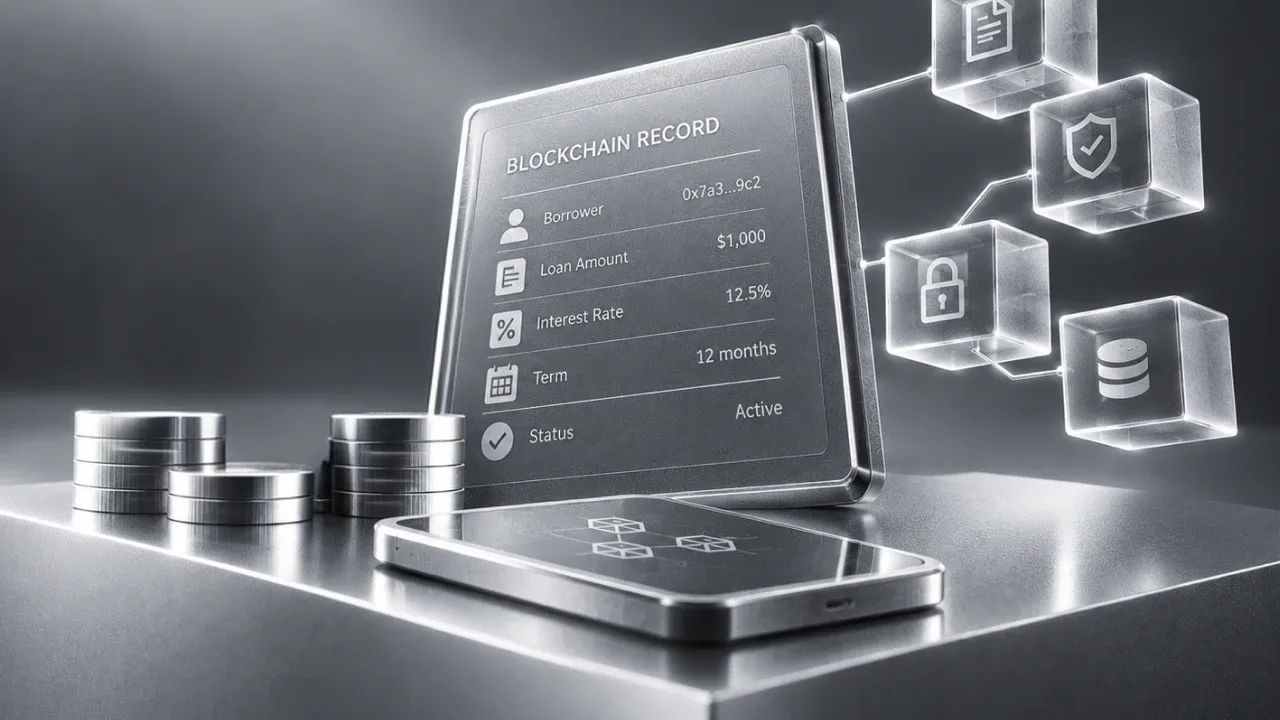
A blockchain-powered lending platform records some parts of a loan in a public blockchain layer and leaves others off-chain. Investor participation and payout distribution can be checked independently, while underwriting, collateral paperwork, and recovery remain legal or operational processes. That split matters because transparency is not the same thing as putting the whole loan on-chain.
A blockchain-powered lending platform records some parts of a loan in a public blockchain layer and leaves others off-chain. Investor participation and payout distribution can be checked independently, while underwriting, collateral paperwork, and recovery remain legal or operational processes. That split matters because transparency is not the same thing as putting the whole loan on-chain.
What does "blockchain-powered" mean on a lending platform?
A blockchain lending platform does not place every part of a loan into one public record. In practice, blockchain-powered lending usually means that selected events — such as participation records or payout activity — are written on-chain, while the borrower assessment, contracts, collateral, and recovery process remain outside that layer.
The blockchain record can show that a transaction happened or that a participation was recorded. It cannot show whether the borrower passed a sound credit review, whether collateral was properly documented under local law, or what would happen if repayment stopped.
So the term describes part of the infrastructure, not the whole lending relationship. Some facts can be checked directly; others still depend on the operator, the Collateral Agent, and the legal documents behind the loan.
Does a blockchain record guarantee that a loan will be repaid?
No. A blockchain record can confirm that a recorded transaction took place, but it does not say whether the borrower will make the next payment.
The borrower's ability to repay, the value of the collateral, and the outcome of any recovery process sit outside that record. The technology can make certain events easier to verify, but it does not turn them into a repayment guarantee.
Which loan events are actually recorded in the blockchain layer?
Different parts of the loan sit in different places. Participation records and scheduled payouts can be written on-chain, while borrower assessment, legal agreements, and recovery work stay off-chain.
The table below shows how loan participation is recorded, which events can be checked through a public block explorer, and where investors still have to rely on legal or operational information.
| Loan Event | Recorded on-chain? | Where it lives | Investor can verify independently? |
|---|---|---|---|
| Borrower application and underwriting | No | Internal assessment by the operator and agent | No, only the published outcome |
| Loan agreement and collateral paperwork | No | Legal contract under the borrower's jurisdiction | No, relies on the agent's process |
| Disbursement of funds to the borrower | Partially | Transfer visible on-chain; conditions are not | Partially; transaction hash is public, conditions are not |
| Investor's share in the loan (participation) | Yes | Recorded against the smart contract address | Yes, through a public block explorer |
| Scheduled payouts to investors | Yes | Distributed and logged through the smart contract | Yes, traceable on-chain |
| Early sale of a loan claim (secondary transfer) | Yes, if supported on-chain | Recorded as a transfer between addresses | Yes, if the mechanism is on-chain |
| Recovery and collateral liquidation after default | No | Legal process run by the agent | No, only reported outcomes |
This is the practical boundary of the public record. A transaction hash can confirm that a transfer occurred, but it does not reveal the terms behind it. The same applies to participation: the blockchain layer can show the record, while the legal structure of the loan remains off-chain.
Can I see my share of a loan without asking the platform?
Yes, where the participation is tied to a public smart contract address. An investor can use a block explorer to check the relevant record directly instead of relying only on what appears in the platform interface.
That check has a limited scope. It confirms the recorded participation, not the legal status of the collateral, the underwriting, or the progress of a recovery case.
What does a smart contract do in loan servicing, and what does it not do?
A smart contract is mainly used to keep track of the accounting side of the loan. It records who holds a participation and applies the agreed payout rules when money is received.
That is the practical role of smart contract loan servicing. If a payment comes in, the contract can allocate it between investors according to the set rules and leave a record of that transaction on-chain.
Its role stops well before credit decisions or enforcement. It does not judge whether a borrower is creditworthy, decide whether the collateral is sufficient, or determine what should happen after a missed payment.
And if the borrower does not pay, there is nothing for the contract to distribute. It cannot produce the missing funds or start recovery by itself.
Does the smart contract enforce repayment from the borrower?
No. Repayment still has to be dealt with through the loan agreement and the legal process that applies to the borrower and the collateral.
The smart contract can show what happened before the missed payment and continue to record transactions that actually take place. It cannot contact the borrower, take control of pledged assets, bring a legal claim, or take over the work of the Collateral Agent.
What can an investor verify independently, and what requires trust in the operator?
The easiest things to verify are the events that appear in the public blockchain record. An investor can check, for example, whether a participation has been recorded, whether a supported transfer took place, or whether a payout was logged through the smart contract.
Other parts of the loan are not visible in the same way. The underwriting file, the collateral documents, and any recovery work sit outside the public record. For those, the investor still depends on information from the operator, the Collateral Agent, and the underlying legal documentation.
This is where transparency in lending platforms has a natural limit. The blockchain layer makes certain transactions easier to inspect, but not the entire credit relationship.
Why doesn't the collateral agreement itself live on the blockchain?
Because the collateral agreement has to be valid under the law that applies to the borrower or the pledged asset. In some jurisdictions, that may mean signatures, registrations, notices, or other formal steps before the security can be enforced.
A blockchain record cannot replace those requirements. It can record events connected with the loan, but the legal right over the collateral still comes from the contract and the relevant local law.
A blockchain record confirms that a transaction happened – it does not confirm that a borrower will repay, and it is not a substitute for legal collateral enforcement.
What questions should you ask any platform that calls itself "blockchain-powered"?
A useful review starts with five fairly simple questions. They show whether the platform is clear about what sits in the public record and what still happens through contracts, internal procedures, or third parties.
- Which loan events are recorded in the blockchain record, and which remain off-chain? A clear answer should separate the accounting layer from underwriting, legal documentation, and recovery.
- Can investors verify their own loan participation through a public block explorer? If the participation is recorded on-chain, there should be a practical way to inspect it independently.
- Who legally creates the collateral claim, and which jurisdiction governs it? This matters because collateral rights depend on local law and legal documentation, not on the transaction record alone.
- Is there a separate legal recovery process if the borrower stops paying? The platform should explain who deals with the borrower and collateral once the issue moves beyond the blockchain layer.
- Does the platform publish the smart contract address and payout history? Those details make it possible to check whether the events described as public are actually traceable.
These questions make the label more concrete: investors can see what is recorded, what can be verified, and where trust is still required.
What happens to the record when a loan is not repaid on schedule?
A missed repayment does not erase the blockchain history or change transactions that have already been recorded. The existing record stays in place, while the response to non-payment happens outside that layer.
If no repayment arrives, there is no new amount for the smart contract to distribute. The accounting trail remains intact, but the loan itself moves into a legal and operational recovery process.
On 8lends, those recovery and collateral matters sit with an independent Collateral Agent rather than with the smart contract. The public record can still show what happened before default; it cannot carry out the recovery itself.
This platform is operated by a licensed entity registered as a VASP under FSA supervision (Saint Vincent and the Grenadines). An independent Collateral Agent in Switzerland, a PolyReg SRO member, handles collateral and recovery. Returns are not guaranteed and involve risk of loss.
Frequently Asked Questions
It means that selected parts of the lending process are recorded in a blockchain layer and can be checked independently. These may include an investor's participation and payout distribution. Borrower underwriting, loan agreements, collateral documentation, and recovery remain off-chain, so investors still rely on the operator and Collateral Agent for those parts of the process.
Generally, yes, if the participation is recorded against a publicly accessible smart contract address. The investor can use a block explorer to inspect that record directly. This does not independently verify the collateral's legal status or any recovery proceedings, because those matters sit outside the public blockchain layer.
No. The smart contract records participation and applies the agreed accounting and payout rules once funds are available. It cannot make the borrower pay, assess the borrower's ability to repay, or carry out legal enforcement after a default. Repayment still depends on the borrower and the obligations in the loan agreement.
The borrower's obligation is created through a legal agreement governed by a particular jurisdiction. Such documents may require signatures, registrations, or other formalities that have legal effect under local law. The blockchain record can document transactions related to the loan, but it does not replace the contract itself.
The existing record stays in place because it reflects transactions that have already happened. A missed repayment does not erase or rewrite that history. Contact with the borrower, enforcement, and collateral liquidation take place outside the blockchain layer through the relevant legal process and the independent Collateral Agent.
Read next


Do You Have Any Questions?
All questionsThe platform has been audited by CertiK and Cyberscope, and all transactions are publicly visible on the Base blockchain. Two companies with clear responsibilities stand behind the platform: CLEARCHAIN CORP operates the platform and is registered as a Money Services Business with FINTRAC (Canada), and Maclear AG conducts due diligence and monitors collateral. So the platform is well regulated, transparent and accountable
If the project has BuyBack, the partner buys the loan and returns 100% of the principal once it is overdue for 60 days or more. Without BuyBack, Maclear AG initiates the sale of the collateral, and the proceeds are distributed proportionally among investors. Since launch there have been no defaults
The platform is operated by CLEARCHAIN CORP, registered in Canada as a Money Services Business (MSB) and subject to mandatory AML/CFT compliance requirements under FINTRAC. Settlements are made in USD. The platform is not a CASP, so DAC8 requirements do not apply
Small and medium-sized businesses in developing regions do not have easy access to bank financing and are willing to pay higher rates than businesses in the EU or US
You can sell your position to another investor through the Secondary Market before the end of the loan term. With Fastlending there is no fixed term: the principal and accrued income can be withdrawn at any time
The minimum investment is 100 USD
Risk of non-payment by the business, risk of changes in the value of the collateral, risk of limited liquidity if there is no buyer on the Secondary Market, and technical risk associated with the smart contract
Investments from 100 to 500 USD are available without KYC. For amounts over 500 USD, full verification is required: an identity document and proof of address