
What Happens Before a Loan Default Is Officially Declared
November 5, 20268 min read
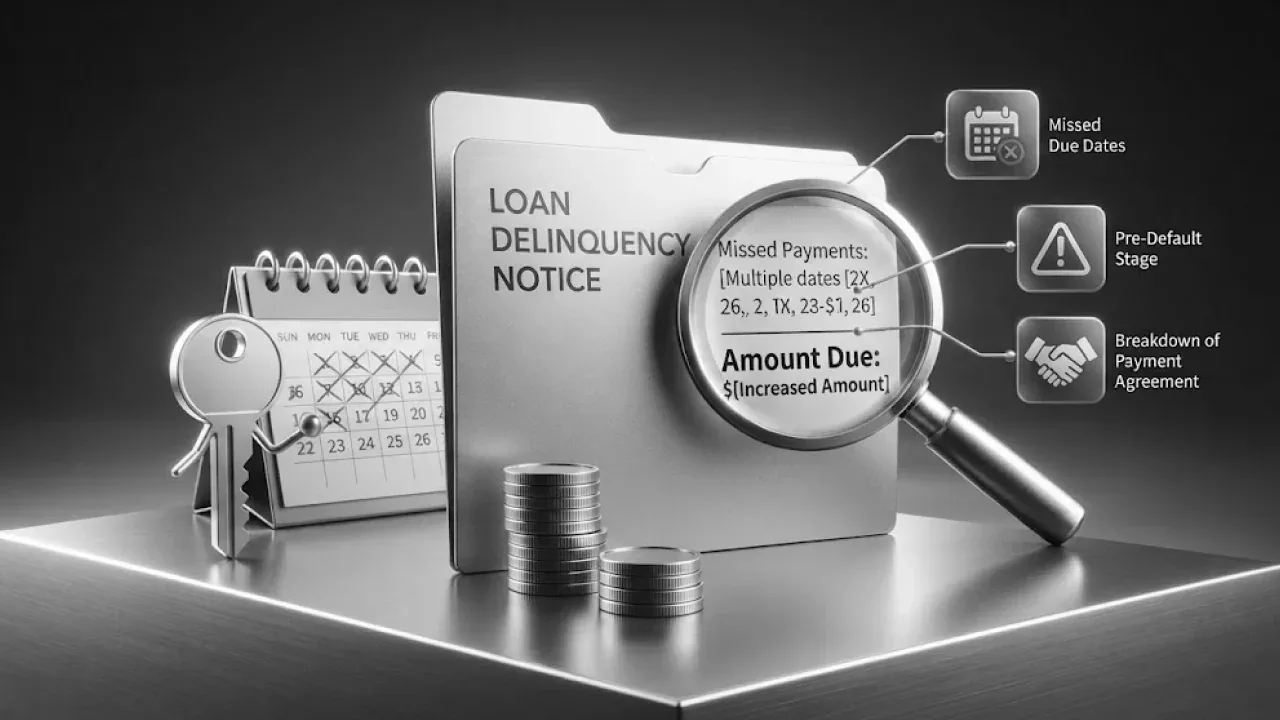
Days 1–59 overdue are the late stage; day 60 starts default and collateral recovery. What a missed payment means in between, and how little the investor controls in that window.
Missing a payment is not the same as losing money. On 8lends, a loan moves into default when a payment is 60 days overdue: a procedural threshold, not the moment capital is lost. Before day 60, the loan is late, and the investor has very little control over what happens next.
What does a late payment mean before a loan defaults?
A late payment means money due under the repayment schedule has not arrived. It establishes that the borrower has missed an obligation. It does not, by itself, establish whether the delay is temporary, whether the borrower can catch up, or how much investors will ultimately receive.
Understanding what happens before a loan default starts with keeping those questions separate. On 8lends, days 1–59 of overdue payment belong to the late stage. The default threshold is reached at 60 days overdue, rather than immediately after the first missed payment.
Does a missed payment mean I've lost my money?
No. A payment delay puts the expected cash flow in doubt, but it is not a final calculation of lost principal. Your capital remains at risk. Equally, being below the default threshold does not establish that repayment will arrive before that threshold is reached.
| Status | What it means | What the investor can do |
|---|---|---|
| On time | Payments arrive according to the agreed schedule. | No action is required because of payment status. |
| Late — days 1–59 | A payment is overdue, but the default threshold has not been reached. | Monitor the position’s status and available updates. |
| Default — day 60 onward | The threshold has been reached and collateral recovery begins. | Follow recovery updates; see the separate explanation of collateral and recovery. |
Late payment vs default is therefore a distinction between stages, not between an investment that carries risk and one that suddenly acquires it. Default is also different from a final loss. See the guide to default rates and recovery.
Why does 8lends use a 60-day default threshold?
The 60-day threshold separates an overdue payment from the formal stage that triggers collateral recovery. Without that distinction, the first delay would immediately trigger recovery.
In lending generally, a missed payment can reflect a temporary cash-flow problem or a more serious inability to meet obligations. The passage of time helps distinguish those situations, although elapsed days alone cannot establish the borrower’s complete financial position.
Why does 8lends wait 60 days before declaring default?
Because 60 days overdue is its procedural trigger for default and the move into recovery. It allows a late-payment stage before that escalation. This describes the function of the threshold; it does not imply that every borrower below it is capable of repaying, or that every borrower crossing it will produce a total loss.
For an investor asking how long before a loan is considered in default, the relevant answer here is 60 days of overdue payment. The clock concerns the missed obligation, not when you noticed it.
The threshold is not a promise of repayment within a grace period. It tells you when the classification changes if the overdue payment remains unresolved.
What typically happens between a missed payment and day 60?
In lending generally, the loan delinquency period is used to establish why a payment was missed and whether the borrower can remedy it. Typical activity can include contacting the borrower, checking the explanation for the delay and discussing how the overdue amount might be paid.
These are general lending practices, not a confirmed schedule of actions taken by 8lends. A late status alone does not confirm whether the borrower has received reminders, incurred penalties, or discussed revised repayment terms.
Does a borrower explanation mean the delay is resolved?
No. An explanation, a proposed payment date, and an actual payment are different things. In lending generally, a borrower may explain that an expected customer payment has been delayed. That explanation can help assess the situation, but it does not supply the missing funds or establish that the revised date will be met.
Likewise, a discussion about revised terms is not the same as an agreed restructuring. Do not assume that a late status means new terms have been approved.
For investors trying to understand what happens when a loan payment is late, the distinction is between a reported intention and a completed event. Read available updates for what they actually confirm. Where no detail is provided, the status alone cannot tell you which conversations have happened or how they will end.
Can you sell a loan once a payment is late?
A late position can formally be offered on the secondary market, but access to a marketplace does not mean there is a buyer. The overdue status is visible to potential purchasers and affects their assessment of the claim.
A buyer considering a troubled loan is taking on uncertainty about repayment and timing. In lending markets generally, that uncertainty can reduce demand or lead buyers to seek a discount.
Can I sell a loan on the secondary market once a payment is late?
Formally, yes, but completing a sale depends on another investor accepting the position and its price. You cannot assume that a late loan will sell as readily as an otherwise comparable position whose payments are current.
A listing is therefore an attempt to transfer the claim, not a withdrawal request. Until a sale completes, it has not released your invested principal.
A discount and applicable selling fees can reduce the proceeds you receive. The separate guide to selling a loan early covers the mechanics. Access to the secondary market does not establish that a particular late position will sell.
What can an investor actually do while a loan is late?
In practice, very little beyond monitoring the position and reading available updates. An individual investor cannot make the borrower pay, choose the timing of its cash receipts, or move the formal default threshold.
Review the scheduled payment date, the current overdue status, and any confirmed information attached to the position. If an update is unclear, asking for clarification can help you understand it. It does not give you control over the borrower’s finances.
A late payment is not a default and does not by itself mean capital is lost - but it is also not a signal to invest more in the same borrower; the only responsible action during this window is to wait for the status to resolve, one way or the other, by day 60.
Here, resolving the status means either the overdue payment is remedied or the default threshold is reached. It does not mean your money must be recovered by day 60. Monitoring and seeking clarification remain possible; neither is a repayment mechanism.
Who is this explanation for, and who is it not for?
It is for an investor who wants to understand the boundary between a delayed payment and a declared default before drawing conclusions about a position. It cannot provide assurance that a late loan will avoid default or instructions for rescuing it by supplying more capital to the same borrower.
What happens when the loan reaches day 60 overdue?
At 60 days overdue, the loan enters default, and collateral recovery begins under the independent Collateral Agent. That process can take 1–12 months; it is not an immediate repayment event. Real-world assets provide collateral that reduces risk, but they do not eliminate the possibility of loss or assure full repayment. See the collateral FAQ, the collateral mechanics explainer, and the separate article on what happens when a borrower defaults for the next stage.
The 8lends platform is run by CLEARCHAIN CORP, registered in British Columbia, Canada, and registered with FINTRAC as a money services business. Maclear AG (Switzerland), a member of PolyReg SRO, acts as the independent Collateral Agent; it does not operate the platform, is not its parent company, does not hold investor funds and is not directly licensed by FINMA.
Investing in business loans involves risk, including possible loss of principal. A fixed rate describes loan terms, not a guaranteed outcome, and collateral does not guarantee full recovery.
Frequently Asked Questions
No, a missed payment does not by itself establish a loss of capital. Before 60 days overdue, the position is late rather than formally defaulted. Your money remains at risk, and repayment is uncertain. Reaching default also does not determine the final loss, because recovery is a separate stage.
The 60-day threshold separates the late-payment stage from formal default and the start of collateral recovery. A temporary delay does not necessarily establish lasting inability to pay. However, the threshold is a procedural rule, not confirmation that a borrower will recover financially or repay before day 60.
Yes, formally you can offer a late position, but a completed sale requires a willing buyer. Potential buyers see the overdue status and may seek a lower price or decline to buy. Secondary-market availability therefore does not mean the position can be sold promptly or at its original value.
Your practical options are limited to monitoring the position, reading updates, and seeking clarification where needed. You cannot direct repayment or accelerate the default threshold. Avoid treating additional investment in the same borrower as a way to rescue the existing position; it does not make the overdue payment arrive.
Collateral recovery begins under the independent Collateral Agent once the 60-day overdue threshold is reached. The process can take 1–12 months, and its outcome is not assured. Default changes the procedural stage; it does not establish how much capital will ultimately be recovered or when you will receive it.
Read next



Do You Have Any Questions?
All questionsThe platform has been audited by CertiK and Cyberscope, and all transactions are publicly visible on the Base blockchain. Two companies with clear responsibilities stand behind the platform: CLEARCHAIN CORP operates the platform and is registered as a Money Services Business with FINTRAC (Canada), and Maclear AG conducts due diligence and monitors collateral. So the platform is well regulated, transparent and accountable
If the project has BuyBack, the partner buys the loan and returns 100% of the principal once it is overdue for 60 days or more. Without BuyBack, Maclear AG initiates the sale of the collateral, and the proceeds are distributed proportionally among investors. Since launch there have been no defaults
The platform is operated by CLEARCHAIN CORP, registered in Canada as a Money Services Business (MSB) and subject to mandatory AML/CFT compliance requirements under FINTRAC. Settlements are made in USD. The platform is not a CASP, so DAC8 requirements do not apply
Small and medium-sized businesses in developing regions do not have easy access to bank financing and are willing to pay higher rates than businesses in the EU or US
You can sell your position to another investor through the Secondary Market before the end of the loan term. With Fastlending there is no fixed term: the principal and accrued income can be withdrawn at any time
The minimum investment is 100 USD
Risk of non-payment by the business, risk of changes in the value of the collateral, risk of limited liquidity if there is no buyer on the Secondary Market, and technical risk associated with the smart contract
Investments from 100 to 500 USD are available without KYC. For amounts over 500 USD, full verification is required: an identity document and proof of address