
29 września 20269 min czytania
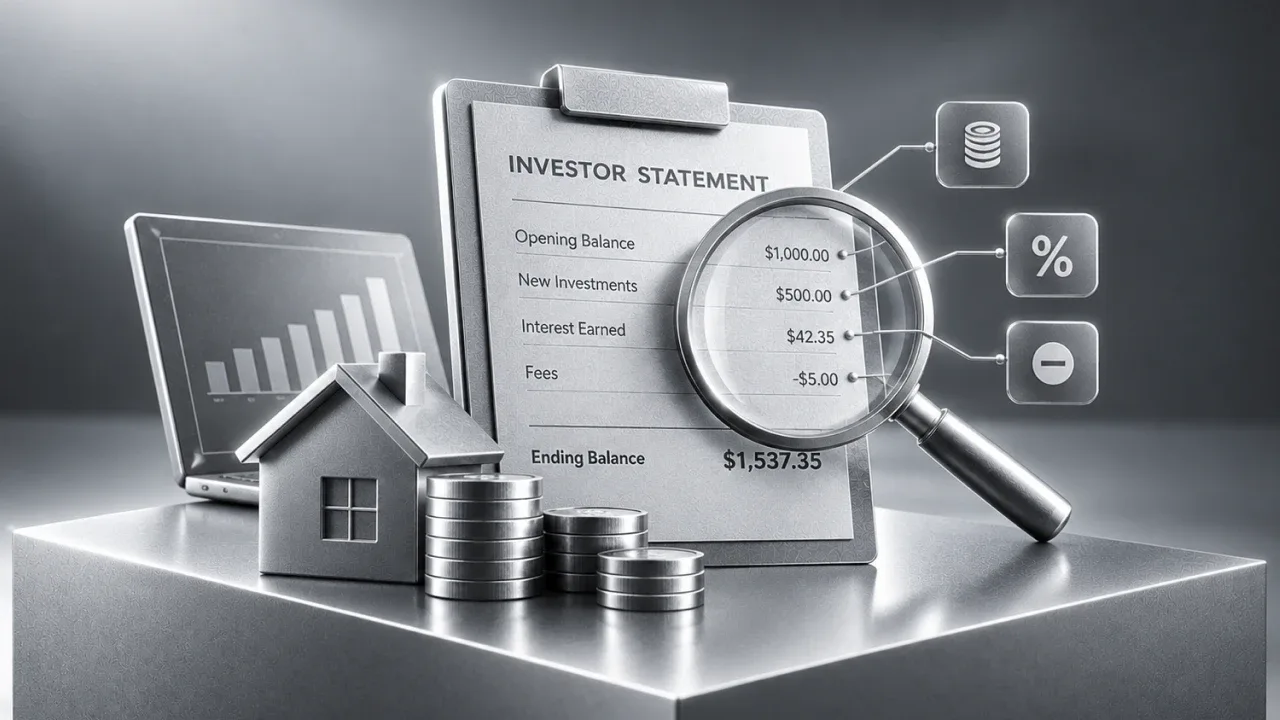
An investor statement on a lending platform lists at least three distinct entry types that require different treatment: principal repayment, which returns capital and is not income; accrued interest, which is income and is typically taxable; and platform fees or deductions. Reconciling each line against the loan schedule prevents overstated returns and incorrect tax filings.
An investor statement on a lending platform lists at least three distinct entry types that require different treatment: principal repayment, which returns capital and is not income; accrued interest, which is income and is typically taxable; and platform fees or deductions. Reconciling each line against the loan schedule prevents overstated returns and incorrect tax filings.
What Shows Up on a Lending Platform Investor Statement?
An investor statement records movements connected to each funded loan over a chosen period. Those movements are not all income.
Some lines show capital being committed or returned. Others show interest earned. A separate group covers transaction-specific fees, deductions, promotional credits, or proceeds from an early sale.
The table below therefore describes each line by substance rather than claiming exact interface wording.
| Statement line | What it means | Income or return of capital | Effect on your return calculation |
|---|---|---|---|
| Funds committed to a loan | Capital is allocated to a funded loan | Neither income nor repayment; this is principal at risk | Establishes the capital base against which later cash flows are measured |
| Scheduled interest payment | Interest paid according to the funded loan's schedule | Income | Counts toward realized income for the period |
| Principal repayment | Part or all of the investor's original capital is returned | Return of capital, not income | Reduces the amount of capital still exposed to the loan; it is not added to investment income |
| Early repayment by the borrower | Borrower repays before the original maturity date | Principal is return of capital; interest is income | Shortens the actual holding period and changes annualized calculations |
| Sale of a claim before maturity | The claim is sold through the Secondary Market, replacing the remaining scheduled payments with the sale proceeds | The transaction result is separate from ordinary loan interest | Reconcile the sale separately from scheduled interest and principal payments |
| Platform fee or deduction | A deduction linked to the transaction to which it applies | Transaction-specific expense or deduction | Reduces the result of that transaction; it should not be applied automatically to unrelated interest or principal entries |
| Bonus credit | Promotional credit not generated by the interest or principal of a specific loan | Separate promotional amount | Keep separate from loan return calculations to avoid overstating loan performance |
The practical rule is simple: classify the line before adding it to any return figure. Cash arriving in the account is not automatically investment income.
Why Is a Principal Repayment Not Investment Income?
Principal repayment returns money that already belonged to the investor. It restores previously committed capital rather than creating new income.
If an investor commits 1,000 to a loan and later receives 1,000 of principal back, the position has returned the original capital. Adding that 1,000 to interest income would make the loan appear to have generated a return that never existed.
This distinction matters most when several loans repay during the same reporting period. A statement can show a large amount of incoming cash even though only a small portion represents earned interest.
Is Principal Repayment Taxable Income?
Principal itself is generally a return of invested capital rather than interest income, but tax treatment depends on the investor's jurisdiction and circumstances.
The statement should therefore separate principal from income before any tax calculation is attempted. This article does not provide jurisdiction-specific tax advice. Investors should use the relevant tax guidance for their country or consult a qualified tax professional when classifying reportable amounts.
What Counts as Accrued Interest, and When Is It Paid?
Interest follows the loan schedule, but the date it is accrued and the date it reaches the investor do not always need to be identical.
A statement may therefore distinguish between interest that has been earned according to the schedule and interest that has actually been paid. That timing difference is not necessarily an error.
For return calculations, realized income for a period should be reconciled against actual payouts rather than assumed from the scheduled amount alone.
What Is Accrued Interest, and Does It Appear Before Payout?
Accrued interest is interest that has accumulated according to the loan terms but has not yet been paid to the investor.
It can therefore appear as an amount associated with the period before the corresponding payout is recorded. The lag matters when reconciling month-end or year-end statements: counting accrued interest once and then counting the later payment again would duplicate the same economic income.
How to Reconcile a Statement for the Period With the Loan Schedule
Reconciliation works best loan by loan rather than by looking only at the total amount credited during the period.
Start with the statement for the reporting period, then open the repayment schedule for each relevant loan. Match every statement entry to the event expected from that schedule: interest, principal, an early repayment, or another transaction.
Next, total income separately from returned principal. Do not combine the two into one figure.
Normal timing differences can explain many mismatches. A scheduled payment may post a few days later than expected. Interest may be accrued but not yet paid. A loan may have been repaid early, or a claim may have been sold before the end of the period.
Why Does My Statement Not Match the Loan Schedule Exactly?
The most common causes are timing and status differences rather than calculation errors.
A payment can be scheduled in one period but credited in the next. Interest can be recorded as accrued before it is paid. Early repayment or sale of a claim can also replace the remaining expected schedule with a different set of cash flows.
If none of those explanations fits, the better next step is to contact support with the specific loan and reporting period rather than reconstruct the figures manually after the fact.
What Fees or Deductions Appear on the Statement?
A fee or deduction should be linked only to the transaction that actually generates it. It should not be treated as a general reduction of every interest or principal payment unless the platform terms explicitly say so.
On 8lends, investors pay no platform fee for registering, investing, receiving payouts, or withdrawing funds. The platform charges the borrower 3% of the raised amount once a loan pool closes successfully. The costs an investor does carry are network gas fees on Base, usually a few cents paid in ETH, and the 10% seller fee when a claim is sold through the Secondary Market.
The same separation applies to promotional credits. A bonus amount is not interest produced by the underlying loan and should not be added to the loan's performance figure.
Does Selling a Claim Early Change the Payout Structure?
Yes. Once a claim is sold before maturity, the sale proceeds replace the future scheduled cash flows that the original investor would otherwise have received.
The difference between the sale proceeds and the investor's remaining economic position is a transaction result, not a scheduled interest payment. It should therefore be reconciled separately. The mechanics of an early exit, including its tax treatment, are covered in the separate guidance on selling a claim before maturity.
Three Common Mistakes When Calculating Your Own Return
The first mistake is counting principal repayment as income. This inflates the apparent return because money originally invested is being counted as though it were newly earned.
The second is mixing proceeds from a secondary-market sale with ordinary interest income. A sale changes the economics of the position and may be treated differently for reporting purposes. Combining the two obscures both the loan's actual interest performance and the result of the sale itself.
The third is ignoring the difference between accrued and paid interest. An investor can understate one period by excluding accrued interest and then overstate the next by counting the same amount again when it is paid.
A reliable statement review therefore separates four buckets: capital committed, capital returned, income earned, and transaction-specific adjustments.
Principal repayment is the return of your own capital, not investment income: counting it as return inflates your actual yield and can lead to inaccurate tax reporting.
This article explains statement mechanics only. Tax classification depends on jurisdiction and personal circumstances and should be checked against applicable local rules or with a qualified tax professional.
Najczęściej zadawane pytania
Principal repayment is generally the return of money you originally invested, not interest income. It should therefore be separated from interest before calculating investment income for the period. Tax reporting rules differ by jurisdiction, however, so the final treatment should be checked against the rules that apply to you rather than inferred solely from the platform statement.
Accrued interest is interest that has been earned under the loan schedule but has not yet been paid. It can therefore appear before the corresponding cash payout. This timing difference is normal and should be taken into account when reconciling a statement. The same amount should not be counted once as accrued income and again as a separate new income event when paid.
The difference is often caused by timing. A scheduled payment may be credited a few days later, or interest may be accrued in one period and paid in another. Early repayment or sale of a claim can also change the expected cash-flow pattern. If none of those explanations applies, contact support with the specific loan and reporting period.
No. 8lends charges investors nothing for registering, investing, receiving payouts, or withdrawing; the platform fee of 3% is paid by the borrower when the loan pool closes. An investor's own costs are Base network gas fees, typically a few cents in ETH, and the 10% seller fee on a Secondary Market sale. Any deduction shown on a statement should be linked to the particular transaction it applies to rather than assumed to affect every interest or principal payment.
Treat them separately from scheduled interest income. Selling a claim replaces the remaining contractual cash flows with a transaction at the sale price, so the result should be reconciled independently from ordinary interest and principal entries. The detailed mechanics of an early exit, including any jurisdiction-specific tax treatment, are covered in the dedicated article on selling a claim before maturity.
Przeczytaj dalej


Masz pytania?
Wszystkie pytaniaPlatformę zaudytowały CertiK i Cyberscope, a wszystkie transakcje są publicznie widoczne w blockchainie Base. Za platformą stoją dwie firmy o jasno rozdzielonych obowiązkach: CLEARCHAIN CORP prowadzi platformę i jest zarejestrowana jako Money Services Business w FINTRAC (Kanada), a Maclear AG wykonuje due diligence i nadzoruje zabezpieczenie. Platforma jest więc dobrze uregulowana, przejrzysta i rozliczalna
Jeśli projekt ma BuyBack, partner odkupuje pożyczkę i zwraca 100% kapitału po 60 dniach opóźnienia lub więcej. Bez BuyBack Maclear AG rozpoczyna sprzedaż zabezpieczenia, a wpływy są dzielone proporcjonalnie między inwestorów. Od startu nie było ani jednej niewypłacalności
Platformę prowadzi CLEARCHAIN CORP, zarejestrowana w Kanadzie jako Money Services Business (MSB) i podlegająca obowiązkowym wymogom AML/CFT w ramach FINTRAC. Rozliczenia odbywają się w USD. Platforma nie jest CASP, więc wymogi DAC8 jej nie dotyczą
Małe i średnie firmy w regionach rozwijających się nie mają łatwego dostępu do finansowania bankowego i są gotowe płacić wyższe stawki niż firmy w UE czy USA
Możesz sprzedać swoją pozycję innemu inwestorowi na Secondary Market przed końcem okresu pożyczki. W Fastlending nie ma stałego terminu: kapitał i naliczony dochód można wypłacić w dowolnym momencie
Minimalna inwestycja to 100 USD
Ryzyko braku spłaty przez firmę, ryzyko zmiany wartości zabezpieczenia, ryzyko ograniczonej płynności, gdy na Secondary Market nie ma kupującego, oraz ryzyko techniczne związane ze smart kontraktem
Inwestycje od 100 do 500 USD są dostępne bez KYC. Powyżej 500 USD wymagana jest pełna weryfikacja: dokument tożsamości i potwierdzenie adresu