
Realistic Net Returns in P2P Lending After Defaults and Tax
August 27, 20268 min read
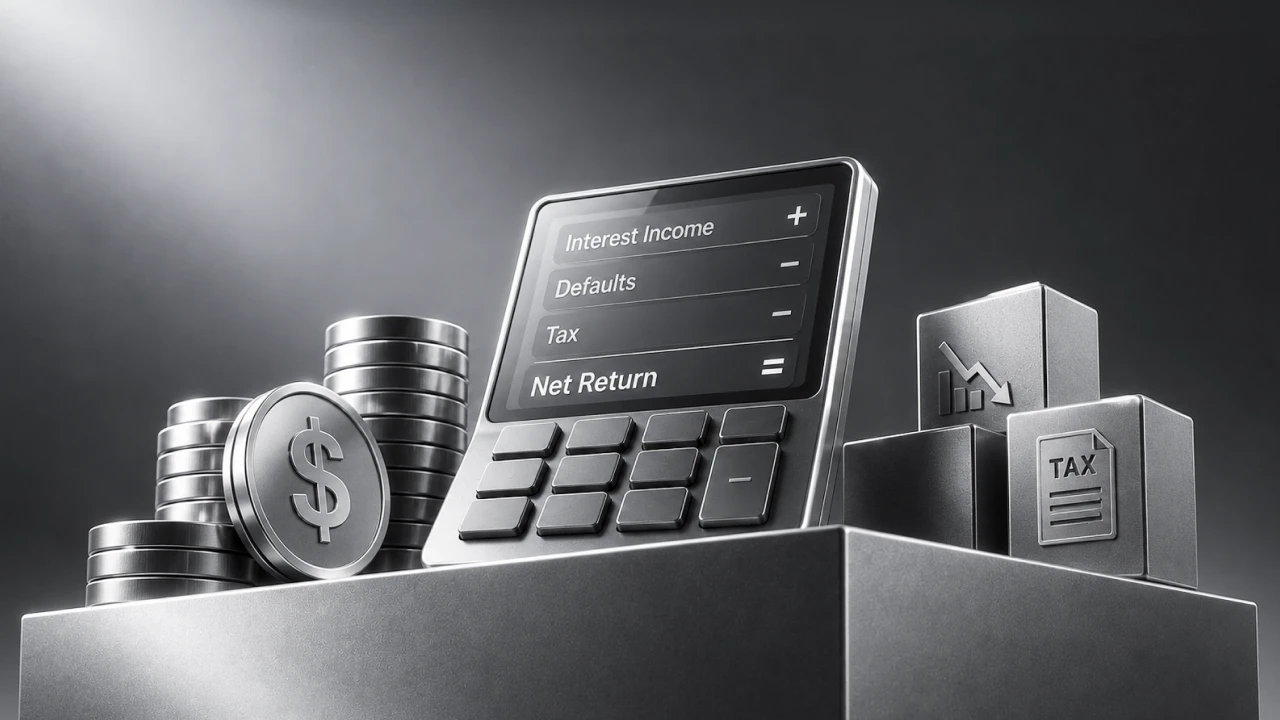
A P2P platform advertising 20% is not a 20% take-home. Your real net return is the gross rate minus a default drag — loans that don't fully repay — minus tax on the interest. On collateral-backed platforms like 8lends, recovered principal from real-world assets and BuyBack protection reduce the default drag, but they do not remove tax on what you earn.
The Honest Answer: The Advertised Rate Is Not What You Keep
The rate that is advertised is not the real value that the investor can keep in practice. The advertised rate accounts for gross return, while the net amount may be smaller due to taxation. The investment usually goes through the following assessment process when determining factual returns:
1) Gross return;
2) Default drag;
3) Applicable taxes;
4) Net return (factual return);
One of the core misunderstandings is about the fact that, if the borrower defaults, the funds that have been infested are completely lost. In fact, the recoverable amount (whether partial or full principal) is determined on a case-by-case basis and depends on multiple factors like the jurisdiction, enforcement procedure, the borrower’s situation, and the loan protection mechanisms. If the loan is not secured by the collateral or any other means, the amount that can be recovered may be smaller. The loans backed by the collateral may help to recover the principal in full, or a major part of it.
How Much Do You Really Make on P2P Lending?
The factual rate that the investor can make on P2P lending varies. The return on investment depends on factors like the diversification of the portfolio; the terms of the loan, including the type of the collateral against it; the terms of repayment; the value of the collateral; and the taxes in a particular jurisdiction. Therefore, the investor who may have similar figures at the start or the same value of the portfolio may end up with an entirely different value at the end of the fiscal year.
How to Calculate Your Real Net Return
The calculation of net return is important to assess the current performance of the P2P lending portfolio for the investor. One way to do so is to start with the advertised interest rate and consider borrower default and taxation by calculating these as the factors contributing to the losses. The following formula helps to calculate the net returns on investment. Net return = Gross rate * (1 - Default loss rate) * (1 - Marginal tax rate). A separate formula to calculate the default loss rate also exists. Default loss rate = Default probability * (1 - Recovery rate). Both formulas represent a simplified but illustrative modeling of the main drivers of the performance of the investment portfolio in the long run.
The rate on the loan before any taxes are taken, defaults that potentially affect the returns, or the fees from the claim being sold earlier or taken by the platform is called the gross rate. Gross rate is the maximum potential return in case the borrower makes timely interest payments and completes the repayment according to the defined schedule.
The fall in returns and the rate that remains after default of the borrower that results in their inability to repay the debt is called the default loss rate. The default loss rate may change depending on the two variables that fluctuate, the first variable being the expected rate of default. It means the estimation of how often the borrower is expected to claim insolvency. The second factor behind the default loss rate is the recovery rate, which estimates how much money of the principal may be recovered through the legal proceedings, including the liquidation of the collateral or BuyBack mechanism of the platform. If the recovery rate is higher, the probability of the borrower’s default is perceived as being lower in absolute terms.
The marginal tax rate accounts for differences in the taxation of the investor’s returns. Many jurisdictions define interest payments as taxable income, meaning that the amount that is left after taxation may be smaller than the interest payment before. 8lends as the platform does not withhold taxes; instead, the investors should declare the taxes themselves, based on their jurisdiction and the specific rules that may apply to their portfolio. Some jurisdictions treat digital assets (including returns in USD and other dollar-pegged digital currencies) under specialized tax regimes, which may create additional or different tax obligations for the investor.
All these factors influence the final amount that the investor can receive after the complete financial and legal cycle regarding returns on investment. That is why the investors who both start with the APR around 20% may end up receiving entirely different returns. When making an investment decision, it is also necessary to see what the LTV ratio of the particular loan is. It is equally important to assess whether BuyBack can realistically increase the principal's recovery possibility.
A Worked Example: From a 20% Gross Rate to Net
The following illustrative example of a diversified portfolio for 5,000 USD with a 20% APR helps to understand how much net returns are left in comparison to the gross rate under different loan scenarios. In the example above, the gross annual interest rate equals 1,000 USD. The two subsequent scenarios of lending, unsecured lending and collateral-backed loans, are given in the table below.
| Stage | Pessimistic Scenario (Unsecured Lending) | Collateral-Backed Scenario (Illustrative 8lends Profile, RWA + BuyBack) |
|---|---|---|
| Diversified portfolio value | 5,000 USD | 5,000 USD |
| Gross | 1,000 USD (20.0%) | 1,000 USD (20.0%) |
| After default drag | 350 USD (7.0%) | 850 USD (17.0%) |
| After tax | 259 USD (5.2%) | 629 USD (12.6%) |
| Net (USD) | 259 USD (5.2%) | 629 USD (12.6% |
Illustrative example only. Returns are not guaranteed. The example is educational; factual jurisdictional rules on taxes and claims ownership in a portfolio vary regionally. Does not constitute legal or tax advice.
How Collateral and BuyBack Change the Default Math
Many sources giving investment advice cite default rates as an important aspect; however, recovery rate is equally important. In case of an unsecured loan, the borrower’s default may effectively reduce the potential returns to a value close to zero. This way, the risk of complete capital loss becomes more realistic. If the loan is pledged against the collateral, especially with a conservative LTV, the investor gets an additional layer of protection of the funds.
Collateral may come in various forms, including real estate objects, commercial vehicles, equipment, operational assets of the company, and other tangible assets. 8lends runs a prior assessment of the collateral, including its valuation and legal classification, through an independent Collateral Agent Maclear AG. Collateral’s due diligence allows it to offer a structured process of returns of the principal.
There are projects that offer an additional layer of protection coming from a BuyBack mechanism. A BuyBack is the obligation of the loan originator to repurchase the loan in case of the borrower’s default in case certain conditions for the repurchasing are met. BuyBack is an additional layer of investor protection and it can reduce the risk to the principal. However, investment always carries some degree of borrower-related risk and therefore is not entirely risk-free.
8lends has reported zero historical defaults as of May 2026, reflecting the platform’s track record until the defined period. However, the overview of the historical performance does not guarantee equal outcomes in the future and should not be interpreted as a prediction of performance.
Do Defaults Eat Into P2P Returns?
Yes, defaults can definitely eat into P2P returns. Yet the effect the default has on the principal differs based on the individual terms of a particular loan. If the loan is backed by the collateral with a conservative LTV and additional recovery mechanisms like BuyBack support the loan as well, there is a chance to secure higher returns of the principal in case of the borrower’s default. However, if the loan is unsecured, the effect of the default drag may be higher.
Setting Realistic Expectations by Strategy
On 8lends the interest rate is fixed at 19-25% APR, but the outcome is not: your net return depends on the defaults and tax, and collateral, LTV, and BuyBack reduce — but do not remove — the risk of loss.
Weighed investment decisions in P2P lending should rely on multiple overlapping factors, including reinvestment possibilities, risk profile, portfolio diversification, and the terms of the particular loans. Therefore, the investors should conduct a thorough prior assessment of every project they want to include in their portfolio.
Diversification is one of the ways to reduce portfolio risks by distributing the capital across multiple projects in different regions and industries. This reduces the investor’s exposure to single-borrower concentration risk.
The consideration of the investment horizons is equally important, as short-term returns can vary from the long-term trends. That is why the investor should assess the potential process of the principal recovery before investing in the project.
Tax rates that apply to the interest payments as well as capital gains in some P2P loans are also worth considering. 8lends as the platform does not withhold taxes, the investor should file all the tax documents according to the requirements of their particular jurisdiction and should keep track of the taxation they are obliged to themselves. Receiving interest payments in USD or other digital assets may lead to the specific tax regimes in certain jurisdictions, leading to additional taxation.
What Net Return Is Realistic for a Diversified Portfolio?
No universal number can describe a realistic net return for a diversified portfolio. The individual circumstances that affect the net return include the loan terms, the return rate, the borrower’s default rate, potential reinvestment, and taxation. That is why different investors can receive different net returns from the same portfolio value.
Are 8lends Returns Guaranteed?
The returns on 8lends are not guaranteed. Typically, 8lends offers an interest rate between 19% and 25% APR for the loans, yet the exact returns depend on the value of the collateral, LTV ratio, BuyBack availability, and the loan’s risk profile. Despite all the mechanisms mentioned above potentially reducing the borrower-related risk, they cannot eliminate it completely.
Spotlight — 8lends Fixed loan rate, transparent recovery mechanics On 8lends, investors fund real SME loans using USD, receiving monthly interest at fixed rates. Every transaction — investment, interest payout, principal return — is recorded on the Base blockchain and publicly verifiable. Each borrower passes 40+ due diligence criteria assessed by Maclear AG and is rated AAA–D before listing. Loans are backed by real-world collateral and selected projects include BuyBack protection — returning 100% of principal if a borrower delays beyond 60 days. 19–25% APR Fixed APR in USD $152.7M+ Total funded $53.2M+ Total repaid 50.8K+ Investors View open projects →
FAQHow much do you really make on P2P lending?The advertised rate is not the same as the actual returns on a P2P investment. The returns depend on multiple factors like reinvestment, taxation, terms of the loan, and risk profile.Do defaults eat into P2P returns?Yes, defaults do eat into P2P returns. If the loan is secured against the collateral and LTV is conservative, higher returns on the principal are possible in comparison to an unsecured loan.Is a 20% return realistic on P2P lending?Yes, P2P lending featuring a 20% return rate is realistic. However, the outcome depends on multiple factors, including whether the loan is secured against the collateral or not, how many taxes are withheld, how diversified the portfolio is, and what the recovery rate is in case of the borrower’s default.What is a realistic net return after tax?There is no universal figure that can describe the exact value of a realistic net return after tax. Net returns depend on default drag, taxation, the type of returns, and the terms of the loan.How does collateral improve my net return?The collateral can improve the investor’s net return by providing security for the loan. If the borrower defaults, the collateral may be liquidated to distribute the funds on a pro rata basis among the investors who have contributed to the project.
Explore open 8lends projects — SME loans secured by real-world collateral, legally registered through an independent Swiss collateral agent.Start investing →The content of this article is provided for informational and educational purposes only. It does not constitute investment, financial, tax, or legal advice. P2P lending and crowdlending investments carry a risk of partial or total capital loss. Collateral and BuyBack arrangements do not guarantee the return of funds; recovery outcomes vary. Past performance is not indicative of future results. Readers should conduct independent research and consult qualified advisors before making any financial decisions. Availability of products and services may be restricted in certain jurisdictions.
Read next



Do You Have Any Questions?
All questionsThe platform has been audited by CertiK and Cyberscope, and all transactions are publicly visible on the Base blockchain. Two companies with clear responsibilities stand behind the platform: CLEARCHAIN CORP operates the platform and is registered as a Money Services Business with FINTRAC (Canada), and Maclear AG conducts due diligence and monitors collateral. So the platform is well regulated, transparent and accountable
If the project has BuyBack, the partner buys the loan and returns 100% of the principal once it is overdue for 60 days or more. Without BuyBack, Maclear AG initiates the sale of the collateral, and the proceeds are distributed proportionally among investors. Since launch there have been no defaults
The platform is operated by CLEARCHAIN CORP, registered in Canada as a Money Services Business (MSB) and subject to mandatory AML/CFT compliance requirements under FINTRAC. Settlements are made in USD. The platform is not a CASP, so DAC8 requirements do not apply
Small and medium-sized businesses in developing regions do not have easy access to bank financing and are willing to pay higher rates than businesses in the EU or US
You can sell your position to another investor through the Secondary Market before the end of the loan term. With Fastlending there is no fixed term: the principal and accrued income can be withdrawn at any time
The minimum investment is 100 USD
Risk of non-payment by the business, risk of changes in the value of the collateral, risk of limited liquidity if there is no buyer on the Secondary Market, and technical risk associated with the smart contract
Investments from 100 to 500 USD are available without KYC. For amounts over 500 USD, full verification is required: an identity document and proof of address