
How to Invest 5,000 USD in Business Loans: A Worked Example

17 września 202611 min czytania
Investing 5,000 USD in business loans means splitting that amount across multiple individual loan positions rather than funding one loan in full. With a 100 USD minimum per position, 5,000 USD can become 50 positions of 100 USD, 25 of 200 USD, or 10 of 500 USD — each split changing how much a single borrower default costs the portfolio. This is a worked illustrative example of that arithmetic: position sizing, a term ladder across 4 to 16 months, expected monthly interest, and what one default with partial recovery does to the total.
Investing 5,000 USD in business loans means splitting that amount across multiple individual loan positions rather than funding one loan in full. With a 100 USD minimum per position, 5,000 USD can become 50 positions of 100 USD, 25 of 200 USD, or 10 of 500 USD — each split changing how much a single borrower default costs the portfolio. This is a worked illustrative example of that arithmetic: position sizing, a term ladder across 4 to 16 months, expected monthly interest, and what one default with partial recovery does to the total.
What Investing 5,000 USD in Business Loans Actually Involves
A 5,000 USD business-loan portfolio can be divided into separate claims, each linked to an individual borrower and repayment schedule.
On 8lends, the minimum investment per position is 100 USD. Loans carry a fixed 19–25% APR at the time of investment, with terms of 4–16 months. Interest is paid monthly, while principal is repaid as a bullet payment at the end of each position’s term. The investor fee is 0%.
The amount is denominated in digital USD on the Base network. Position size determines concentration, APR determines scheduled interest, and maturity determines when principal is due back. Registration, KYC, wallet setup, and choosing a first project belong in the separate step-by-step guide; here, the focus is how 5,000 USD can be divided across secured P2B loan positions.
Three Ways to Split 5,000 USD: 50, 25, or 10 Positions
The same 5,000 USD can be divided in several ways. Three illustrative models are 50 positions of 100 USD, 25 positions of 200 USD, or 10 positions of 500 USD.
| Allocation Model | Positions | Size of One Position | Share of One Position in Portfolio | Monthly Interest From One Position at 22% APR | Portfolio Loss From a Single Default, Assuming 60% Recovery Through Collateral |
|---|---|---|---|---|---|
| 50 × 100 USD | 50 | 100 USD | 2,0% | 1,83 USD | 40 USD (0,8% of portfolio) |
| 25 × 200 USD | 25 | 200 USD | 4,0% | 3,67 USD | 80 USD (1,6% of portfolio) |
| 10 × 500 USD | 10 | 500 USD | 10,0% | 9,17 USD | 200 USD (4,0% of portfolio) |
Illustrative example only. The 60% recovery assumption is hypothetical and is used only to demonstrate the arithmetic of partial recovery.
All three portfolios contain the same 5,000 USD and use the same 22% APR assumption, so their total scheduled monthly interest is also the same:
5,000 × 22% / 12 = 91.67 USD per month
Changing position size does not change that aggregate figure. It changes how much of the portfolio depends on each individual borrower.
Why the Position Size Changes How Much One Default Costs
In the 50-position model, each 100 USD claim represents 2% of the portfolio. In the 25-position model, each 200 USD claim represents 4%. With 10 positions of 500 USD, one borrower represents 10% of total capital.
If exactly one borrower defaults, the amount exposed to that single default is therefore smaller in the first model than in the third. Other diversification dimensions — including borrower grade, industry, collateral type, and maturity — are covered separately; here, the variable is position count.
Building a Term Ladder: Mixing 4, 8, 12, and 16-Month Loans
Position count determines concentration, while maturity determines when principal returns.
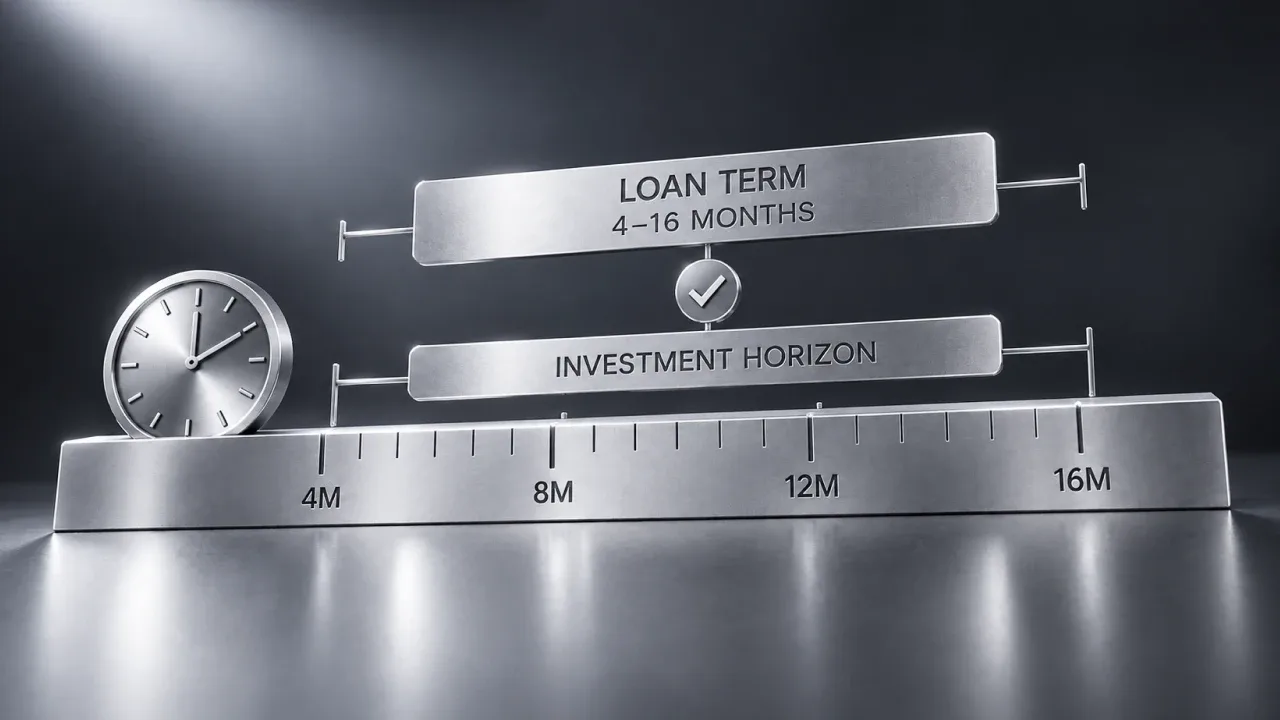
Consider the 50 × 100 USD model. Instead of placing all 50 claims into loans with similar maturity dates, an illustrative ladder could place roughly one quarter in 4-month loans, one quarter in 8-month loans, one quarter in 12-month loans, and one quarter in 16-month loans.
The purpose is not to increase APR, but to distribute bullet principal repayments through time. If all positions mature together, a large part of the portfolio returns at once. Staggered maturities create several points at which portions of principal become available, although future loans may offer different rates or terms.
Why Mixing Grades Matters as Much as Mixing Terms
Term and loan grade measure different things.
Maturity determines how long capital is committed and when principal is due back. Grade reflects the platform’s assessment of borrower risk. A portfolio can therefore be diversified by maturity while remaining concentrated in one grade, or diversified by grade while having most positions mature at the same time.
The AAA–D grading system is explained separately; here, the key point is that term diversification and credit-grade diversification are separate decisions.
What Monthly Income Looks Like at 19%, 22%, and 25% APR
For a fully active 5,000 USD portfolio, scheduled monthly interest can be illustrated with:
Portfolio value × APR / 12
At 19% APR:
5,000 × 19% / 12 = 79.17 USD per month
At 22% APR:
5,000 × 22% / 12 = 91.67 USD per month
At 25% APR:
5,000 × 25% / 12 = 104.17 USD per month
These figures show the arithmetic of the stated loan rates, not a forecast of realized portfolio return.
They assume the full 5,000 USD has already been deployed, all positions are active, and every borrower is paying according to schedule. Actual cash flow can build gradually as individual loan pools close and positions become active. It can also decline when payments are delayed or a borrower defaults.
What Monthly Income Can 5,000 USD Realistically Generate?
Under the stated 19–25% APR assumptions, scheduled monthly interest ranges from about 79.17 to 104.17 USD while the full 5,000 USD is active and performing. Realized cash flow may be lower if capital is not fully deployed or payments are delayed.
What One Default Actually Costs — With Partial Recovery
A default does not necessarily mean the entire original position is ultimately lost. Secured lending can provide a recovery route through collateral, but the amount recovered depends on what the collateral actually realizes after costs and discounts.
For this worked example, assume exactly one position defaults and 60% of the claim is ultimately recovered through collateral. The 60% assumption is purely illustrative. It is not a stated 8lends recovery rate and is not guaranteed.
| Allocation Model | Position Size | Loss with 0% recovery (total loss of position) | Loss with 60% recovery |
|---|---|---|---|
| 50 × 100 USD | 100 USD | 100 USD (2,0% of portfolio) | 40 USD (0,8% of portfolio) |
| 25 × 200 USD | 200 USD | 200 USD (4,0% of portfolio) | 80 USD (1,6% of portfolio) |
| 10 × 500 USD | 500 USD | 500 USD (10,0% of portfolio) | 200 USD (4,0% of portfolio) |
This is an illustrative calculation, not a forecast of returns. The 60% recovery figure is a hypothetical assumption used to show the arithmetic of partial recovery — it is not a stated or guaranteed recovery rate on 8lends. Actual recovery after a default depends on the liquidation discount on the collateral, enforcement costs, and how quickly the asset can be sold. The 19–25% APR is the loan’s interest rate, not a guaranteed portfolio return. Diversifying across more positions reduces the effect of one default; it does not remove borrower credit risk or guarantee any specific net return. Capital remains at risk, including in a fully diversified, collateral-backed portfolio.
The calculation separates two mechanisms: diversification reduces the share of capital attached to one borrower, while recovery reduces the final loss on a defaulted claim. With 50 positions and hypothetical 60% recovery, one 100 USD default produces a 40 USD loss, or 0.8% of the portfolio. With 10 positions and no recovery, one 500 USD default produces a 500 USD loss, or 10%. These figures illustrate arithmetic only.
What Changes When Recovery Is Partial, Not Zero
At 0% recovery, the investor loses the full defaulted position in this simplified example. At 60% recovery, only the remaining 40% becomes the illustrated capital loss.
8lends loans can be secured by real-world assets such as equipment, vehicles, real estate, or inventory. Certain structures can also involve BuyBack by a third party; BuyBack is not a repurchase guarantee provided by the platform itself.
Collateral does not ensure full recovery: assets may be sold at a discount, and enforcement can involve costs and delays. A default is recorded after 60 days of arrears; the detailed enforcement process is covered separately.
Reinvesting Monthly Interest Without Letting It Sit Idle
Monthly interest creates another allocation decision because the minimum amount for a new position is 100 USD.
For a 5,000 USD portfolio, aggregate scheduled interest is the same whether the capital is divided into 50, 25, or 10 equal positions, provided the portfolio-wide APR assumption stays the same.
At 19% APR:
79.17 × 2 = approximately 158.33 USD after two months
At 22% APR:
91.67 × 2 = approximately 183.33 USD after two months
At 25% APR:
104.17 USD after one month
In this simplified illustration, the 100 USD threshold for another position is therefore reached after two months at 19% or 22% APR, and after one month at 25%.
How Long It Takes to Accumulate Enough for a New Position
The accumulation period does not depend on whether the original 5,000 USD was divided into 10, 25, or 50 positions. It depends on total performing capital and the APR earned across that capital.
Reinvestment on 8lends is not automatic. There is no auto-reinvest function, so accumulated interest must be manually allocated when the investor decides there is enough for another position.
Some cash may therefore remain temporarily undeployed; the calculations do not assume every payment is immediately reinvested.
Scaling the Same Logic to 10,000 USD
The same position-sizing logic can be applied to how to invest 10,000 USD.
| Allocation Model | Positions | Size of One Position | Share of One Position in Portfolio | Monthly Interest for the Portfolio at 22% APR | Portfolio Loss From a Single Default, Assuming 60% Recovery Through Collateral |
|---|---|---|---|---|---|
| 100 × 100 USD | 100 | 100 USD | 1,0% | 183,33 USD/month | 40 USD (0,4% of portfolio) |
| 50 × 200 USD | 50 | 200 USD | 2,0% | 183,33 USD/month | 80 USD (0,8% of portfolio) |
| 20 × 500 USD | 20 | 500 USD | 5,0% | 183,33 USD/month | 200 USD (2,0% of portfolio) |
At 22% APR:
10,000 × 22% / 12 = 183.33 USD per month
Doubling the portfolio doubles scheduled monthly interest at the same APR and halves the percentage impact of a fixed-size default. A 40 USD loss is 0.8% of a 5,000 USD portfolio but 0.4% of a 10,000 USD portfolio.
The larger portfolio also reaches the 100 USD minimum for another position more quickly. At 19%, 22%, or 25% APR, a fully active 10,000 USD portfolio generates more than 100 USD in scheduled interest in one month, so the threshold is reached in approximately one month in all three illustrative cases.
What This Calculation Does Not Account For
These examples isolate portfolio size, position size, term, APR, one default, and hypothetical partial recovery. A live portfolio can contain different rates, maturities, grades, collateral, activation dates, and borrower outcomes. Multiple borrowers can become delinquent at once, recovery can take longer than expected, and collateral may realize less than its original valuation.
The calculations also assume capital is deployed. Cash waiting for a suitable position is not generating interest. These examples are allocation arithmetic, not a forecast. Capital remains at risk, and neither diversification nor collateral guarantees repayment or a specific return.
Najczęściej zadawane pytania
There is no single correct split. Three illustrative models are 50 × 100 USD, 25 × 200 USD, and 10 × 500 USD. At the same portfolio APR, aggregate scheduled interest is unchanged. What changes is the share of the portfolio tied to each individual borrower and therefore the effect of one default.
That depends on how much concentration the investor is prepared to accept. With a 100 USD minimum per claim, the maximum number of equal positions that 5,000 USD can create is 50. Fewer positions mean a larger share of the portfolio depends on each borrower.
The result depends on both position size and recovery. In the hypothetical 60% recovery example, a 100 USD position creates a 40 USD loss, a 200 USD position an 80 USD loss, and a 500 USD position a 200 USD loss. Actual recovery may differ and is not guaranteed.
Yes, once enough has accumulated to meet the 100 USD minimum for another position. Reinvestment is manual rather than automatic. In the illustrative 5,000 USD portfolio, the threshold is reached after about two months at 19% or 22% APR and after one month at 25%, assuming all capital is active and payments arrive as scheduled.
The underlying arithmetic is the same, just at a larger scale. Doubling the portfolio doubles scheduled monthly interest at the same APR and reduces the percentage impact of a fixed-size defaulted position. It also allows the 100 USD minimum for another position to be reached in about one month across all three illustrative APR scenarios.
Przeczytaj dalej
Masz pytania?
Wszystkie pytaniaPlatformę zaudytowały CertiK i Cyberscope, a wszystkie transakcje są publicznie widoczne w blockchainie Base. Za platformą stoją dwie firmy o jasno rozdzielonych obowiązkach: CLEARCHAIN CORP prowadzi platformę i jest zarejestrowana jako Money Services Business w FINTRAC (Kanada), a Maclear AG wykonuje due diligence i nadzoruje zabezpieczenie. Platforma jest więc dobrze uregulowana, przejrzysta i rozliczalna
Jeśli projekt ma BuyBack, partner odkupuje pożyczkę i zwraca 100% kapitału po 60 dniach opóźnienia lub więcej. Bez BuyBack Maclear AG rozpoczyna sprzedaż zabezpieczenia, a wpływy są dzielone proporcjonalnie między inwestorów. Od startu nie było ani jednej niewypłacalności
Platformę prowadzi CLEARCHAIN CORP, zarejestrowana w Kanadzie jako Money Services Business (MSB) i podlegająca obowiązkowym wymogom AML/CFT w ramach FINTRAC. Rozliczenia odbywają się w USD. Platforma nie jest CASP, więc wymogi DAC8 jej nie dotyczą
Małe i średnie firmy w regionach rozwijających się nie mają łatwego dostępu do finansowania bankowego i są gotowe płacić wyższe stawki niż firmy w UE czy USA
Możesz sprzedać swoją pozycję innemu inwestorowi na Secondary Market przed końcem okresu pożyczki. W Fastlending nie ma stałego terminu: kapitał i naliczony dochód można wypłacić w dowolnym momencie
Minimalna inwestycja to 100 USD
Ryzyko braku spłaty przez firmę, ryzyko zmiany wartości zabezpieczenia, ryzyko ograniczonej płynności, gdy na Secondary Market nie ma kupującego, oraz ryzyko techniczne związane ze smart kontraktem
Inwestycje od 100 do 500 USD są dostępne bez KYC. Powyżej 500 USD wymagana jest pełna weryfikacja: dokument tożsamości i potwierdzenie adresu