
Private Credit vs Private Equity: The Debt vs Equity Difference for Investors
22 września 202611 min czytania
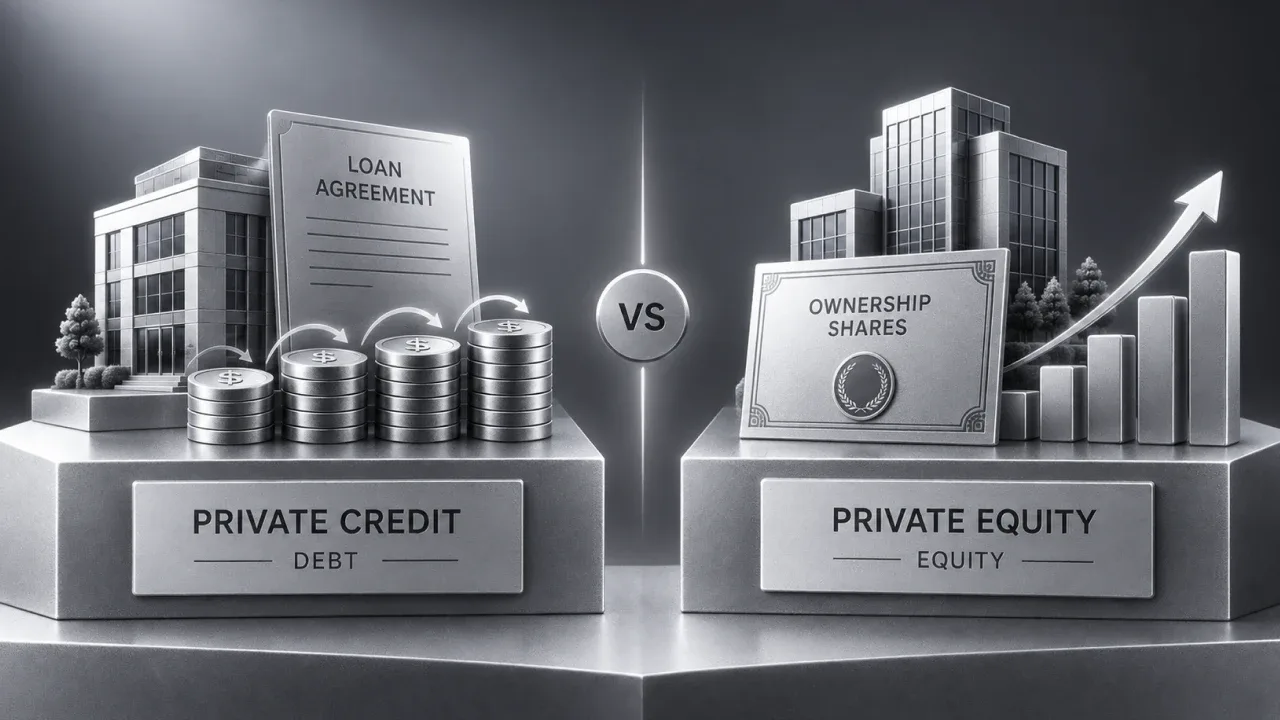
Private credit and private equity are both ways to invest in a private company outside the stock and bond market, but they sit on opposite sides of the same balance sheet. Private credit is a loan: the investor is a creditor, earns a fixed contractual interest rate, and is repaid ahead of equity holders if the company runs into trouble. Private equity is an ownership stake: the investor is a shareholder, earns a return only if the company's value grows and there is an exit, and is paid last, if at all, in a wind-down.
Private credit and private equity are both ways to invest in a private company outside the stock and bond market, but they sit on opposite sides of the same balance sheet. Private credit is a loan: the investor is a creditor, earns a fixed contractual interest rate, and is repaid ahead of equity holders if the company runs into trouble. Private equity is an ownership stake: the investor is a shareholder, earns a return only if the company's value grows and there is an exit, and is paid last, if at all, in a wind-down.
What Private Credit and Private Equity Actually Mean
Private credit means lending money to a privately held business under agreed repayment terms. The investor owns a debt claim rather than part of the company. Private equity works differently: the investor buys an ownership stake and participates in whatever value is created or destroyed over time.
That is the practical divide. Private credit starts with a repayment obligation. Private equity starts with ownership and the possibility that the company may become more valuable.
For the broader background on the asset class itself, including how individual investors can access it, see the separate guide to private credit for individual investors.
Private Credit vs Private Equity: Eight Ways They Differ
| Feature | Private Credit | Private Equity |
|---|---|---|
| What the investor holds | A contractual loan claim - a creditor position | An ownership stake - a shareholder position |
| Source of return | Fixed contractual interest paid by the borrower | Growth in company value, realized at exit (sale, IPO, buyout) |
| Seniority if the company fails | Paid ahead of equity holders, out of the borrower's assets or pledged collateral | Paid last, after all creditors - often nothing is left |
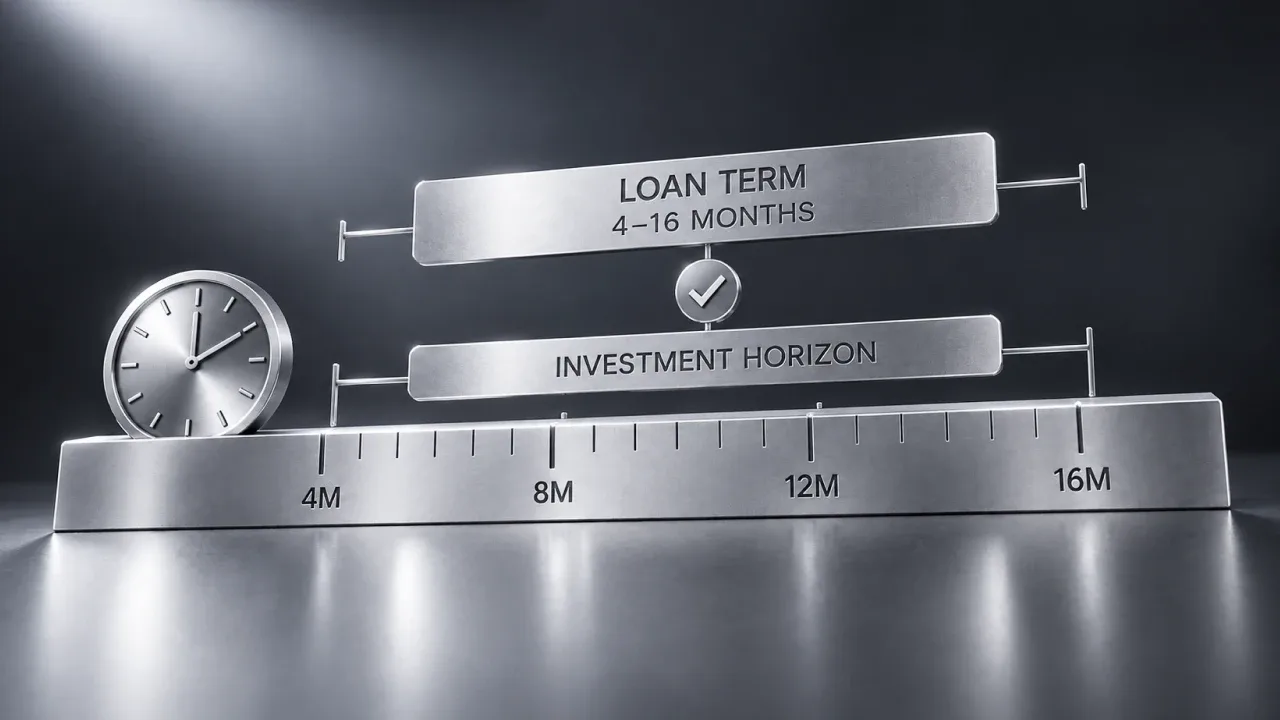
| Typical holding period | Months (4-16 months for a single secured P2B loan on a platform like 8lends) to a few years for institutional direct lending funds | Multi-year, commonly 5-10 years to a realized exit |
| Liquidity before maturity or exit | A secondary market may exist (on 8lends, a 10% fee paid by the seller) – not guaranteed, not instant | Generally none until a sale, IPO, or buyout event |
| How the return is measured | APR / yield on the loan | IRR and MOIC (multiple on invested capital) over the life of the investment |
| Typical entry point for an individual | From 100 USD per loan on a platform like 8lends; institutional direct lending funds require six to seven figures | Usually limited to accredited or qualified investors through funds or direct deals with high minimums |
| What happens if it fails | Default triggers a defined recovery process; collateral, where it exists, can reduce - not eliminate - the loss | Equity is typically wiped out; the investor is not guaranteed any recovery |
None of this makes one structure better than the other — it makes them different tools that behave differently when a business does well and, more importantly, when it does not.
Where the Return Comes From: Contractual Interest vs. Equity Upside
Private credit starts with a contract. The borrower agrees to pay interest and repay principal according to defined terms. If the business performs exceptionally well, the lender normally still receives only what the loan agreement promises.
Private equity reverses that trade-off. There may be no contractual income during the holding period. The investor accepts that uncertainty because the return comes from growth in the value of the ownership stake. If the company doubles in value and there is a successful exit, the shareholder participates in that increase. If the company fails, there may be little or nothing to realize.
Does Private Credit Ever Pay Equity-Like Upside?
Standard private credit is not designed to provide unlimited equity-style upside. Its return is usually defined by the interest rate, fees, and repayment terms.
Some institutional deals can include warrants or other equity-linked features, but the basic distinction remains. A normal loan claim is debt; an ownership stake is equity.
8lends sits on the private-credit side of that line. It offers secured P2B loans to small and medium-sized businesses, not shares in those businesses. Investors receive the contractual loan return; they do not acquire participation in future company value.
On 8lends, the investor fee is 0%. A 3% origination fee is paid by the borrower when the loan is formed. Those fees affect the economics of the lending structure, but they do not turn a credit claim into an equity position.
Who Gets Paid First: Seniority If a Company Runs Into Trouble
The difference becomes sharpest when the business is under stress.
Creditors stand ahead of shareholders in the payment hierarchy. Where a private-credit loan is secured, the lender may also have a claim against pledged assets. Equity sits at the bottom: shareholders own what remains after liabilities are satisfied.
In a successful business, that residual claim can be valuable. In a failed one, it can be worth zero.
What Does "Seniority" Mean in Practice?
Seniority describes payment priority. If a company has secured lenders, other creditors, and shareholders, available assets are distributed according to the legal ranking of claims.
That does not mean a private-credit investor is certain to recover the full amount. If the company has too few assets or collateral sells below expectations, even a senior creditor can take a loss. The point is that losses generally reach equity before they reach debt.
Term and Liquidity: Months vs. Years
An individual private loan has a maturity date. On 8lends, secured P2B loans run for 4–16 months. Interest is paid monthly and principal is returned as a bullet payment at the end of the term, assuming the borrower performs.
Private equity usually has no comparable contractual repayment date. A direct investment or fund position can remain tied up for years while the company grows or waits for an exit; five to ten years is common.
Liquidity is limited in both cases, but differently. Some private-credit platforms provide a secondary market. On 8lends, a seller can use the secondary market subject to a 10% seller fee, but a buyer still has to exist and exit is not guaranteed. Private equity is usually even more dependent on a sale, buyout, or IPO before the investor can realize the position.
How a Private Investor Actually Gets Access
Access is one of the clearest differences for an individual investor.
Institutional private-credit funds can require very large commitments, but P2B platforms can provide lower-entry access to individual loans. On 8lends, the minimum position is 100 USD.
Private equity remains harder to access directly. Many funds and private-company deals are restricted by investor-status rules and high minimum commitments, and capital may remain locked for several years.
What's the Minimum to Invest in Private Credit or Private Equity?
There is no universal minimum for either category. A retail-oriented private-credit platform can start much lower than an institutional fund; on 8lends, an individual secured P2B position starts from 100 USD.
Institutional private-credit funds can require six- or seven-figure commitments. Private-equity funds and direct deals also commonly require much larger minimums than a retail lending platform.
8lends transactions are denominated in digital USD on the Base network. The relevant point for this comparison is still the same: the investor is acquiring a debt claim, not an ownership stake.
What Does "Accredited" or "Qualified" Investor Status Mean for Private Equity?
These labels describe regulatory investor categories used in different jurisdictions. The exact tests vary and can be based on wealth, income, assets, or professional status.
Many private-equity funds and direct offerings use those categories to limit participation. The restriction concerns who can legally access the structure, not whether the investment itself is likely to perform well.
How Return Is Measured: APR vs. IRR and MOIC
Private credit and private equity use different return measures because their cash flows are different.
A private loan can quote an APR because the contractual rate applied to principal is known in advance. Private equity often requires IRR and MOIC because the investor may contribute capital today, receive no cash for years, and realize the result only at exit.
What Is MOIC, and How Is It Different from IRR?
MOIC means multiple on invested capital. If 5,000 USD becomes 10,000 USD, the MOIC is 2.0x. It tells the investor how many times the original capital came back, but not how long the process took.
IRR adds time. A 2.0x result achieved in three years is different from 2.0x achieved in ten. That is why a loan APR and a private-equity MOIC should not be compared as if they were the same metric.
Same $5,000, Two Structures: A Side-by-Side Example
The following is an illustrative example only. It is not a projection of a real 8lends loan or a real private-equity transaction.
Assume 5,000 USD is invested in each structure.
Scenario A: Private Credit
The 5,000 USD goes into one secured 12-month business loan paying a fixed 21% APR, within the 19–25% range used on 8lends. Interest is paid monthly, with principal returned as a bullet payment at the end of month 12.
Monthly interest:
5,000 × 21% / 12 = 87.50 USD
Interest over 12 months:
87.50 × 12 = 1,050 USD
At month 12, the 5,000 USD principal is due back. Total cash received over the year is therefore 6,050 USD, consisting of 5,000 USD of principal and 1,050 USD of interest.
Scenario B: Private Equity
The same 5,000 USD buys a hypothetical ownership stake in a private company. There are no interim distributions. Five years later, the stake is sold for twice its original value.
At exit:
5,000 × 2.0 = 10,000 USD
Profit is 5,000 USD, producing a 2.0x MOIC.
Approximate annual IRR:
2^(1/5) − 1 ≈ 14.9%
The private-credit investor receives contractual cash flow during the first year and principal at maturity if the borrower performs. The private-equity investor receives nothing during the five-year holding period in this example and realizes the result only at exit.
The failure cases also differ. If the private-credit borrower stops paying, the loan is treated as in default after 60 days of arrears under the 8lends framework and collateral recovery can begin. Actual recovery depends on enforcement and the value realized from pledged assets such as equipment, vehicles, real estate, or inventory. Recovery is not guaranteed, but default does not automatically imply a total loss.
If the private company in the equity scenario fails, shareholders rank behind creditors. Where no residual value remains after creditors are paid, the equity stake can be wiped out completely.
The purpose of the example is not to compare 21% with 14.9% and declare one superior. The figures describe two different return mechanisms: contractual income over a defined loan term versus growth in ownership value realized at exit. The 21% APR and the hypothetical 2.0x MOIC after five years are illustrative assumptions, not forecasts.
Both structures put capital at risk. In private credit, a lower position on the risk spectrum comes from a contractual interest rate and, where collateral exists, a claim that is senior to equity — not from an absence of risk. A borrower can still default, and recovery is not guaranteed. In private equity, the entire investment can be lost if the company fails, because equity is subordinate to every creditor. Higher potential upside in equity is compensation for that subordination, not a free additional return. Neither structure offers guaranteed returns or a risk-free way to gain exposure to a private company.
Private credit and private equity can both provide exposure to private companies, but they do so through opposite legal positions. One is debt and one is ownership. That distinction determines where the return comes from, how long capital may remain tied up, how performance is measured, and who absorbs losses first when a business fails. Capital remains at risk in both structures, including in secured private credit.
Najczęściej zadawane pytania
Private credit is a loan. The investor is a creditor and receives contractual interest under defined repayment terms. Private equity is an ownership stake. The investor is a shareholder and earns a return if the company's value grows and that value is realized through an exit.
The risks are structured differently. Private equity is subordinate to every creditor, so a failed company can leave shareholders with a complete loss. Private credit is not risk-free, but creditors stand ahead of equity holders, and secured loans may have collateral supporting recovery.
Generally, yes. Creditors rank ahead of shareholders in the payment hierarchy. The amount actually recovered still depends on claim priority, available assets, and any collateral.
Potentially, but access is asymmetric. Private-equity funds and direct deals often require accredited or qualified investor status and high minimums. Some private-credit platforms provide much lower entry points; 8lends, for example, allows participation in secured P2B loans from 100 USD.
There is no universal answer. Private credit emphasizes a contractual rate, defined term, and creditor status. Private equity accepts deeper illiquidity and subordination in exchange for participation in company-value growth. Both can lose capital, and neither guarantees a particular outcome.
Przeczytaj dalej


Masz pytania?
Wszystkie pytaniaPlatformę zaudytowały CertiK i Cyberscope, a wszystkie transakcje są publicznie widoczne w blockchainie Base. Za platformą stoją dwie firmy o jasno rozdzielonych obowiązkach: CLEARCHAIN CORP prowadzi platformę i jest zarejestrowana jako Money Services Business w FINTRAC (Kanada), a Maclear AG wykonuje due diligence i nadzoruje zabezpieczenie. Platforma jest więc dobrze uregulowana, przejrzysta i rozliczalna
Jeśli projekt ma BuyBack, partner odkupuje pożyczkę i zwraca 100% kapitału po 60 dniach opóźnienia lub więcej. Bez BuyBack Maclear AG rozpoczyna sprzedaż zabezpieczenia, a wpływy są dzielone proporcjonalnie między inwestorów. Od startu nie było ani jednej niewypłacalności
Platformę prowadzi CLEARCHAIN CORP, zarejestrowana w Kanadzie jako Money Services Business (MSB) i podlegająca obowiązkowym wymogom AML/CFT w ramach FINTRAC. Rozliczenia odbywają się w USD. Platforma nie jest CASP, więc wymogi DAC8 jej nie dotyczą
Małe i średnie firmy w regionach rozwijających się nie mają łatwego dostępu do finansowania bankowego i są gotowe płacić wyższe stawki niż firmy w UE czy USA
Możesz sprzedać swoją pozycję innemu inwestorowi na Secondary Market przed końcem okresu pożyczki. W Fastlending nie ma stałego terminu: kapitał i naliczony dochód można wypłacić w dowolnym momencie
Minimalna inwestycja to 100 USD
Ryzyko braku spłaty przez firmę, ryzyko zmiany wartości zabezpieczenia, ryzyko ograniczonej płynności, gdy na Secondary Market nie ma kupującego, oraz ryzyko techniczne związane ze smart kontraktem
Inwestycje od 100 do 500 USD są dostępne bez KYC. Powyżej 500 USD wymagana jest pełna weryfikacja: dokument tożsamości i potwierdzenie adresu