
Debt Investments Explained: A Taxonomy by How Each Type Actually Works
September 16, 202612 min read
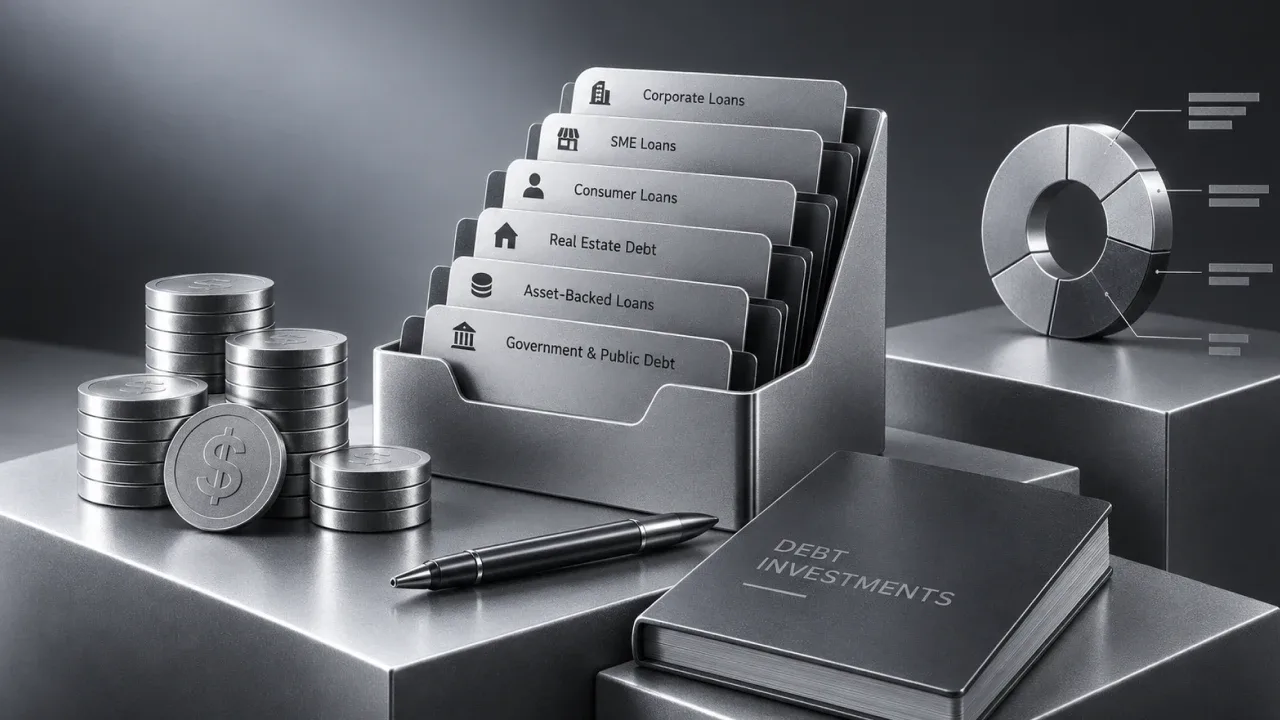
A debt investment is any position where an investor lends money and expects repayment of principal plus interest, rather than buying an ownership stake. The category covers government bonds, corporate bonds, notes, direct lending funds, and direct loans to individual borrowers — instruments that may look similar at first but work quite differently once you look at who owes the money, whether the claim is secured, how long the capital is tied up, and how returns are measured.
A debt investment is any position where an investor lends money and expects repayment of principal plus interest, rather than buying an ownership stake. The category covers government bonds, corporate bonds, notes, direct lending funds, and direct loans to individual borrowers — instruments that may look similar at first but work quite differently once you look at who owes the money, whether the claim is secured, how long the capital is tied up, and how returns are measured.
What Counts as a Debt Investment (and What Doesn't)
A debt investment puts the investor in the position of a creditor, not an owner. The money may go to a government, a company, a bank, a managed fund, or an individual business. In every case, the investor relies on an agreement that sets out how interest and principal are supposed to be paid.
The mechanics vary. A bond may pay a regular coupon, a direct lending fund collects interest from a pool of borrowers, and a structured note can link its return to an index. What connects them is the underlying obligation to repay. The more useful question, then, is not simply whether an instrument counts as debt, but what kind of claim the investor actually holds.
The Six Questions That Define Any Debt Instrument
Most debt instruments become easier to understand once six practical questions are answered.
Who owes the money? It could be a government, a company, a bank, a pool of borrowers, or one individual business.
Where does the income come from? Depending on the structure, it may be a coupon, interest collected from borrowers, or a payoff calculated under a predefined formula.
Is there collateral? Some claims are unsecured. Others give the creditor rights over specific assets if repayment fails.
How long is the term? Debt can mature within a few months or remain outstanding for decades.
Can the position be sold early? Public bonds often trade in established markets. Private debt usually offers fewer exit routes.
Finally, how is return measured? Bonds are commonly discussed in terms of yield to maturity, while a private loan may quote a fixed APR.
These questions make it possible to compare instruments without treating every form of debt as though it worked in the same way.
Government and Corporate Bonds: Publicly Traded Debt
Government and corporate bonds differ mainly in who stands behind the obligation. A government bond is issued by a sovereign state or public agency; a corporate bond is issued by a company. Both normally pay coupons and return their face value at maturity, provided the issuer meets its obligations.
Many bonds can also be sold before they mature. The market price may be higher or lower than face value because interest rates, credit conditions, and investor demand change over time. Selling early therefore provides a possible exit, but not necessarily at the original purchase price.
Investment-Grade vs. High-Yield Corporate Bonds — Same Instrument, Different Risk
Investment-grade and high-yield bonds are both corporate debt. The distinction is primarily the issuer’s assessed credit quality.
Investment-grade issuers are generally considered more capable of meeting their obligations. High-yield issuers carry lower ratings and usually need to offer more yield to attract investors. That extra yield is compensation for additional credit risk, not free additional return.
Both categories can have fixed coupons, stated maturity dates, and secondary-market prices that move as conditions change.
Notes and Structured Products: Debt Wrapped Around a Formula
Structured notes are debt claims, but their returns are not always based on a conventional coupon. The payoff may depend on an index, interest rate, currency, commodity, or another reference asset.
The issuer is often a bank. This leaves the investor with two separate questions: what does the payoff formula produce, and will the issuer remain able to make the payment?
What Makes a Structured Note Different from a Plain Bond
A conventional bond is usually easier to map. Its coupon, maturity date, and repayment value are generally known from the outset.
A structured note can behave differently. Its return may depend on whether an index reaches a particular level, remains within a range, or performs in a specified way. The resulting payoff may not move in a straight line with the underlying asset.
Early exit can also be uncertain. Some notes can be sold before maturity, but there may be no deep market for them. In practice, liquidity may depend on whether the issuer is prepared to quote a repurchase price.
Direct Lending Funds and Business Development Companies (BDCs): Pooled Private Debt
A direct lending fund pools investor capital and lends it to several businesses. Rather than selecting each borrower personally, the investor owns an interest in a vehicle managed by someone else.
The manager chooses the loans, monitors the borrowers, and handles restructuring or recovery when problems arise. Income comes from the underlying loan portfolio after the fund’s fees and expenses.
How a Fund Manager Changes the Risk Profile
This arrangement gives the investor built-in exposure to more than one borrower, but it also places several important decisions in the manager’s hands. Performance depends on underwriting, portfolio construction, fees, valuation methods, and the rules governing withdrawals.
A loan participation works differently. Instead of owning part of a managed pool, the investor takes exposure to one identifiable loan. The fund provides more automatic diversification; the participation offers a clearer view of the individual borrower and transaction.
Direct Loans and Loan Participations: Lending to One Borrower at a Time
Direct loans bring the analysis down to one borrower. The investor can usually see the amount borrowed, the rate, the maturity date, the repayment structure, and any collateral attached to the loan.
These claims are often private. They may have no continuously quoted price or large public market, even when the contractual maturity and interest rate are clearly defined. The loan itself is not uncertain; the difference lies in how easily the investor can exit before it matures.
Where Secured P2B Business Loans Fit in This Taxonomy
Secured P2B lending sits inside this direct-loan category.
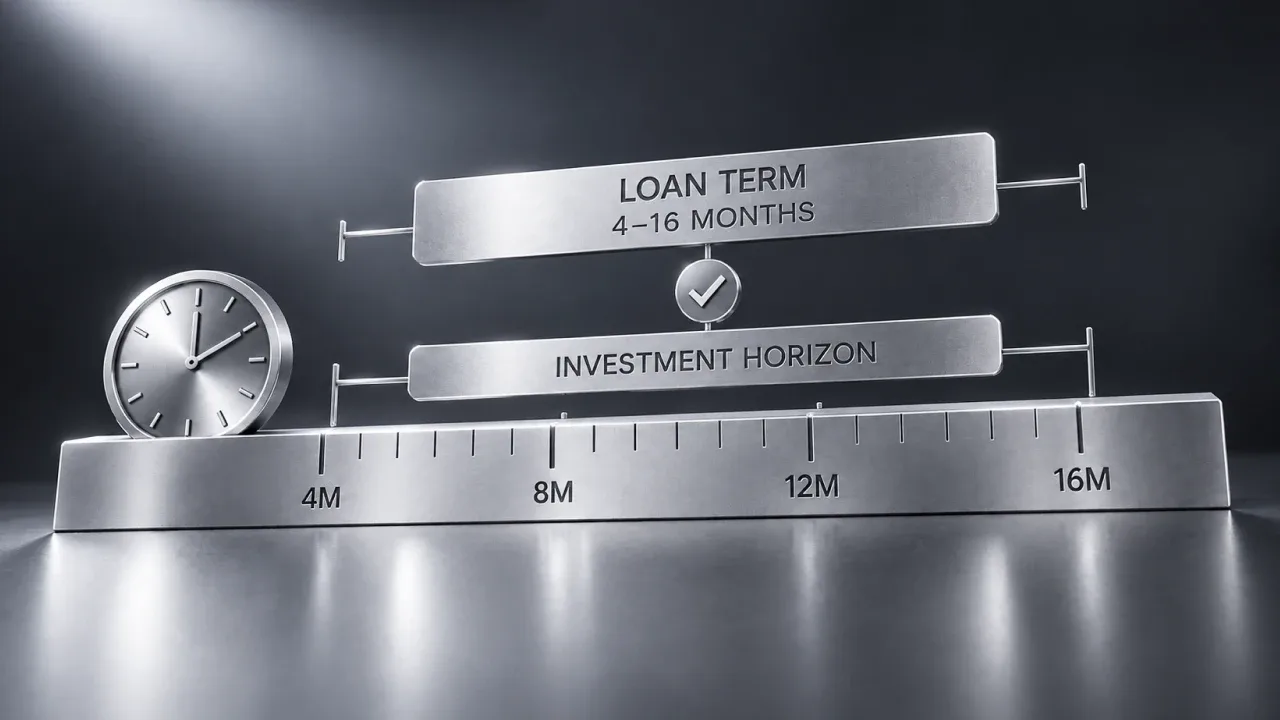
On 8lends, investors participate in loans to SME borrowers. Rates are fixed at 19–25% APR when the investment is made, and individual loan terms run from 4 to 16 months. Interest is paid monthly. Principal comes back as a bullet payment at the end of the term.
Some loans are backed by real-world assets such as equipment, vehicles, real estate, or inventory.
The minimum position is 100 USD. Investments are denominated in digital USD on the Base network. The investor fee is 0%, while borrowers pay a 3% origination fee. Borrowers are assessed against more than 40 due-diligence criteria.
The trade-off becomes clearer when this structure is compared with listed debt.
There is no deep public bond market for the position. An investor who wants to sell through the 8lends Secondary Market pays a 10% seller fee, and selling early may also involve accepting a discount.
Collateral can provide a route to recovery after default. It does not make repayment certain.
Five Debt Instruments Compared
| Feature | Government Bonds | Corporate Bonds (IG / High-Yield) | Notes and Structured Products | Direct Lending Funds / BDCs | Direct Loans / Participations (P2P/P2B) |
|---|---|---|---|---|---|
| Who owes the money? | Government or government agency | Public or private company | Bank issuing the note; payoff may be linked to an asset or index | Pool of borrowers selected by the manager | One specific borrower under one loan |
| Where does income come from? | Coupon fixed at issuance | Coupon; higher yields generally compensate for higher credit risk | Formula-based payoff, sometimes conditional | Interest on pool loans minus the manager's fee | Interest on the loan; the rate is fixed at the time of investment |
| Collateral | Typically unsecured; repayment relies on the sovereign issuer’s creditworthiness and fiscal capacity | Usually unsecured; some issues are secured by the issuer's assets | Depends on the structure; often an unsecured risk of the issuer | Some of the funds are secured by the borrower's assets, while others are unsecured | It may or may not be backed by a real asset (equipment, vehicles, real estate, inventory)—it depends on the platform |
| Typical term | Months - 30+ years | 1-30+ years | Months – several years, as defined by the structure | Often evergreen or multi-year, sometimes with redemption windows | Months to several years at individual-loan level |
| How to exit before maturity | Sale through the bond market | Sale through the bond market | Sale to the issuer or on the secondary market; often low liquidity | Redemption windows are usually limited; they are not available every day | As a rule, there is no public market—only the platform's own secondary market, which charges a commission and may offer a discount. |
| Return metric | Yield to maturity (YTM) | YTM and spread over a risk-free reference rate | Expected return based on the payoff formula, which is often nonlinear | Fund-level yield after fees | Fixed APR set when the investment is made |
| At default | Public debt restructuring – rare, but not out of the question | Bankruptcy proceedings, order of priority of creditors | It depends on the creditworthiness of the note issuer | The manager oversees restructuring/collection at the pool level | Collateral enforcement may follow if the loan is secured; recovery is not guaranteed |
This is not a ranking.
The table simply shows how the same word — debt — can describe instruments with very different mechanics. A higher stated rate will usually be connected to higher credit risk, lower liquidity, greater structural complexity, or some combination of the three.
Same $10,000, Two Debt Instruments: A Cash-Flow Comparison
The easiest way to see the difference is to compare cash flows over the same period.
Take two hypothetical instruments, each with 10,000 USD invested for 12 months. Neither is based on a real bond or a real 8lends loan.
Instrument A is a hypothetical investment-grade corporate bond paying a 5% annual coupon in two semiannual installments.
Instrument B is a hypothetical secured P2B loan paying a fixed 21% APR, with interest every month and principal returned at the end of month 12.
For the bond:
10,000 × 5% / 2 = 250 USD every six months
Month 6: 250 USD
Month 12: 250 USD coupon + 10,000 USD principal = 10,250 USD
Total cash received over the year is 10,500 USD. Of that, 500 USD is coupon income.
Now the P2B loan:
10,000 × 21% / 12 = 175 USD per month
For months 1 through 11, the investor receives 175 USD each month.
In month 12, the final payment is:
175 USD interest + 10,000 USD principal = 10,175 USD
Over the full year, total cash received is 12,100 USD, including 2,100 USD in interest.
On paper, the difference is large. But the comparison only becomes meaningful once the structure behind those numbers is considered.
The bond represents debt from a hypothetical investment-grade issuer and can be assumed to have access to a relatively liquid secondary market. The P2B loan represents exposure to one business borrower without an equivalent public market.
The 21% rate is therefore not evidence that the second instrument is automatically preferable. It reflects a very different mix of credit and liquidity risk.
Why Yield to Maturity and a Fixed APR Aren't the Same Measurement
This is also why YTM and APR should not be read as if they were the same number with different labels.
Yield to maturity uses the bond's current market price, remaining coupon payments, repayment value, and time left until maturity. If the bond trades above or below face value, its YTM can differ from its coupon rate.
A fixed APR on a business loan works differently. It is the contractual annual rate attached to that specific loan when the investment is made.
There is no need for a continuously quoted market price to calculate it.
Both measures say something about return, but they are built from different mechanics.
A higher stated rate on a debt investment is not a bonus. It compensates for a particular form of risk — borrower or issuer default, illiquidity, or both. Yield to maturity and fixed APR are not directly interchangeable, and neither guarantees the final outcome. Capital is at risk across all of the debt investments described here. Collateral may reduce the eventual loss if a borrower defaults, but it cannot eliminate that risk.
The collateral mechanism for secured P2B loans is covered separately in What Real-World Collateral Backs a Loan on 8lends.
Debt investments all create a creditor relationship, but beyond that, the similarities narrow quickly. Term, liquidity, collateral, borrower quality, and the way return is measured can vary considerably from one structure to another. None removes the possibility of losing capital.
Frequently Asked Questions
A debt investment is a position where the investor lends money under agreed terms and expects repayment of principal plus interest rather than acquiring an ownership stake.
The main categories include government bonds, corporate bonds, structured notes, direct lending funds and BDCs, and direct loans or loan participations such as P2P and P2B lending.
The main difference is credit quality. High-yield issuers have lower credit ratings and generally need to offer higher yields to compensate investors for greater default risk.
YTM reflects a bond's market price, remaining payments, repayment value, and time to maturity. A fixed APR is the contractual annual rate set for a particular loan when the investment is made.
It depends on the structure. Sovereign debt can be restructured. A corporate issuer may go through bankruptcy or another creditor-recovery process. With a secured business loan, recovery can involve enforcing and selling pledged assets. None of these routes guarantees full recovery.
Read next

Do You Have Any Questions?
All questionsThe platform has been audited by CertiK and Cyberscope, and all transactions are publicly visible on the Base blockchain. Two companies with clear responsibilities stand behind the platform: CLEARCHAIN CORP operates the platform and is registered as a Money Services Business with FINTRAC (Canada), and Maclear AG conducts due diligence and monitors collateral. So the platform is well regulated, transparent and accountable
If the project has BuyBack, the partner buys the loan and returns 100% of the principal once it is overdue for 60 days or more. Without BuyBack, Maclear AG initiates the sale of the collateral, and the proceeds are distributed proportionally among investors. Since launch there have been no defaults
The platform is operated by CLEARCHAIN CORP, registered in Canada as a Money Services Business (MSB) and subject to mandatory AML/CFT compliance requirements under FINTRAC. Settlements are made in USD. The platform is not a CASP, so DAC8 requirements do not apply
Small and medium-sized businesses in developing regions do not have easy access to bank financing and are willing to pay higher rates than businesses in the EU or US
You can sell your position to another investor through the Secondary Market before the end of the loan term. With Fastlending there is no fixed term: the principal and accrued income can be withdrawn at any time
The minimum investment is 100 USD
Risk of non-payment by the business, risk of changes in the value of the collateral, risk of limited liquidity if there is no buyer on the Secondary Market, and technical risk associated with the smart contract
Investments from 100 to 500 USD are available without KYC. For amounts over 500 USD, full verification is required: an identity document and proof of address