
Investment Horizon and Loan Term: Matching Your Timeline to a 4-16-Month Loan
September 17, 202611 min read
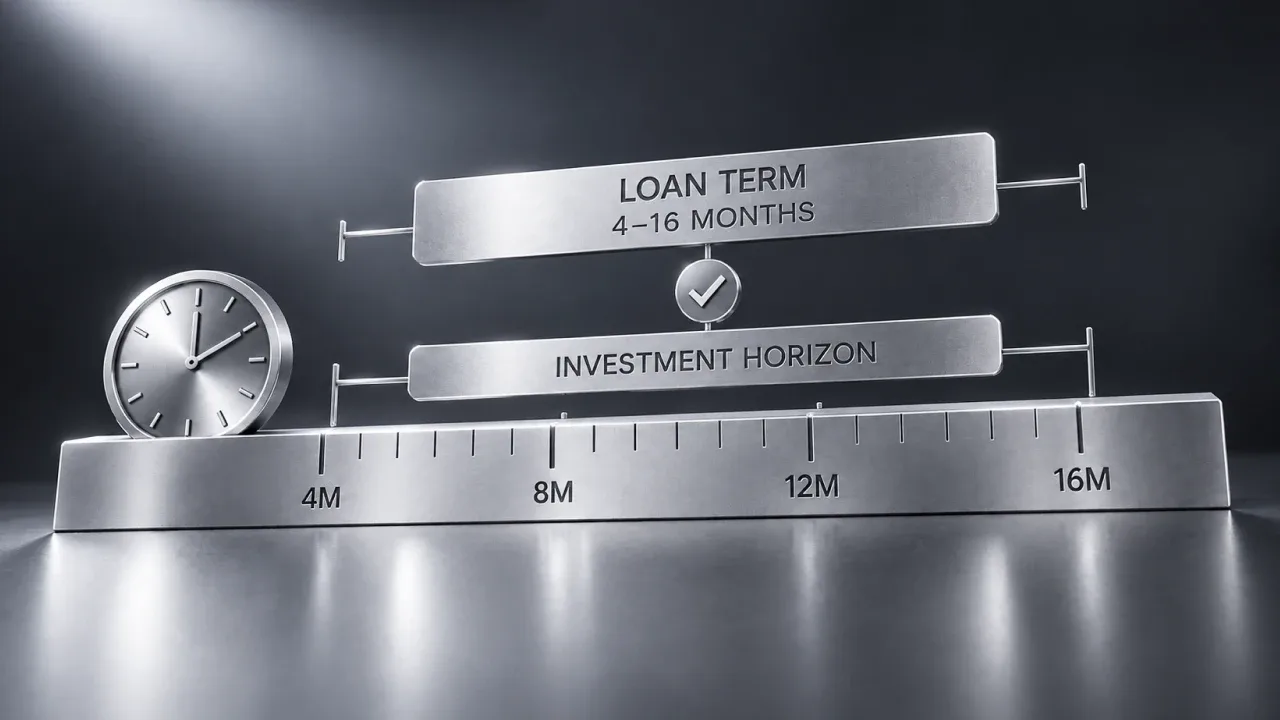
Investment horizon is the length of time you can leave capital committed before you are likely to need it back. On 8lends, every loan runs for a fixed term between 4 and 16 months: interest arrives monthly, and the principal is repaid in a single bullet payment at maturity. Matching your horizon to that term — rather than assuming a short loan means fast access to cash — is the difference between a plan that works and one that forces an unplanned early exit.
Investment horizon is the length of time you can leave capital committed before you are likely to need it back. On 8lends, every loan runs for a fixed term between 4 and 16 months: interest arrives monthly, and the principal is repaid in a single bullet payment at maturity. Matching your horizon to that term — rather than assuming a short loan means fast access to cash — is the difference between a plan that works and one that forces an unplanned early exit.
What Investment Horizon Means for a Fixed-Term Loan
An investment horizon describes how long you can realistically leave money committed. A loan term is different: it is the contractual period for which the loan remains outstanding.
That distinction matters because principal is not returned gradually on 8lends. Interest arrives monthly, but the original amount comes back as one bullet payment at maturity.
If you expect to need 5,000 USD in nine months, a 6-month loan may fit your timeline. A 12-month loan does not, even if one year still feels relatively short. The practical question is whether the principal is scheduled to return before you need it.
Short, Medium, and Long Horizons — and Where a 4-16-Month Loan Fits
There is no universal boundary between short-, medium-, and long-term investing. On 8lends, the comparison is more practical because individual loans run for 4 to 16 months.
A horizon below six months can match the shortest available terms. A 6- to 18-month horizon offers more options, although no single loan covers the full 18 months. Beyond that, the investor would need to reinvest capital as earlier positions mature.
What Counts as a Medium-Term Investment?
For the purpose of matching a timeline to 8lends loans, roughly 6 to 18 months is a useful working range. The label matters less than the maturity date: a loan fits only if its principal is due back before the money may be needed.
Why a Short Loan Term Is Not the Same as Liquidity
A short term brings the scheduled repayment date closer, but it does not provide continuous access to principal. Even a 4-month loan remains fixed until maturity unless the position is sold earlier.
Maturity tells you when repayment is due. Liquidity tells you whether you can convert the position into cash before then—and at what cost. A short loan can offer the first without guaranteeing the second.
Can I Get My Money Back Before the Loan Matures?
There is no early-withdrawal mechanism for an active position. The alternative is a sale through the Secondary Market, where the seller pays a 10% fee and still needs a buyer.
For planning purposes, rely on the contractual maturity date. A possible sale is an exit route, not cash on demand.
Laddering: Spreading One Allocation Across Several Loan Terms
A loan-term ladder divides one allocation across several maturity dates. Instead of placing 4,000 USD into one 16-month loan, for example, an investor could use four 1,000 USD positions maturing after 4, 8, 12, and 16 months.
Each maturity creates a point at which the returned principal can be kept, used elsewhere, or reinvested. The positions themselves do not become more liquid; their repayment dates are simply spread out.
Term is only one part of portfolio diversification. Borrower, industry, grade, and collateral concentration still need to be considered separately.
How Do I Build a Loan-Term Ladder?
Start with the dates when different portions of the money may be needed, then select terms that mature around them. The aim is not to predict future rates. It is to avoid tying the entire allocation to one repayment date when your own cash needs are spread over time.
Illustrative Example: 4,000 USD Across a 4/8/12/16-Month Ladder
Consider an investor who allocates 4,000 USD equally across four positions: claim A with a 4-month term, claim B with an 8-month term, claim C with a 12-month term, and claim D with a 16-month term. Each receives 1,000 USD.
Assume each claim carries a 21% APR, fixed separately when the position is purchased. The same rate is used only for illustration and is not a return projection.
Monthly interest on one 1,000 USD position is:
1,000 × 21% / 12 = 17.50 USD
While all four positions remain active, monthly interest across the portfolio is:
17.50 × 4 = 70.00 USD
| Month | Active Positions | Monthly Interest, USD | Principal Returned, USD | Monthly Total, USD |
|---|---|---|---|---|
| 1 | A, B, C, D | 70,00 | 0 | 70,00 |
| 2 | A, B, C, D | 70,00 | 0 | 70,00 |
| 3 | A, B, C, D | 70,00 | 0 | 70,00 |
| 4 | A, B, C, D | 70,00 | 1 000 (A) | 1 070,00 |
| 5 | B, C, D | 52,50 | 0 | 52,50 |
| 6 | B, C, D | 52,50 | 0 | 52,50 |
| 7 | B, C, D | 52,50 | 0 | 52,50 |
| 8 | B, C, D | 52,50 | 1 000 (B) | 1 052,50 |
| 9 | C, D | 35,00 | 0 | 35,00 |
| 10 | C, D | 35,00 | 0 | 35,00 |
| 11 | C, D | 35,00 | 0 | 35,00 |
| 12 | C, D | 35,00 | 1 000 (C) | 1 035,00 |
| 13 | D | 17,50 | 0 | 17,50 |
| 14 | D | 17,50 | 0 | 17,50 |
| 15 | D | 17,50 | 0 | 17,50 |
| 16 | D | 17,50 | 1 000 (D) | 1 017,50 |
Over the full 16 months, total interest is 700 USD. The full 4,000 USD of principal is returned across the four maturities, producing total cash flow of 4,700 USD. The portfolio is fully unwound at the end of month 16, when claim D matures.
Now compare this with placing the same 4,000 USD into one 16-month loan at the same illustrative 21% APR.
Monthly interest would be:
4,000 × 21% / 12 = 70.00 USD
Over 16 months:
70 × 16 = 1,120 USD
The 4,000 USD principal would return only at the end of month 16.
The ladder therefore produces lower total interest in this non-reinvested example: 700 USD instead of 1,120 USD. This is an arithmetic consequence of part of the capital earning for a shorter period because it returns at months 4, 8, and 12.
The difference is not an investment “loss.” It is the trade-off for creating earlier scheduled access points to portions of principal. If each matured tranche is immediately reinvested into another loan at the same rate, the result can move closer to the single 16-month position. However, the rate on the new investment is not guaranteed to match the previous one.
A 4-month loan term is not the same as 4-month liquidity. Interest is paid monthly, but the principal on each position is repaid in a single bullet payment at maturity, and there is no early-withdrawal button before that date. The only route to cash before maturity is a Secondary Market sale, which depends on finding a buyer and carries a 10% seller fee — it is not guaranteed. Reinvesting a matured tranche is also not guaranteed to earn the same rate: on 8lends, the rate is fixed at the moment each individual investment is made, not across future reinvestments. Capital remains at risk throughout, including in short-term positions.
Reinvestment Risk: What Happens When a Tranche Matures
A ladder creates earlier maturity dates, but each maturity also creates a new decision.
If the returned principal is not needed, it can be reinvested. The next available loan, however, may have a different term, borrower, collateral structure, or APR.
That is reinvestment risk. The current 19-25% APR range should not be read as a rate locked across an investor’s entire multi-year horizon. Each loan rate is fixed only for the individual investment made at that time.
Does 8lends Guarantee the Same Rate When I Reinvest?
No. A matured tranche does not automatically carry its previous rate into a new loan. The rate is fixed separately when each individual claim is purchased.
For repeated reinvestment, two questions should therefore remain separate: when will the current principal return, and what terms will be available when it is invested again? The first follows from the current loan contract. The second is not guaranteed in advance.
When a Delay or Default Extends Your Actual Horizon
Contractual maturity is the scheduled repayment date, not an unconditional promise that capital will arrive on that exact day.
If a borrower pays late, the investor’s effective horizon becomes longer than planned. Formal default is recorded on the 60th day of delinquency, after which the loan default and recovery process may extend the timeline further. After that, recovery can involve collateral enforcement through the independent Collateral Agent, Maclear AG.
For horizon planning, the important point is that a delay or default can push actual capital recovery beyond the original 4-, 8-, 12-, or 16-month term.
Does a Late Payment or Default Change My Investment Horizon?
Yes, in practical terms.
The original loan term remains the contractual schedule, but the investor may have to wait longer for principal if repayment is delayed. Even a carefully matched maturity should therefore allow for uncertainty if the money will be needed on a fixed date.
Matching Horizon to Loan Term: A Practical Framework
| Investment horizon | Can a Single Secured P2B Loan (4–16 Months) Match It? | What to Consider | What Not to Do |
|---|---|---|---|
| Less than 6 months | Yes – some of the available terms (4, 6 months) fit perfectly | The principal is repaid in a single lump sum at maturity, not in installments; prior to that date, there is no access to the principal, except through sale on the Secondary Market | Do not confuse a short nominal term with the ability to exit at any time. |
| 6-18 months | Partially—terms of 6–16 months can be covered by a single loan, but a full 18-month term cannot be covered by a single loan (the maximum term on the platform is 16 months). | To reach the upper limit of the horizon, you need either a ladder of several maturities or the reinvestment of a single matured tranche into a new loan | Do not place the full allocation into one 16-month loan if part of the capital may be needed earlier. |
| 18+ months | No. A single loan does not cover the full horizon. | The horizon is closed only by successively reinvesting several loans one after another; the rate for each new loan is reset at the time of its purchase | Do not consider the current APR of 19–25% to be fixed for the entire multi-year term – it is fixed only for the term of the specific loan. |
This table is not about whether an investor should invest. It shows which horizons can be matched directly by one secured P2B loan and which require an additional step, such as laddering or reinvestment.
The One Rule That Prevents Most Liquidity Mistakes
The simplest rule is not to commit money to a fixed-term loan if you may need that principal before maturity.
Monthly interest does not mean principal is being returned gradually. A Secondary Market provides a possible exit route, not guaranteed liquidity. And a 4-month maturity still means principal remains contractually committed for four months unless another investor buys the position earlier.
Planning should therefore start from scheduled principal repayment, not from a hoped-for early exit.
Should I Invest Money I Might Need Before Maturity?
Money that may be required before the contractual maturity date should not be treated as comfortably available for a fixed-term loan.
If the timing of a future expense is uncertain, the mismatch can be reduced by choosing shorter terms, spreading capital across several maturities, or keeping the uncertain portion outside the fixed-term allocation.
Capital invested through P2B lending remains at risk. Borrower delay, default, collateral recovery, or inability to sell on the Secondary Market can extend the time required to recover funds and may result in capital loss.
Capital remains at risk in P2B lending, including in short-term positions. Fixed maturity, collateral, and access to a Secondary Market do not guarantee repayment, liquidity, or protection from loss.
Frequently Asked Questions
An investment horizon is the period for which an investor can realistically leave capital committed before needing it for another purpose. It is not the same as the contractual term of a specific loan: the horizon belongs to the investor, while the loan term belongs to the investment.
There is no universal standard. For matching an investor’s timeline with 8lends loan terms, roughly 6 to 18 months is a useful working range. The upper end cannot be covered by one individual loan because the maximum term is 16 months.
There is no direct early repayment on demand. The route to cash before maturity is a sale through the aSecondary Markethttps://www.8lends.io/blog/selling-a-p2p-loan-early-liquidity-in-crowdlending. The seller pays a 10% fee, and completion depends on finding a buyer, so a sale is not guaranteed.
No. The rate is fixed separately when each individual claim is purchased. A rate on a current loan does not automatically carry over to a future reinvested tranche.
Yes, effectively. A delay can push actual capital recovery beyond the original maturity date. Formal default is recorded on the 60th day of delinquency, after which collateral-recovery procedures may extend the timeline further.
Read next

Do You Have Any Questions?
All questionsThe platform has been audited by CertiK and Cyberscope, and all transactions are publicly visible on the Base blockchain. Two companies with clear responsibilities stand behind the platform: CLEARCHAIN CORP operates the platform and is registered as a Money Services Business with FINTRAC (Canada), and Maclear AG conducts due diligence and monitors collateral. So the platform is well regulated, transparent and accountable
If the project has BuyBack, the partner buys the loan and returns 100% of the principal once it is overdue for 60 days or more. Without BuyBack, Maclear AG initiates the sale of the collateral, and the proceeds are distributed proportionally among investors. Since launch there have been no defaults
The platform is operated by CLEARCHAIN CORP, registered in Canada as a Money Services Business (MSB) and subject to mandatory AML/CFT compliance requirements under FINTRAC. Settlements are made in USD. The platform is not a CASP, so DAC8 requirements do not apply
Small and medium-sized businesses in developing regions do not have easy access to bank financing and are willing to pay higher rates than businesses in the EU or US
You can sell your position to another investor through the Secondary Market before the end of the loan term. With Fastlending there is no fixed term: the principal and accrued income can be withdrawn at any time
The minimum investment is 100 USD
Risk of non-payment by the business, risk of changes in the value of the collateral, risk of limited liquidity if there is no buyer on the Secondary Market, and technical risk associated with the smart contract
Investments from 100 to 500 USD are available without KYC. For amounts over 500 USD, full verification is required: an identity document and proof of address