
September 14, 202610 min read
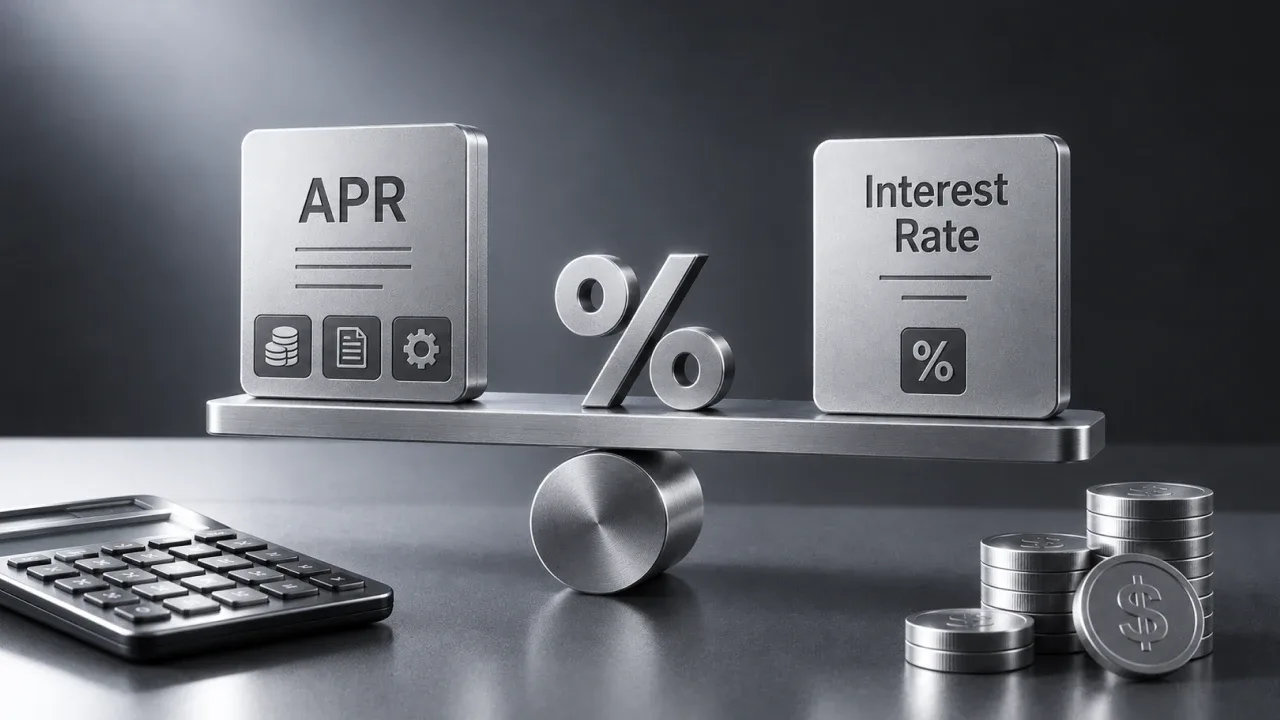
APR and interest rate are not always the same number, and neither is automatically the same as APY. The interest rate is the base cost of borrowing expressed as a percentage of principal. APR (annual percentage rate) is that same rate annualized on a standard yearly basis. APY (annual percentage yield) is different again — it accounts for compounding. A loan listing showing "19-25% APR" states a fixed nominal annual rate paid as simple monthly interest, not a compounded APY, and not the final dollar cost a borrower actually pays.
APR and interest rate are not always the same number, and neither is automatically the same as APY. The interest rate is the base cost of borrowing expressed as a percentage of principal. APR (annual percentage rate) is that same rate annualized on a standard yearly basis. APY (annual percentage yield) is different again — it accounts for compounding. A loan listing showing "19-25% APR" states a fixed nominal annual rate paid as simple monthly interest, not a compounded APY, and not the final dollar cost a borrower actually pays.
What Is the Difference Between Interest Rate and APR?
The interest rate is the percentage used to calculate interest on principal. If a loan charges 1.5% per month, for example, that percentage is the periodic interest rate used in the interest calculation.
APR puts a rate on an annual scale. That makes different loans easier to compare even when interest is paid monthly or the loan itself lasts less than a year. With simple interest, a monthly rate of 1.5% corresponds to 18% APR: 1.5% × 12.
For an 8lends listing, the quoted 19-25% APR is the fixed annual loan rate used to calculate simple monthly interest. The borrower's separate 3% origination fee is not the same thing as the investor-facing loan rate. It matters when calculating the borrower's all-in financing cost, which is why the two numbers should not be casually treated as interchangeable.
Is APR Always Higher Than the Nominal Interest Rate?
No. If the nominal rate is already expressed as an annual rate and no additional adjustment is being built into the displayed APR, the two can be numerically identical.
A loan stated at 22% per year can therefore also show 22% APR. In other lending contexts, APR may incorporate certain fees into annualized borrowing cost, so it can be higher than the stated rate. The important point is to check what the quoted figure represents.
On 8lends, the 19-25% figure shown to investors is the fixed APR on the loan. It is not a compounded APY, and it should not be read as a guaranteed realized return.
APR vs APY: Why Simple Interest and Compounded Interest Are Not the Same Number
APR and APY diverge because APY includes compounding.
APR tells you what the rate looks like on a yearly basis without assuming that each interest payment is added back to principal. APY asks a different question: what would the effective annual yield be if interest were repeatedly reinvested and itself started earning interest?
That distinction matters whenever cash is paid out during the year. If monthly interest is simply received and held as cash, there is no compounding inside the original investment. If each payment is immediately reinvested, the investor creates compounding through a separate decision.
What Does "Simple Interest, Paid Monthly" Actually Mean?
Suppose a 10,000 USD loan carries a fixed 22% APR. Monthly interest is:
10,000 × 22% / 12 = 183.33 USD
If the principal remains unchanged for the full 12-month term, the same 183.33 USD is calculated each month. The platform pays that interest out; it does not automatically add it to the outstanding principal of the same loan.
Over twelve months, the scheduled interest therefore totals 2,200 USD, or exactly 22% of the original 10,000 USD principal. There is no interest-on-interest inside that calculation.
Nominal Rate, APR, APY: One Table, Three Different Numbers
| Metric | What it includes | Who typically uses it | How it is calculated | Example for an 8lends loan |
|---|---|---|---|---|
| Nominal (stated) interest rate | Only the base interest rate charged for a given period, without accounting for payment frequency or fees | Loan agreements where the rate is stated as one of the transaction terms | The rate specified in the loan terms, without annualization or compounding adjustments | 22% per annum — the rate stated in the terms of a specific loan |
| APR (annual percentage rate) | The nominal rate expressed on an annual basis; depending on the context, it may include certain fees, but does not account for compounding | Lenders and platforms for comparing the annual cost or return of different offers on a common basis | Periodic rate × number of periods per year, using simple interest without compounding | 19–25% APR — the fixed rate shown on an 8lends loan card, with simple monthly interest |
| APY (annual percentage yield) | The effect of compounding — reinvesting accrued interest over the course of a year | Banks for deposit products and investment products where interest is automatically compounded | APY = (1 + APR / n)^n − 1, where n is the number of compounding periods per year | An 8lends loan does not pay APY: there is no compounding, and accrued interest is not automatically reinvested |
The three terms answer three different questions: what rate is written into the loan terms, what that rate is on an annual basis, and what the effective yield would become if each payment were reinvested. On an 8lends loan card, APR is shown deliberately because the platform does not promise automatic compounding. APY would describe a reinvestment assumption that is not part of the original loan.
A 10,000 USD Loan at 22% APR: What Each Side Actually Sees
The following is an illustrative example, not a projection of a specific 8lends loan.
Assume a 10,000 USD loan with a 12-month term, fixed 22% APR, monthly interest, and principal repaid in one bullet payment at maturity. The borrower also pays a 3% origination fee. The 22% rate sits within the 19-25% fixed APR range used on 8lends.
Investor Side — Monthly Interest and Annual Income
Monthly interest is:
10,000 × 22% / 12 = 183.33 USD
Over twelve months:
183.33 × 12 = 2,200 USD
If every scheduled payment is made and the 10,000 USD principal is repaid at maturity, the investor receives 2,200 USD of interest during the year. On a term of exactly twelve months, the annual interest equals 22% of the amount invested.
The investor fee on 8lends is 0%. That does not turn the scheduled 22% into a guaranteed result: payment still depends on the borrower meeting its obligations.
Borrower Side — Why the Effective Cost Is Higher Than 22%
The borrower pays a 3% origination fee when the loan pool is formed:
10,000 × 3% = 300 USD
The fee is withheld from the pool, so the borrower receives 9,700 USD in cash. Interest and principal obligations, however, are calculated from the full 10,000 USD loan amount.
Total financing cost over twelve months is:
2,200 USD interest + 300 USD origination fee = 2,500 USD
Measured against the gross loan amount:
2,500 / 10,000 × 100 = 25.0%
The 25% figure expresses the total financing cost as a share of the loan’s 10,000 USD face amount. The borrower receives only 9,700 USD after the origination fee is withheld, however. Relative to those net proceeds:
2,500 / 9,700 × 100 ≈ 25.77%
The two percentages use different bases. The first follows the gross loan amount; the second shows the simple all-in cost relative to the cash the borrower actually receives. Neither should be confused with a regulatory APR calculation, which may depend on jurisdiction and methodology.
This calculation is intended to show the mechanics of translating a nominal rate and a separate fee into effective borrowing cost. It is not an offer of specific loan terms or a forecast of investor income.
What Would My Personal APY Be If I Reinvested Every Payment?
APR describes the original loan. APY becomes relevant only when the monthly cash flows are compounded.
What Is My Actual APY If I Manually Reinvest Every Monthly Interest Payment?
Assume the investor takes every 183.33 USD monthly interest payment and immediately invests it in a new claim paying the same 22% APR.
The standard monthly-compounding formula is:
APY = (1 + APR / 12)^12 − 1
Using 22% APR:
(1 + 0.22 / 12)^12 − 1 ≈ 24.4%
The difference between 22% and 24.4% does not come from the original borrower paying a higher rate. It comes from the investor repeatedly putting received interest back to work.
That calculation also makes assumptions that may not hold in practice. Each payment has to be reinvested without delay. New claims need to be available at the same 22% APR. Every new claim represents a new borrower exposure with its own credit risk. If the investor leaves a monthly payment in cash instead, that payment does not compound.
For this reason, 8lends does not quote the 24.4% figure as the yield on a 22% APR loan. It is a hypothetical personal APY generated by the investor's own reinvestment decisions.
APR is a fixed rate stated at the moment of investment — it is not a guaranteed return. The actual amount an investor receives still depends on the borrower making every scheduled interest payment and repaying the principal at maturity. A reinvestment-based APY figure assumes every future payment is redeployed on time into a new claim at the same rate — an assumption, not a promise, and each new claim carries its own borrower risk. Capital remains at risk, including on loans quoted at a fixed APR.
Why Does 8lends Quote APR, Not APY?
APR fits the actual cash-flow structure of the loans.
8lends loans run for 4-16 months. The investor rate is fixed at 19-25% APR at the moment of investment. Interest is paid monthly, while principal is returned in one bullet payment at maturity.
Because monthly interest is distributed rather than automatically reinvested, the original claim does not compound. Showing APY on the loan card would therefore require an assumption about what the investor does after receiving each payment.
The platform instead shows the contractual annual rate that governs the loan itself. An investor can then decide separately whether to spend the monthly interest, hold it as cash, or place it into another claim.
Minimum investment starts from 100 USD. The loans are backed by real-world assets such as equipment, vehicles, real estate, or inventory, and borrower due diligence covers more than 40 criteria. These product features provide context for the loan but do not change the distinction between APR and APY.
Transactions settle in digital USD on Base. Settlement infrastructure likewise has no effect on whether interest is simple or compounded.
The clean reading of an 8lends loan card is therefore straightforward: 19-25% APR is the fixed annual rate used to calculate simple interest on that loan. It is not an automatically compounded APY, and it is not a statement of net realized return after defaults, taxes, or investor-specific reinvestment decisions.
Frequently Asked Questions
The interest rate is the base percentage used to calculate interest on principal. APR expresses that rate on an annual basis under simple interest. Depending on the lending product, an APR calculation can also incorporate specified fees, but the 19-25% APR displayed on 8lends refers to the fixed loan rate shown to investors.
APR does not assume compounding. APY does. With the same positive nominal rate, APY becomes higher when interest is reinvested and begins earning additional interest.
APR is the annualized rate used to describe a loan's interest on a common yearly scale. On 8lends, the investor sees a fixed 19-25% APR set at the moment of investment, with simple monthly interest.
8lends quotes APR. Monthly interest is paid out rather than automatically capitalized, so the platform does not publish or promise an APY on the original claim. Any compounded result depends on the investor choosing to reinvest those payments.
The borrower also pays a 3% origination fee. In the illustrative 12-month example, 2,200 USD of interest plus the 300 USD fee produces a total financing cost of 2,500 USD. That equals 25% of the 10,000 USD face amount, or approximately 25.77% of the 9,700 USD the borrower actually receives.
Read next


Do You Have Any Questions?
All questionsThe platform has been audited by CertiK and Cyberscope, and all transactions are publicly visible on the Base blockchain. Two companies with clear responsibilities stand behind the platform: CLEARCHAIN CORP operates the platform and is registered as a Money Services Business with FINTRAC (Canada), and Maclear AG conducts due diligence and monitors collateral. So the platform is well regulated, transparent and accountable
If the project has BuyBack, the partner buys the loan and returns 100% of the principal once it is overdue for 60 days or more. Without BuyBack, Maclear AG initiates the sale of the collateral, and the proceeds are distributed proportionally among investors. Since launch there have been no defaults
The platform is operated by CLEARCHAIN CORP, registered in Canada as a Money Services Business (MSB) and subject to mandatory AML/CFT compliance requirements under FINTRAC. Settlements are made in USD. The platform is not a CASP, so DAC8 requirements do not apply
Small and medium-sized businesses in developing regions do not have easy access to bank financing and are willing to pay higher rates than businesses in the EU or US
You can sell your position to another investor through the Secondary Market before the end of the loan term. With Fastlending there is no fixed term: the principal and accrued income can be withdrawn at any time
The minimum investment is 100 USD
Risk of non-payment by the business, risk of changes in the value of the collateral, risk of limited liquidity if there is no buyer on the Secondary Market, and technical risk associated with the smart contract
Investments from 100 to 500 USD are available without KYC. For amounts over 500 USD, full verification is required: an identity document and proof of address